
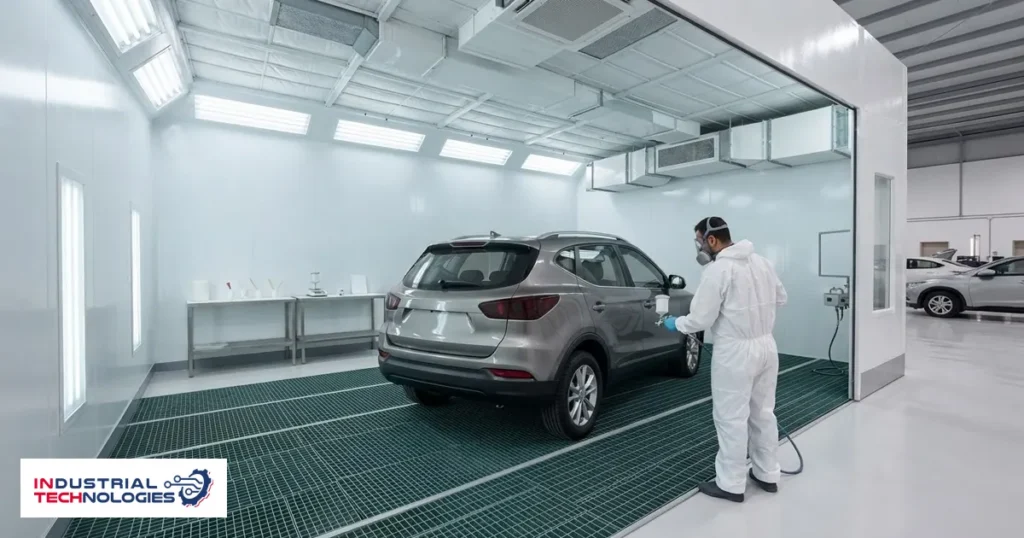
The request sometimes arrives ready-made: “we want a booth that recirculates air to save energy.” The direction is right, but it assumes recirculation is a fixed figure that ships with the chamber, when it actually changes with the cycle and with the site.
A recirculating paint booth returns part of the heated air to the chamber during bake, while spray air is fully extracted because it carries overspray. The mechanism is published on the highest-extraction INTECH model: a pneumatic damper that switches between painting and drying modes. What that mechanism is worth in your facility is worked out from three inputs.
Input one: the bake share of your cycle
Recirculation only runs during bake. A cycle where spraying takes most of the time gains little from it; a cycle with a long bake, from heavy film builds or materials that need a longer hold at temperature, gains more. So the finishing material and its heat curve are asked for before any saving is estimated.
Input two: outside air temperature
Extracted air is replaced with outside air that has to be heated. The closer outside air is to bake temperature, the less energy heating it takes, and the smaller the saving from recirculation. The gap between outside air and bake temperature is smaller in summer than in winter, so the value of recirculation at one site changes between seasons. That is why the saving is read over a year, not a single day.
Input three: the dust that arrives with fresh air
Every cubic metre drawn from outside passes the stop and pre-filters first, and dust enters a chamber through its air intakes before any other opening. Recirculated air does not cross the intake again, so intake filters carry less during bake. On dusty sites that effect can show up in the filter change schedule before it shows up in the energy bill.
What sets the value in your facility
| Input | Effect on the value | How it is fixed |
|---|---|---|
| Bake share of the cycle | Longer bake, more value | From the finishing material and its heat curve |
| Outside air temperature | Closer to bake temperature, less value | From site location and operating seasons |
| Dust at the air intake | Less passes the intake filters during bake | From site conditions and the filter change schedule |
| Heat output required | Built on the air actually being heated | Within 200,000–600,000 kcal/h |
| Spray phase | No recirculation, full extraction | Because spray air carries overspray |
Frequently asked
Can air be recirculated during spraying too?
Spray air carries overspray, so it is fully extracted through filtration to outside, as the damper does in painting mode. Recirculation is confined to bake, which is what makes the two modes differ in how much air leaves.
How much energy does recirculation save?
No general figure is given, because the saving follows the bake share of your cycle and the outside air temperature at your site across the year. It is estimated per project from those inputs together with the heat output set in the configuration.
Is recirculation available on INTECH models?
The highest-extraction model publishes a pneumatic damper switching between painting and drying modes in its standard supply. On custom booths the recirculation arrangement is configured per project within the configuration signed off before manufacture.
Does recirculation replace wall insulation?
No, because they address two different losses: recirculation cuts the heat leaving with extracted air, and insulation cuts the heat escaping through the wall. This family publishes 50 mm insulated panels, or 1.5 mm galvanised sheet for large cabins.
Related reading
Practical next step
Send your finishing material, typical bake duration, site location and operating seasons, and we return an extraction and recirculation configuration built on those inputs. Contact an expert. The published range sits on the paint booths family page.