
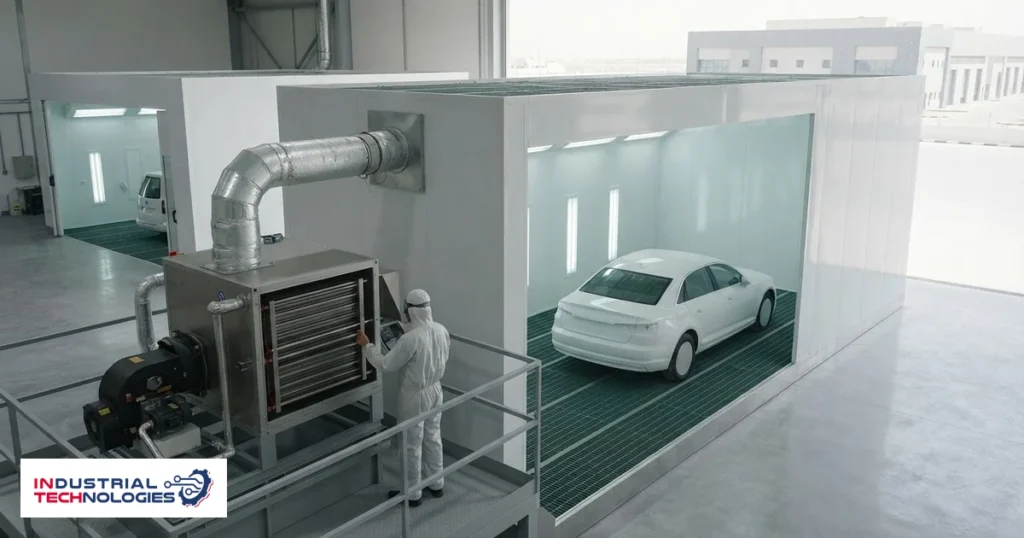
The burner gets named in every quotation. The component that actually decides how much of the burner’s output reaches your workpiece almost never does.
In a direct-fired arrangement combustion products travel with the air into the chamber. In an indirect arrangement they do not, because a heat exchanger stands between the flame and the air that touches wet paint. Which arrangement you have is a finish-quality decision before it is an efficiency one.
Three numbers, not one
What is published across the INTECH models is specific: a paint booth heat exchanger in SUS304 stainless steel, 1.5 mm thick, transferring more than 90% of burner output to chamber air.
Each of those three values answers a different question. The material answers how it behaves in a corrosive, humid, thermally cycled environment. The thickness answers how long it survives that cycling. The efficiency answers how much of the fuel you pay for actually arrives.
An offer that quotes only the burner — Riello G20 diesel at 200,000 kcal/h, as documented on the standard models — has described the input and said nothing about what fraction of it reaches the chamber.
Why the thickness figure earns its place
A body shop booth does not run at a constant temperature. It heats for cure, cools, and does it again — several times a day, six days a week. Every one of those cycles expands and contracts the exchanger.
Thinner sections fatigue faster under that pattern, and a fatigued exchanger does not fail loudly. It develops a path that lets combustion products into the supply air, and the first symptom is a finish defect that nobody traces back to the heating system.
The 1.5 mm SUS304 section is documented specifically as tolerating repeated heating and cooling cycles that damage thinner exchangers — which is why it is a specification line rather than a manufacturing detail.
The weld is part of the specification
On every INTECH model the SUS304 exchanger is argon-arc welded. This is worth reading carefully, because a heat exchanger is only as sound as its joints.
Argon shielding during welding protects the weld pool from atmospheric contamination, which matters most on stainless steel and matters most where the joint will spend its life being thermally cycled. It is the difference between a seam that ages with the sheet and one that ages faster than it.
Where it sits among the other heating options
Five heating systems are delivered across the paint booths and finishing systems family: Italian Riello and Baltur diesel burners, gas, electric heating, heat pump, and shortwave infrared.
The exchanger question applies to the combustion options. Electric heating and shortwave infrared do not produce combustion products at all, which removes the contamination path — but they trade it for a different constraint, since the infrared configuration delivered for waterborne work draws 30 kW across ten units.
So the honest framing is not that one system is better. It is that combustion heating buys you fuel flexibility and hands you an exchanger to specify, inspect and eventually service.
Burner output against what reaches the chamber
An offer that quotes only the burner has described the input and said nothing about delivery:
| Item | Published | What it tells you |
|---|---|---|
| Burner | Riello G20 diesel at 200,000 kcal/h | The input figure |
| Heat exchanger | SUS304 stainless, 1.5 mm thick | The component nobody quotes |
| Transfer | More than 90% of burner output to chamber air | What actually arrives |
Common questions
What does the efficiency percentage actually measure?
How much of the burner’s thermal output is transferred into the chamber air rather than lost to the flue. At above 90% on the documented models, roughly nine tenths of what the burner produces reaches the air you are heating.
Does stainless steel matter here or is it marketing?
It matters because of what the exchanger is exposed to: repeated condensation and drying cycles on the flue side, and heated air on the other. SUS304 is specified for that environment, and the alternative shows its age through corrosion at the coolest part of the flue path.
Can the exchanger be inspected in service?
Access to the treatment unit is one of the reasons a booth needs service space around it rather than just its own footprint — enough room to open doors and reach the treatment unit and filter box. Build that access into the layout, because it is not recoverable afterwards.
What to ask for in writing
Material, thickness, transfer efficiency and weld method — four values on one line. Any offer that cannot supply them is quoting a burner and calling it a heating system.
The documented figures for each model sit on the INTECH X500 product page, or request a quotation with your available site utilities.