
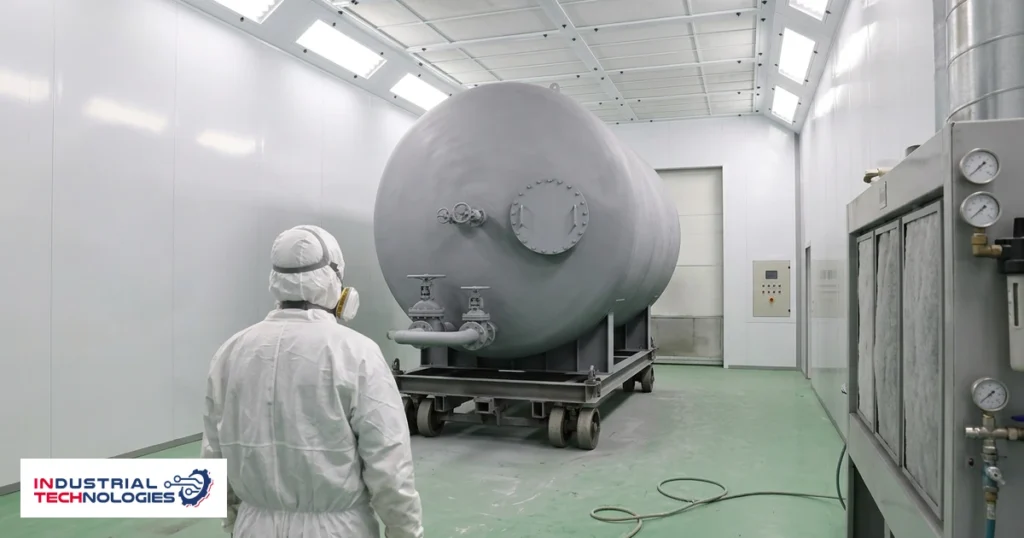
On most industrial finishing projects the first number sent to us is the size. On tank projects specifically, the number that matters most arrives second in order and first in effect: the weight.
An industrial tank coating booth is designed around how the part is carried before it is designed around its dimensions, because a vessel weighing tonnes is not hung the way a sheet part is.
Weight determines how it enters
Part size, weight and handling method are the first inputs in industrial finishing. A chamber bought before they are fixed becomes a constraint on production rather than a step within it.
Provision for hanging or moving parts inside the cabin goes into the design from the start, and it differs entirely between a part suspended from above and one carried in on a moving base.
| Input | What follows from it |
|---|---|
| Maximum vessel weight | Hanging or conveying system and load points |
| Vessel dimensions | Internal size within 3,000 – 24,000 mm length |
| Finishing material | Heat curve and filter class |
| Vessels per batch | Internal size, more than the single-part dimension |
| Line throughput | The permitted cycle time |
Cylindrical form and the air path
A cylindrical vessel behaves differently from a flat panel in air: the curved surface needs reach from more than one direction, and the underside and crown do not receive the same flow if extraction runs one way only.
Extraction direction — downdraft or side — is therefore set by the nature of the work and the part, rather than by what is conventional in an automotive booth.
Heat curve for industrial coatings
The heat curve is set to the industrial coating in use. The published heat output range in this family runs from 200,000 to 600,000 kcal/h, with electrical power from 11 to 50 kW.
A tank is a large metal mass, which means it absorbs heat slowly and releases it slowly. Time to cure temperature here is longer than for a sheet part of the same weight — and that has to enter the cycle time calculation.
Continuous duty and durability
A vessel plant runs the chamber across connected shifts. In that pattern durability, ease of maintenance and spare parts availability come ahead of peak specification, because a stopped finishing chamber halts a line rather than a station.
Frequently asked questions
What is the largest vessel you can take?
The published range extends to 24,000 mm long, 20,000 mm wide and 6000 mm high. Final size is built on the largest vessel on your line plus the technician’s working space around it.
Does the specification include the handling system?
Provision for hanging or moving parts inside the cabin is part of the design and is discussed with the specification. Its detail is built on your part weight and load points, and the scope is defined in the technical offer.
How many filtration stages does tank coating need?
It depends on your finishing material and acceptance requirements. Published filtration begins with stop, pre and ceiling stages at EU3, EU4 and EU5 and extends to three-stage bag and high-efficiency filtration.
Can the chamber handle parts other than tanks?
Yes, if size and handling are built on your product horizon rather than a single product. That is a design-stage decision, because changing the handling system after installation is far harder than changing a schedule.
Related reading
- Powder Coating Curing Oven
- Industrial Baking Oven
- Signage Finishing Oven
- Aero Component Coating Oven
- Booth Static Discharge System
What to do next
Send the largest vessel size and weight, how it moves, the finishing material and line throughput, and we will return a chamber specification built on your line. Request a quote. Sector detail is on the industrial and manufacturing page.