
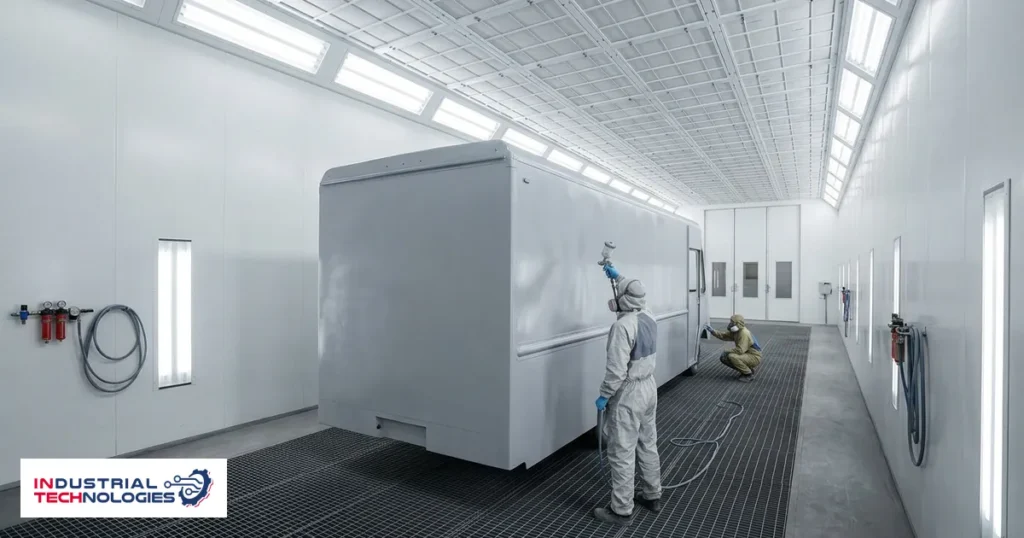
A food vehicle conversion workshop works in the opposite direction from a car workshop. The car workshop receives a finished vehicle of known size; the conversion shop builds the body first, discovers its final dimensions, and then needs an enclosure that takes it.
So food truck body finishing begins from a question the automotive sector never asks: what is the largest body you will build, rather than the largest vehicle you will receive.
The finished body is the size
A converted vehicle is wider and taller than its base chassis: the serving hatch, the awning, the roof-mounted extraction unit all add to the envelope. The chamber is built on the body after conversion, not on the chassis before it.
The delivered range in this family extends to 24,000 mm long, 20,000 mm wide and 6000 mm high, which takes food vehicles and caravans across their size spread comfortably.
| Element | Effect on chamber size |
|---|---|
| Roof-mounted extraction unit | Raises the highest point above the box roof |
| Awning or open serving hatch | Increases required width in use, not in transit |
| Side steps and platforms | Consume the technician’s working space around the body |
| Trailer where fitted | Adds to overall length rather than counting separately |
A flat surface shows everything
The sides of a food vehicle are large flat panels, and they are the least forgiving vehicle surface for spray defects. Any unevenness in flow or in air cleanliness shows on a flat panel in a way it does not on a curved car body.
Ceiling filter class is therefore read more seriously here. Published filtration covers stop, pre and ceiling stages at EU3, EU4 and EU5, reaching three-stage bag and high-efficiency filtration at ≥98% where a build requires it.
Graphics and multiple colours
These vehicles usually carry more than one colour with hard edges between them, which means several spray passes inside the same chamber. A chamber designed for one long cycle differs from one designed for short repeated cycles, specifically in extraction capacity.
The workshop that serves more than one product
Most conversion workshops in the Saudi market do not build food vehicles alone — they build caravans, expedition vehicles and special-purpose bodies. Buying a chamber sized for today’s largest product constrains you next year; size it on the product horizon instead.
Frequently asked questions
Do I measure the chassis or the finished body?
The finished body, at its highest and widest points. The chassis alone is a misleading figure here, because what you paint is the completed product rather than its base.
Will an automotive booth serve food vehicles?
It serves smaller vehicles that fit the automotive cabin at 6900×4000×2650 mm. Anything exceeding it in length or height is built to order within the published range.
How many spray passes does one vehicle need?
It depends on colour count and graphic edges. Send your usual finishing pattern so extraction is sized for repeated cycles if that is how you work.
Do I need a separate preparation room?
If you sand and prepare surfaces in the same workshop, then yes. A preparation room with its own extraction stops dust returning to the prepared surface, and the separation is physical rather than procedural.
Related reading
What to do next
Send the size of the largest body you build after conversion and your usual finishing pattern, and we will return a chamber design built on your product. Request a quote. Sector detail is on the trucks and RV industry page.