
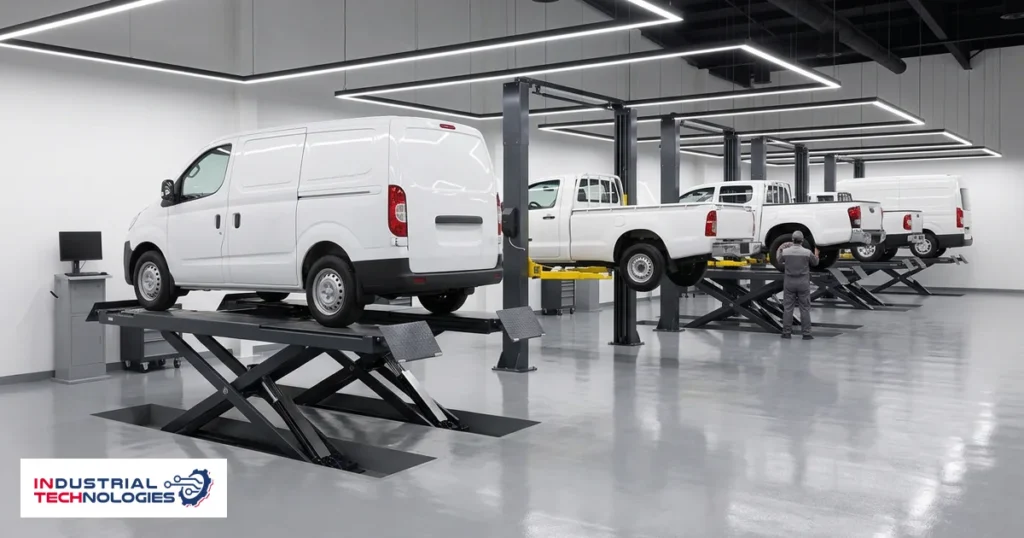
Fleet workshops fail differently from retail ones. A retail shop is limited by how much work arrives. A fleet shop has guaranteed work and is limited by how fast vehicles move through the building — which makes fleet workshop layout an availability problem rather than a capacity one.
The metric that should drive the design
Retail shops optimise for jobs completed. Fleet operations should optimise for vehicle-hours off the road, which is a different objective and occasionally leads to opposite decisions.
A bay that finishes work efficiently but holds a vehicle waiting for a part is performing badly by the fleet metric while looking fine by the retail one. Every hour a vehicle sits in your building is an hour it is not earning — and at fleet scale that number is the whole business case.
Separate scheduled from unscheduled work
This is the layout decision with the largest single effect, and it is often skipped because it looks like it wastes flexibility.
Scheduled preventive work is predictable: known duration, known parts, known sequence. Unscheduled repair is the opposite. Running both through the same bays means the unpredictable job blocks the predictable queue, and your maintenance schedule slips — which is precisely what generates more unscheduled work later.
Dedicated preventive bays with rapid-service equipment — surface-mounted scissor lifts at roughly 1220 mm working height suit this well — keep the routine flow moving regardless of what has broken today.
Bay mix follows your work orders, not a template
| Bay type | Handles | Typical equipment |
|---|---|---|
| Preventive / rapid | Fluids, filters, brakes, tires, inspection | Scissor lift, ≈ 1220 mm working height |
| Mechanical repair | Transmission, exhaust, underbody | Two-post, ≈ 1990 mm lifting height |
| Diagnostic | Electrical faults, calibration | Scanner, level floor, controlled lighting |
| Air conditioning | Seasonal peak servicing | Service station — accuracy ±10 g |
Do not size this from a template. Pull three months of work orders and count by category — the ratio is usually clearer, and often different, from what the workshop believes.
The air conditioning row deserves attention in this region specifically. AC work is seasonal and peaks hard, and a fleet that treats it as an occasional repair discovers in summer that it has become the constraint on the whole operation.
Parts storage as a layout decision
In a fleet operation, parts are largely predictable — you know the vehicle types and the service intervals, so you know what will be consumed.
That predictability is worth exploiting physically: fast-moving items stocked at the preventive bays rather than in a central store the technician walks to. It sounds minor. Multiplied across every routine service, walking time becomes one of the larger recoverable losses in a fleet shop.
Common questions
How many bays for a given fleet size?
Fleet size alone does not answer it. Vehicle type, duty cycle, service interval and how much work you outsource all change the figure. The honest method is to work from your own service schedule: how many vehicles are due per week, and how long each job actually takes in your building.
Is it better to expand bays or extend hours?
Extending hours uses existing capital and suits a shop whose constraint is time. Adding bays suits one whose constraint is simultaneous capacity — several vehicles needing the same bay type at once. Look at where vehicles actually queue before deciding; the two problems look identical from the outside.
Should the workshop handle everything in-house?
Not necessarily. Specialised low-frequency work often costs less outsourced than as idle capital and unpractised skills. The work worth bringing in-house is the high-frequency, schedule-critical kind — because that is where turnaround time compounds across the fleet.
What determines the installation schedule?
Site preparation — slab level and thickness, electrical capacity — rather than the equipment itself. Duration is established after a site assessment, and any figure offered before that is an estimate rather than a commitment.
Related reading
- Distribution fleet workshop
- Fleet maintenance scheduling around the booth
- Part hanging inside the chamber
- Dust and overspray extraction
- Digital wheel balancer
- R134a vs R1234yf
Where to start
The auto fleet page covers what changes in configuration at fleet scale. For the equipment decisions behind each bay type, see lift selection comparison and AC service station accuracy.