
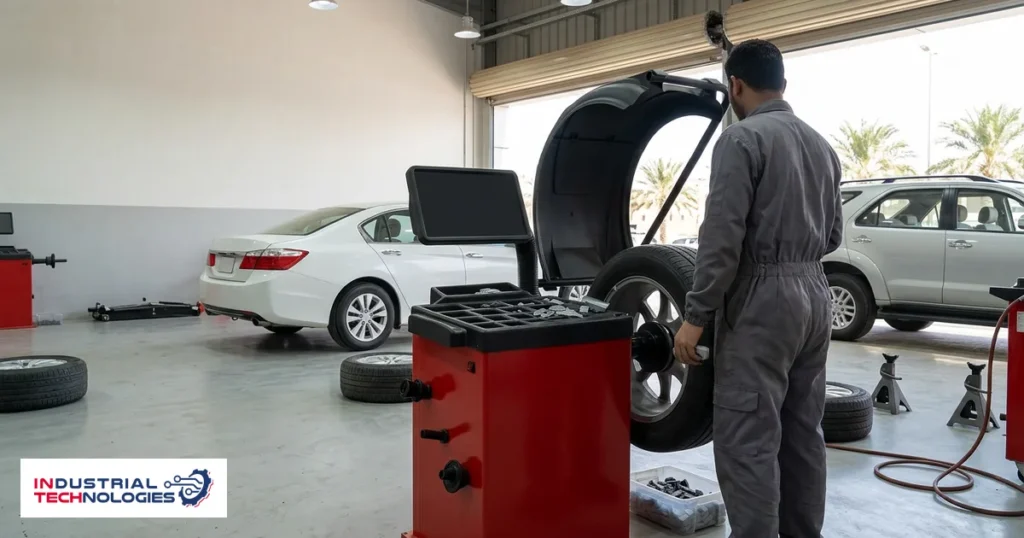
A balanced wheel goes unnoticed. An unbalanced one is noticed by the driver at a particular speed, who then comes back to say the vibration appeared after the visit — and is usually right.
That is why a digital wheel balancer is judged on three things: how accurately it reads the weight, how accurately the weight is placed, and the cycle time that decides how many wheels pass through a shift.
Reading and placing are two steps
The balancer states the weight required and its position on the rim circumference. The common error happens in the second step, not the first: the correct weight in the wrong position leaves residual vibration.
The published equipment in the tire and oil service family includes laser-guided weight placement behind the spokes, automatic capture of rim dimensions, and a short balancing cycle. The laser matters most on alloy wheels, where the weight is fixed behind the rim rather than on its edge for appearance, in a position the eye cannot see while fitting.
Automatic rim capture removes a human step
Rim diameter and width are inputs to the calculation. Entering them by hand means a possible error on every wheel, and a millimetre wrong in width shifts the weight distribution between the two correction planes.
Automatic capture moves those figures from the technician’s memory to the machine’s measurement. That is the kind of automation worth paying for in a workshop where crews change.
Accuracy and rim range by model
The published position is explicit: weight accuracy and rim size range vary by model and are set out in the quotation. Those two figures together decide which model fits. A centre servicing passenger cars in similar sizes has a different requirement from a fleet centre taking pick-ups and light trucks across a far wider rim range.
Cycle time turns accuracy into capacity
A short cycle means the technician does not wait for the machine, and the difference shows not on one wheel but on four, then on the number of vehicles in a shift. Four wheels a vehicle and ten vehicles a day make forty balancing cycles, so every ten seconds of difference per cycle is more than six minutes of bay time a day before removal and refitting are counted.
Cycle time is therefore read together with accuracy. A faster machine that needs rebalancing on one wheel in five is not faster.
| Item | Published | Why it matters |
|---|---|---|
| Laser pointer | For weight placement behind the spokes | Settles position, not the reading |
| Automatic rim capture | Rim diameter and width | Removes a manual entry step |
| Weight accuracy and rim range | Vary by model | Set out in the quotation |
| Balancing weights | Supplied from the local warehouse | A consumable held in stock, not ordered at a stop |
Frequently asked
Why does vibration return after a correct reading?
Most often because the weight went into the wrong position rather than because the reading was wrong, which is the problem laser placement addresses. Wheel mounting and the condition of the tire and rim also play a part, and they are checked before the balancer is blamed.
Does collision repair need a balancer?
The published configuration for collision repair pairs a high-accuracy aligner with a balancer for verification after frame straightening.
What suits a car rental operation?
The published configuration for car rental lists a quiet balancer with fast inspection and tire condition reports before and after each rental, because turnover is high.
Are balancing weights a running cost?
Yes. They are consumed on every job and supplied from the local warehouse, so plan a working stock rather than ordering at the point of running out — running out stops the bay without a single fault in the machine.
Related reading
Practical next step
Send the rim sizes you handle from smallest to largest, the daily number of vehicles through the tire bay, and whether trucks enter it. Request a Quote. The published range is on the tire and oil service page.