
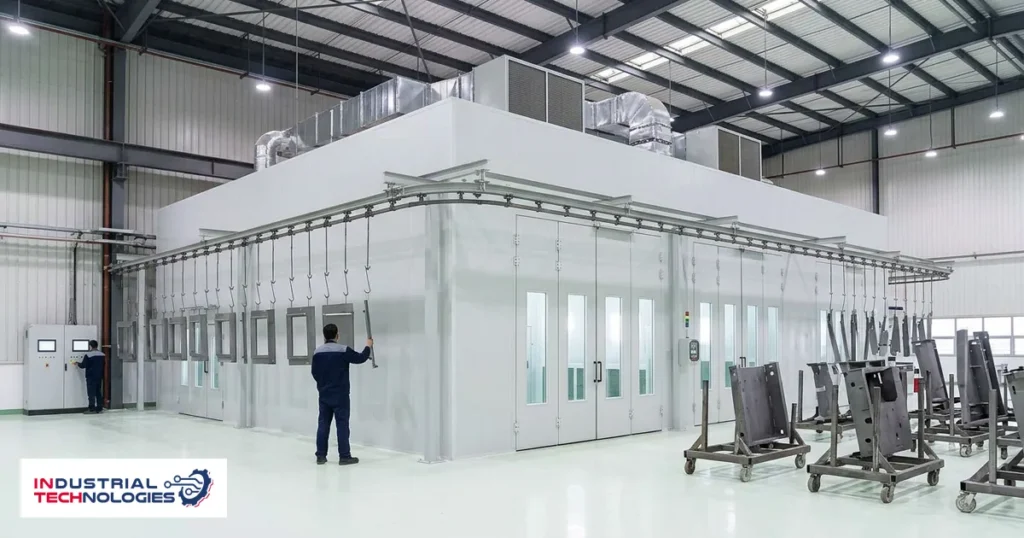
In a workshop the booth is a station in its own right. In a plant it is a step inside a line. That difference changes the selection criteria entirely.
Booth cycle time and line takt are read together rather than separately: the finishing cycle must match the line’s rhythm or beat it, otherwise finishing becomes the bottleneck.
The two cases that cost money
| Case | What happens on the line | The real cost |
|---|---|---|
| Cycle slower than takt | The line waits for the booth | Whole-line capacity drops to booth capacity |
| Cycle equal to or faster than takt | The line passes through without waiting | The target condition |
| Cycle much faster than takt | The booth waits for the line | Idle capital in capacity that is never used |
Why throughput is asked before size
The chamber specification is derived from four inputs, and the line’s target throughput is one of them. The reason is practical: finishing that cannot keep up cancels out any improvement upstream of it, so improving an earlier station ahead of a slow booth produces not one additional part.
What gets adjusted when the numbers do not meet
Cycle time is not an independent figure requested from the oven. It is the result of size, air capacity, heat curve and coating material together. Air capacity delivered in this family runs from 18,000 to 190,000 m³/h per supply or extraction set, and heat output from 200,000 to 600,000 kcal/h — the cycle is set from within those two ranges.
Frequently asked questions
How is takt measured before the booth is bought?
By target throughput: how many parts are to leave the line per hour or per shift. That figure comes from the production plan rather than from the oven, and it is sent with the design inputs so cycle time can be built on it.
Can throughput be raised after installation?
Raising throughput means shortening cycle time, which depends on the size, air capacity and heat curve fixed at design. That is why target throughput is stated before the specification rather than after installation.
What cycle time is delivered?
Cycle time follows the part, the coating material and the line’s throughput, so no single figure applies to every plant. It is derived per project from those inputs and fixed with the specification.
Is loading and unloading counted inside the cycle?
How the part is loaded — hung, conveyed or on a stand — is one of the first design inputs, because it belongs to the total station time rather than to spray time alone.
Related reading
- Continuous shift booth operation
- Four inputs for industrial booth design
- Steel structure finishing chamber
- conveyor paint drying oven
Next step
Send the dimensions and weight of the largest part or platform to be coated, together with your site area, and the internal size and configuration come back against them. Talk to a specialist. The published range sits on the paint booths family page, and the sector configuration on the Industrial & Manufacturing sector page.