
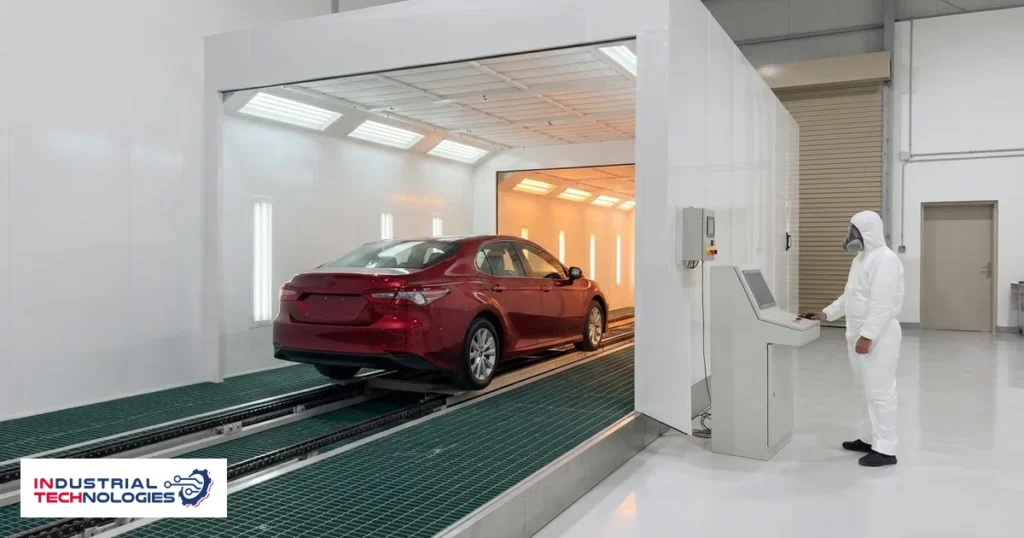
In a batch booth the part comes in, the door closes and the cycle runs, so size follows the largest part that will enter. On a line where the conveyor never stops there is no door to close and no part standing still. The question that replaces “what size?” is “how many minutes must each part spend at temperature?”
A conveyor paint drying oven answers that question in metres. Parts enter at one end and leave at the other, and the distance between is the drying time written as a length. The industrial configuration published on the family page already calls for chambers arranged to hang or convey parts; a tunnel is the case where conveying becomes the whole design.
Length is dwell multiplied by speed
The heated length equals conveyor speed multiplied by the dwell the coating requires. That dwell does not come from the oven. It comes from the material supplier as a time to reach cure temperature plus a time held there. Double the line speed with the same dwell and the required length doubles, or the oven has to bring parts up to temperature faster, which is settled in heat output rather than in length.
So no tunnel length is quoted before two figures are known: target line speed, and the dwell stated in your finishing material data. Entry and exit zones are added on top, because a part does not reach temperature the moment it crosses the opening.
Two openings, open for the whole shift
A batch booth holds its air behind a closed door. A tunnel stays open at both ends for as long as the conveyor runs, and heat looks for the nearest way out. Opening height and position are therefore set on the largest hung part and no more, and supply and extraction are balanced so hot air does not spill into the hall. Hung part height is counted together with the conveyor rail above it, as in any chamber where parts are hung.
What the configuration changes
| Item | What sets it |
|---|---|
| Heated length | Conveyor speed multiplied by the dwell in the finishing material data, calculated per project |
| Entry and exit zones | Added to the length so parts reach cure temperature inside the tunnel, not at its end |
| Openings | Height and width set on the largest hung part plus the conveyor rail above it |
| Heat output | Built on the mass entering per hour rather than tunnel volume alone, within 200,000–600,000 kcal/h |
| Air capacity | Within 18,000–190,000 m³/h per supply or extraction set |
| Overall length | Calculated per project; the published length range for custom ovens in this family is 3,000–24,000 mm |
A conveyor stop is a thermal event
In a batch booth heating stops when the cycle ends. In a tunnel, a conveyor stop means every part inside stays at temperature longer than the coating asks for. Heat control is therefore tied to conveyor status from the start, and what happens to parts inside the tunnel during a stop is agreed before manufacture rather than after the first stoppage.
Raising throughput after installation
Speeding the line up after installation shortens dwell in the same proportion, because the length is fixed. Target speed is therefore set on the production horizon rather than on today’s output, the same rule that governs cycle time and line takt for any chamber inside a line.
Frequently asked
Can one tunnel take parts of different sizes on the same line?
Yes, provided the largest clears the openings and the conveyor carries the heaviest, but every part gets the same dwell because the speed is shared. Where finishing material or film build differs widely between parts, that is reviewed before a tunnel is chosen, since a batch booth allows a cycle per batch and a tunnel does not.
How long is a typical production tunnel?
There is no typical length, because it is the product of two figures that belong to your line: conveyor speed and the dwell in your material data. It is calculated per project and fixed with the configuration before manufacture, within the published length range for custom ovens in this family.
Is the tunnel oven a standard unit or designed per line?
It is supplied and configured per project, because its length, openings and heat output follow your line. Like any custom oven it starts with a site survey and fixed inputs, then configuration sign-off before manufacture.
Can an existing batch booth be converted into a tunnel?
Conversion changes the openings, the air path and the control logic together, so it is usually a new design rather than a modification. It is assessed after inspecting the existing chamber and the line it would serve, and it is not promised before that.
Related reading
Practical next step
Send your target line speed, the largest hung part and its weight, and your finishing material with its dwell data, and we return a tunnel length and configuration built on your line. Contact an expert. The published range sits on the paint booths family page, and the sector configuration on the industrial and manufacturing sector page.