
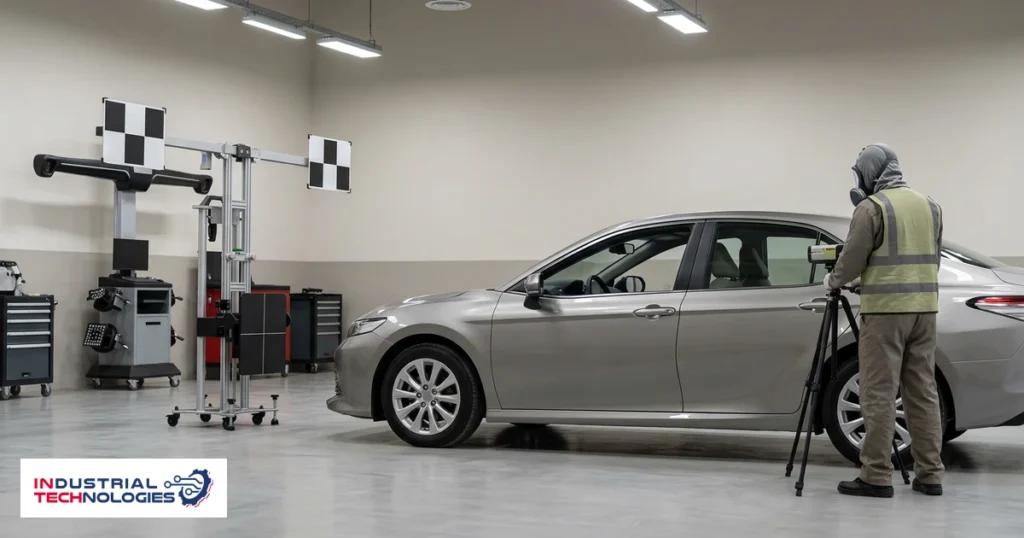
ADAS calibration equipment is usually evaluated as an accessory to a diagnostic scanner. It is not. It is a separate system with its own space, floor and lighting requirements — and shops that discover this after purchase end up with a platform they cannot use correctly.
Why calibration is not a scanner function
A scanner reads and clears fault codes and, on capable units, initiates a calibration routine. What it cannot do is provide the physical reference the vehicle’s sensors are being aligned against.
That reference is a set of targets held at precise positions relative to the vehicle’s centreline. The camera behind the windscreen and the radar in the front structure are being told, in effect, “this is straight ahead” — and if the targets are not where the procedure assumes, the vehicle is calibrated to a false reference.
This is the risk worth stating plainly: a bad calibration does not announce itself. It completes, reports success, and the vehicle leaves with a driver-assistance system quietly aiming at the wrong place.
The bay decides more than the platform
| Requirement | Why it exists | Consequence if wrong |
|---|---|---|
| Level floor | Target height and vehicle attitude are referenced to it | Calibration completes against a false reference |
| Clear frontal space | Targets sit at defined distances ahead | Procedure cannot be run to specification |
| Controlled lighting | Camera calibration is an optical process | Inconsistent or failed routines |
| No reflective clutter | Radar and camera pick up surroundings | Interference and repeat attempts |
| Stable vehicle position | Everything references the centreline | Compound error across all sensors |
Floor level is the one we would check first and the one most often assumed. A workshop slab poured with a drainage fall — a sensible, deliberate feature — may need local levelling in the calibration bay specifically.
It is worth connecting this to the wider point: floor specification is not only a lifting question. It reaches into calibration accuracy, which is a liability question.
Which shops actually need it
The assumption is that calibration belongs to collision repair. Increasingly it does not stay there.
Windscreen replacement alone triggers camera calibration on many models — and that work reaches general service shops, glass specialists and fleet operations. Suspension and alignment work can trigger it too, because sensor aim is referenced to vehicle geometry.
The practical test is not “am I a collision shop”. It is: what work am I currently turning away, or completing without the calibration step it requires? The second half of that question is the uncomfortable one.
Static and dynamic are not alternatives
Static calibration uses targets in the bay. Dynamic calibration requires driving the vehicle under defined conditions. Many models require one, some require both, and which applies is determined by the manufacturer procedure for that vehicle — not by shop preference.
Two consequences for the buyer. First, a platform covering static calibration does not remove the dynamic requirement where it exists. Second, dynamic procedures need suitable road conditions, which is a real constraint in dense urban operation and deserves thinking about before you commit.
Common questions
What space does a calibration bay need?
It varies by system and by target vehicle range, and it is fixed in the quotation once your bay dimensions are known. What is constant across every case: clear frontal space, a level floor, and controlled lighting. Measure those three before specifying anything.
Can the calibration bay share space with a lift?
Sharing is common, but the calibration requirements have to be met when calibration is running — clear frontal space, level positioning, no reflective clutter. A bay that works for both needs planning at layout stage rather than improvisation on the day.
How do I know a calibration was successful?
The procedure reports completion, which is necessary but not sufficient. Verification against the manufacturer’s stated method for that model is the actual answer, and documenting each calibration — vehicle, procedure, date, result — is a discipline worth adopting from day one for exactly the liability reason above.
Is training included?
Basic operating training is included to the extent agreed in the quotation. For calibration specifically we would insist the technician who will run it attends — the value of the system lives entirely in correct procedure, not in owning the hardware.
Where to start
ADAS calibration platforms and diagnostic equipment sit under general workshop equipment and tooling. Because floor condition determines calibration validity, the note on what stops installations covers the same slab measurements from the lifting side.