
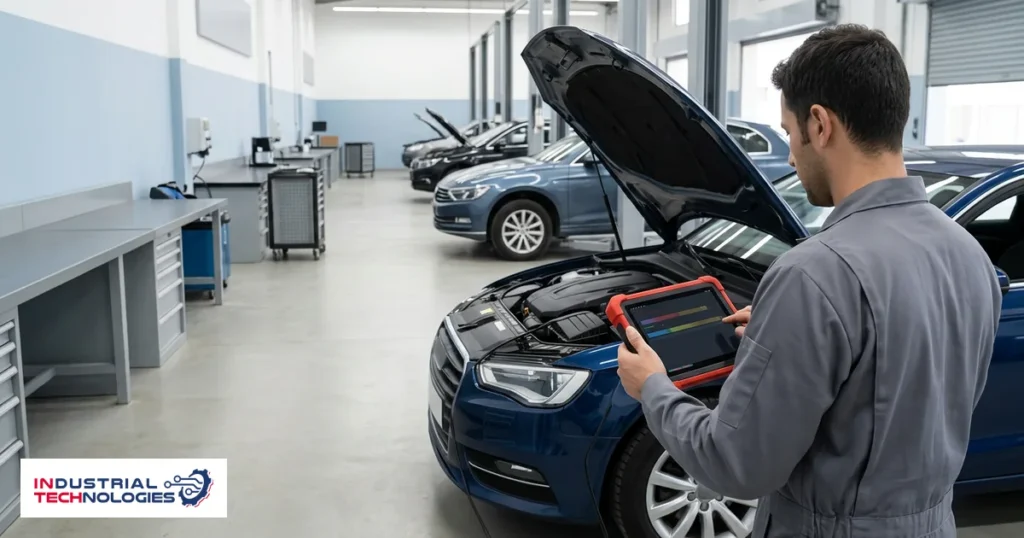
Scanner marketing is built almost entirely on coverage lists — hundreds of makes, thousands of models, a wall of logos. It is the easiest specification to publish and among the least useful for deciding anything.
A better basis for diagnostic scanner selection is narrower and more awkward to advertise: what the tool can do once it is connected, and which jobs it will never do regardless of how many badges it lists.
Reading is not the hard part any more
Pulling fault codes is close to a commodity. Almost anything on the market reads generic codes, and a workshop that only needs codes has a solved problem.
Depth is where tools separate, and it has three layers worth asking about explicitly. Can it read manufacturer-specific data beyond the generic set? Can it run bidirectional tests — commanding a component to actuate rather than only observing it? Can it write: coding, adaptation, resets after a component is replaced?
That third layer is where most shops discover the limits of what they bought. A tool that reads everything and writes nothing sends the car to the dealer at the last step of the job — after you have already spent the diagnostic hour.
Depth is per-brand, not global
The important nuance behind coverage lists: a tool rarely has uniform capability across everything it claims. Deep on some marques, superficial on others, and the list does not say which.
So the useful question is not “how many brands” but “how deep on my top five”. Take the five marques that generate most of your invoices and ask specifically what the tool does on those — bidirectional, coding, service resets. A vague answer is itself an answer.
The general workshop tooling range includes both multi-brand platforms — Autel MaxiSys MS906 MAX and Launch X431 Pro3 SE — because the right depth-versus-breadth balance genuinely differs between an independent workshop and a dealer service centre.
What no scanner replaces
This is the part that gets skipped in the showroom, and it is the reason a scanner budget is not a diagnostics budget.
- Battery and electrical system testing. A scanner reads what the vehicle reports about its battery. It does not load-test it. That is a dedicated instrument — the range lists the Midtronics MDX-P300 for exactly this.
- High-voltage pack work. Balancing modules on an EV pack is a separate discipline with a separate unit, the Midtronics xMB-9640. No general scanner covers it.
- Injector cleaning and testing. Diagnosis identifies the injector; a bench such as the SmartSafe CNC605 is what services it.
- ADAS calibration. The scanner initiates the routine, but the calibration itself needs targets, floor space and controlled conditions.
A shop that budgets for one scanner and expects it to cover this list will be disappointed on the first job that needs any of it.
The costs that appear after purchase
Two of them, and both are routinely left out of the comparison.
The first is software. Vehicle coverage ages; a tool without current software loses capability on exactly the newest vehicles you most want to accept. Ask what the renewal costs and what the tool still does once it lapses — some degrade to read-only, some keep their last state.
The second is the technician. The deepest tool in the country produces nothing in hands that use it as a code reader. If the choice is between a deeper tool and training the people already on the floor, we would take the training first — the tool’s ceiling is irrelevant until someone can reach the current one.
The instruments behind the decision
What the range lists, and what each one is actually for:
| Task | Listed platform | Note |
|---|---|---|
| Multi-brand diagnosis | Autel MaxiSys MS906 MAX · Launch X431 Pro3 SE | Depth-versus-breadth balance differs between an independent workshop and a dealer centre |
| Battery and electrical system | Midtronics MDX-P300 | A dedicated instrument, not a scanner function |
| EV pack module balancing | Midtronics xMB-9640 | A separate discipline with a separate unit |
| Injector servicing | SmartSafe CNC605 | Diagnosis identifies the injector; a bench services it |
Common questions
Does one scanner cover every brand?
It can list every brand and still be shallow on most of them. Coverage and depth are different specifications, and only the second determines whether you finish the job in your own bay.
Manufacturer tool or multi-brand platform?
It follows from your vehicle mix. A single-marque dealer workshop gets full capability from the manufacturer’s own tool. An independent shop taking whatever arrives needs breadth, and generally reaches for a manufacturer tool only for the one marque that dominates its work.
Do I still need a separate battery tester?
Yes. Battery and charging-system testing is a dedicated instrument, and it stays dedicated as vehicle electrical systems get more complex — which is why it is listed as its own unit in the range rather than as a scanner feature.
Where to start
List your top five marques by invoice volume and the three diagnostic jobs you currently send elsewhere. Those two lists specify the tool far better than any coverage table. Then compare against the units on the workshop tooling page, and if calibration work is part of the plan, read ADAS calibration: the bay matters more than the platform before committing floor space.