
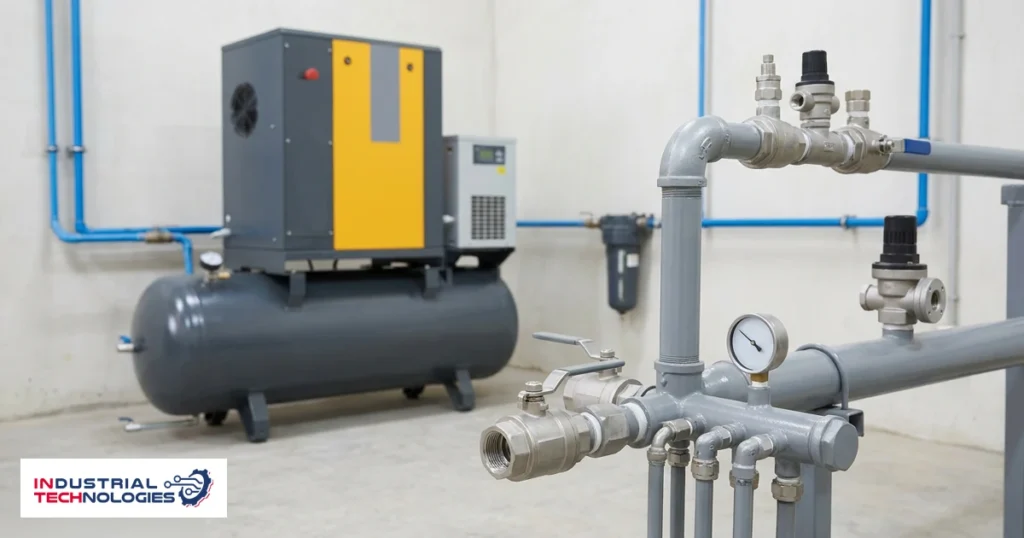
Most compressed air complaints are not compressor problems. The compressor is sized adequately, the gauge at the tank reads correctly, and the tool at the far end of the shop still underperforms. Compressed air system design — the piping, the layout, the treatment — is where the capacity you paid for gets lost.
Size on simultaneous demand, not on the sum
Adding up the consumption of every tool in the shop produces a number you will never need. Assuming one tool at a time produces a number that fails on your first busy morning.
The honest method is to establish realistic simultaneous demand: how many tools genuinely run together at your peak. Review a week of actual work rather than estimating from memory — the gap between the two is usually larger than people expect.
Tool type matters as much as tool count. A spray gun draws continuously for the duration of the job; an impact wrench draws in short bursts a receiver absorbs easily. Two shops with identical tool inventories can need genuinely different compressors for that reason alone.
Pressure drop is a distance problem
Air loses pressure as it travels, and the loss compounds with length, with undersized pipe, and with every fitting and sharp bend in the run.
The practical consequence is that a shop can have adequate pressure at the tank and inadequate pressure at the bay furthest from it. The symptom presents as “the compressor is too small” and gets solved by buying a bigger one — which raises energy cost without addressing the loss.
Before specifying a larger compressor, measure pressure at the tool, not at the tank. That one measurement redirects a significant share of these projects.
Ring main versus branch layout
A branch layout runs a single line outward with drops along it. It is cheaper and simpler, and pressure declines steadily toward the far end.
A ring main loops the line back on itself so every drop is fed from two directions. That halves the effective distance to the furthest point and evens out pressure across the shop.
My view: a ring main is worth its extra cost in any shop with more than a few bays, and it is far cheaper to install during fit-out than to retrofit later. It also lets you isolate a section for maintenance without shutting down the whole shop — which is a benefit people only value the first time they need it.
Air treatment in a hot, dusty climate
Compressed air carries moisture that condenses in the lines and traces of oil from the compressor. Both reach the spray gun and both become finish defects.
Regional conditions make this worse than the textbook case: the temperature differential between compressed air and pipe wall drives more condensation than temperate-climate design assumes. A shop reporting “unexplained spray defects” should inspect the air line before questioning the material or the technician.
| Stage | Position | Purpose |
|---|---|---|
| Water separator | After the receiver | Bulk liquid removal |
| Dryer | Before distribution | Lowers dew point into the network |
| Fine filter | At point of use | Catches what condensed downstream |
| Drain | At every low point | Condensate accumulates where the pipe falls |
The point-of-use filter is the one most often omitted, and it is not redundant. A filter at the compressor cannot protect you from condensation that formed in fifty metres of pipe after it.
Where the compressor lives
Compressor ratings are established under moderate reference conditions. A unit drawing intake air at 45°C is drawing less dense air, and it delivers less than its published figure.
Worse, it then runs longer to compensate, which raises its own temperature further. Placement is an engineering decision, not a space-allocation decision: shaded, cross-ventilated, drawing the coolest available air. It is the cheapest intervention on this list and the most frequently skipped.
Common questions
One large compressor or two smaller ones?
Two give you continuity — one failure does not stop the shop, and you can shut one down in quiet periods. One large unit is simpler to maintain and cheaper up front. Two for a shop that cannot afford downtime; one for a shop that can rent a temporary replacement.
How do I know my current system is undersized?
Two signals: noticeable pressure drop when an additional tool starts, and a compressor that barely stops during peak hours. The second is the more serious — it means the unit is running at its limit continuously, which shortens its life.
Does pipe material matter?
It affects corrosion behaviour, internal smoothness and how easily the network can be modified later. Material selection should be settled at design stage against your layout and treatment plan rather than chosen on unit price — changing it afterwards means rebuilding the network.
What is the minimum daily maintenance?
Draining accumulated condensate from the receiver. It takes seconds, and neglecting it produces internal corrosion that genuinely shortens tank life. Everything else on the schedule is less frequent and less consequential.
Where to start
Compressors and air equipment sit under general workshop equipment and tooling. If your primary use is refinishing, the note on paint booth airflow explains why air cleanliness is a finish-quality specification rather than a support detail.