
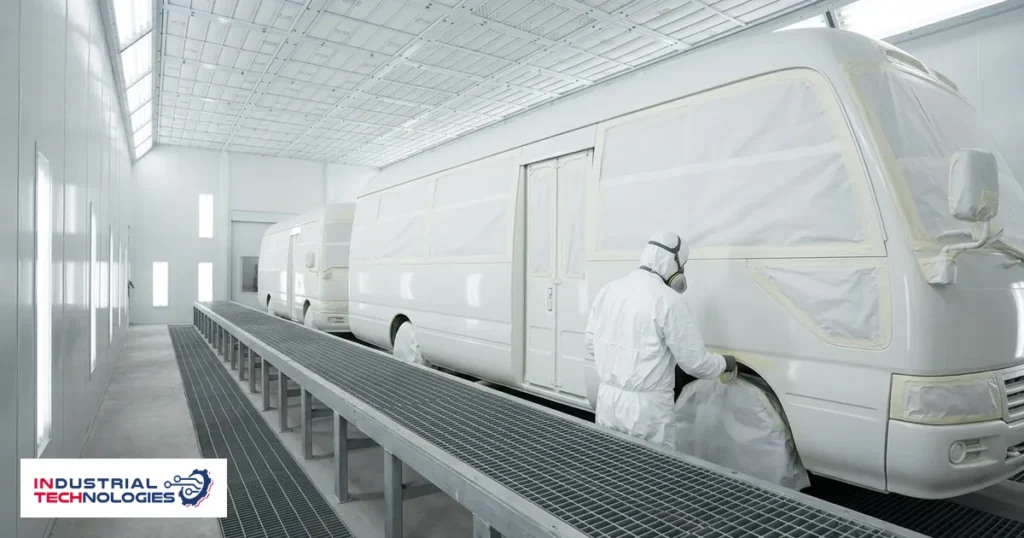
“Truck or bus, same thing” is a sentence that recurs in sales calls and costs the person who says it later. A bus is usually wider and taller; a truck with its trailer is longer. A chamber sized for one can stop the other at the door.
A bus paint booth has its own delivered figures, and they differ from truck chamber figures in width, height and door together.
The delivered figures for this class
Builds in this class start at 8000 mm for minibuses and vans, and extend to 16,000×6,500×4,500 mm for buses and long vehicles.
| Item | Delivered value |
|---|---|
| Minibus and van | from 8000 mm long |
| Buses and long vehicles | up to 16,000×6,500×4,500 mm |
| Air capacity | up to 72,000 + 72,000 m³/h |
| Main door | up to 4000×4200 mm |
Look at the width figure specifically: 6500 mm internal. That separates a bus chamber from a truck chamber more than length does, because working space around a wide vehicle is consumed quickly.
Free height above the roof
An internal height of 4500 mm does not mean the bus may be that tall. The figure includes free volume above the vehicle roof, needed for spraying and ventilation together — it is not slack that can be traded away.
The door is measured at the highest and widest point
The main door in this class reaches 4000×4200 mm. Measuring a bus at shoulder height rather than at its highest point — the roof-mounted air conditioning unit, typically — produces a door the vehicle will not pass through.
In larger builds beyond the bus class the door reaches 14,200×5,000 mm under powered operation, because an opening that size is not hand-operated on a daily cycle.
Air capacity follows volume, not vehicle class
A bus surface is a multiple of a car’s, and spray and dry time extend accordingly. Air capacity in this class reaches 72,000 + 72,000 m³/h, calculated on chamber volume rather than on vehicle category.
Frequently asked questions
Do you have a stock booth at bus size?
Anything beyond the automotive size is built to order rather than sold as a stock model. The delivered range in the bus class reaches 16,000×6,500×4,500 mm, and the final size is built on the longest and widest vehicle entering your workshop.
How does a bus chamber differ from a truck chamber?
A bus drives width and height; a truck with its trailer drives length. The published range takes both to 24,000 mm long, but the distribution across the three dimensions differs with your vehicle.
How should I measure before ordering?
Highest point including anything above the roof, widest point including mirrors if they stay fitted on entry, and overall length. Those three before any discussion of configuration.
Do I need a powered door on a bus chamber?
At 4000×4200 mm manual operation remains practical. Powered operation becomes a specification item on larger builds whose door approaches 14,200×5,000 mm.
Related reading
- Refrigerated Trailer Refinishing
- Food Truck Body Finishing
- Powered Booth Door
- Minibus and Van Paint Booth
- Caravan Paint Booth
- Booth cycle time and line takt
What to do next
Send the overall length, width and height of the largest bus entering your workshop, and we will return a chamber and door built on your dimensions. Request a quote. Sector detail is on the trucks and RV industry page.