
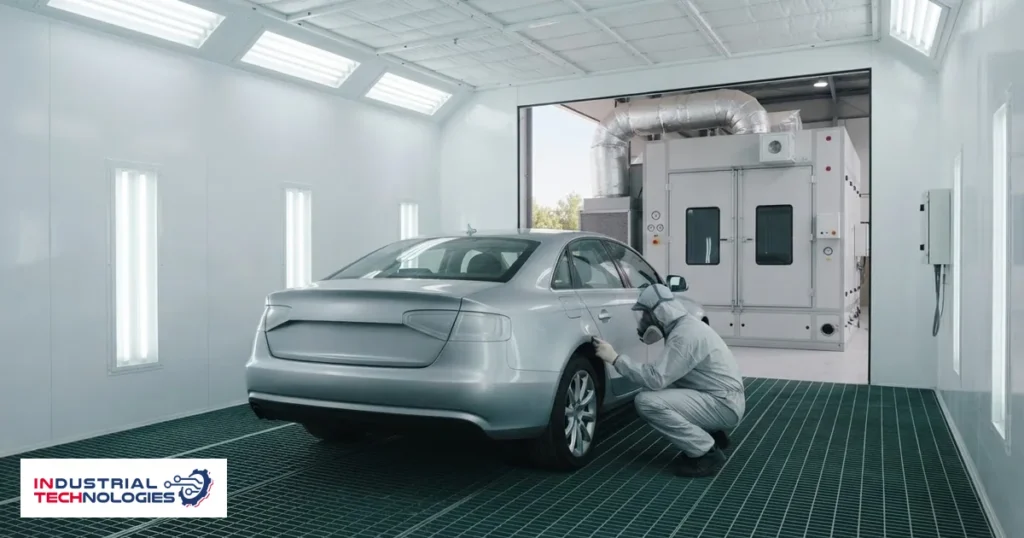
Particulate filters catch things you can see on the filter. They do nothing about the thing that makes a visitor step back at the bay door — the smell of solvent hanging in the air.
That is a different physical problem, and it needs a different medium. Activated carbon filtration is what appears in a specification when vapour rather than dust is the target.
Two media doing two jobs
The open preparation platform publishes multi-layer fibreglass filtration with activated carbon, and exhaust through a fibreglass filter.
The pairing is deliberate rather than redundant. Fibreglass layers intercept particles; carbon adsorbs what is gaseous. A station working near filler and solvent operations needs both, and specifying one while assuming it covers the other is a common gap.
Fibreglass is what the paint booths themselves use for a different reason: dry fibreglass filtration that captures overspray before the exhaust path, protecting the fan and the stack and keeping finish quality stable across shifts.
Where carbon does not belong
Carbon appears in the extraction side of a preparation station. It does not appear in the supply side of a spray chamber, where the requirement is clean incoming air rather than treated outgoing air.
The enclosed preparation room shows the supply-side logic clearly: a pre-filter, then a full ceiling plenum with a high-efficiency filter covering the chamber area, then exhaust through a fibreglass filter.
Reading those two specifications side by side is the fastest way to understand filtration in a finishing shop: one arrangement is protecting the workpiece, the other is treating what leaves.
Carbon is consumed, not clogged
This is the operational point that catches shops out. A particulate filter announces its condition — it visibly loads and airflow drops. Carbon does not.
Adsorption capacity is finite, and when it is used up the medium simply stops working while looking exactly as it did on day one. Nothing on a pressure gauge reports it either, because a saturated carbon bed offers much the same resistance as a fresh one.
Which means carbon belongs on a schedule, not on an inspection. Filtration is replaced periodically according to running hours and workload rather than on failure — typically twice a year within preventive maintenance, with the interval differing between pre-filter, ceiling filter and floor filter.
What custom builds specify
For anything outside the automotive chamber size, filtration stages are set per build alongside dimensions, extraction direction and heating system.
The published executed range covers stop, pre-filter and ceiling stages in EU3, EU4 and EU5 — and up to three stages with bag and high-efficiency filtration at efficiency of 98% or higher. Those grades are the vocabulary to use when specifying, rather than describing filtration by layer count.
Published filtration stages
Particles and vapour are different problems — and the stages address them differently:
| Stage | Published class | What it addresses |
|---|---|---|
| Stop and pre-filter | EU3, EU4, EU5 | Coarse particulate before the ceiling stage |
| Ceiling | EU3, EU4, EU5 | Particulate in the supply air |
| Up to three stages | Bag and high-efficiency filtration at efficiency of 98% or higher | Where the work demands it |
| Activated carbon | Listed alongside glass fibre on the open platform | The gaseous fraction, which fibre does not capture |
Common questions
Does carbon remove the smell entirely?
It reduces vapour in the treated stream. How much reaches the surroundings also depends on extraction volume, stack height and site conditions, which is why the extraction path is designed as a whole rather than as a filter choice.
Is it required by regulation?
Requirements are local. We meet the regulatory requirements applicable to each project, and the certificates and approvals required are supplied on request. Raise your local requirements at design stage rather than after installation.
Can carbon be added to an existing station?
It depends on the housing and the pressure budget of the existing fan, since any added stage adds resistance. It is a question for the model concerned, and the family page sets out what each published station includes.
What to send with your enquiry
The materials used in your preparation work, daily running hours, distance to occupied areas or neighbours, and any local emission requirements. Then request a quotation.