
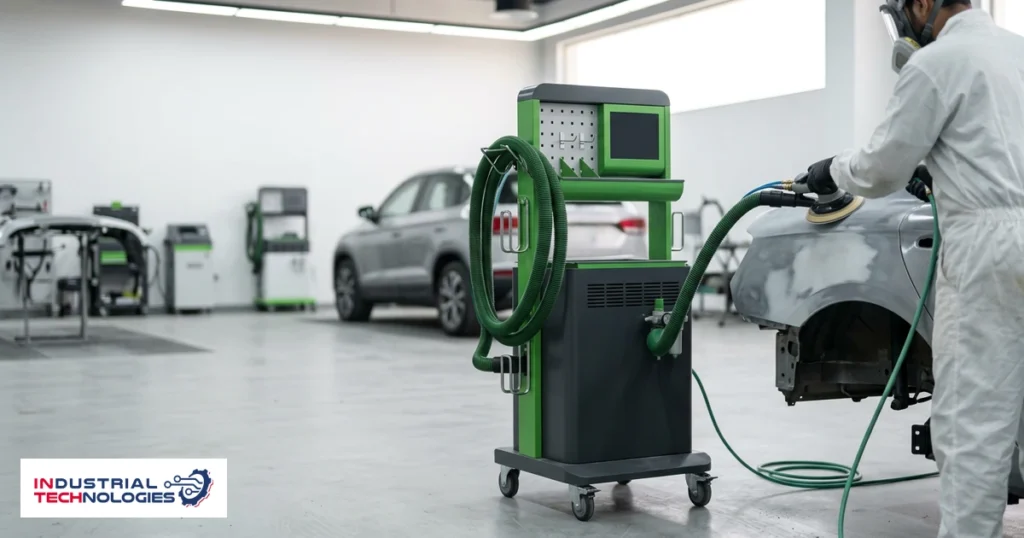
Sanding dust does not stay where it is made. It rises, settles on every horizontal surface in the shop, and comes down onto the first wet panel two hours later — returning a job nobody touched.
Which is why workshop dust extraction is designed as a capture system at the source rather than a cleaning routine afterwards.
Open bay or enclosed cabin
The first decision is not fan power but station form, and the two published options in the prep stations and mixing rooms family differ in logic rather than in size.
The open platform is published with no walls and no enclosed cabin: an extraction and filtration wall placed at the end of the bay, with the workpiece entering from the open side. Air capacity is 15,000 m³/h with a 5.5 kW centrifugal fan at 800 Pa.
Its published operational advantage is specific: the bay stays available for general use when no preparation is running, unlike an enclosed room which occupies its footprint permanently. In a space-constrained shop that argument carries real weight.
Fan pressure is the number to ask for
Volume alone describes a fan in free air. Pressure describes what it can do against resistance, and resistance is what an extraction system is made of.
Filters load, ducts accumulate, and elbows cost flow. A fan quoted at high volume and low pressure loses its stated performance within weeks of real use, when the filtration starts pushing back.
The enclosed room in the same family publishes a 4 kW turbine fan at 800 Pa, and the open platform publishes 5.5 kW at the same pressure. Reading both figures together is how you compare two offers honestly.
Ductwork is part of the specification
A capacity figure only exists once it is connected to a real path, which is why the published standard supply names what is included: four straight duct sections and one elbow, with a fan cabinet measuring 3450×1100×2000 mm.
That detail settles a question usually raised too late — where the fan cabinet stands, and what route it takes to the stack. Every elbow added on site beyond what is supplied reduces actual extraction below the published figure.
The supply also includes a control box with an emergency stop button, and its position should be reachable from where the technician actually works rather than from the end of the bay.
Position beats power
A particle that has travelled a metre from its source is many times harder to capture. Distance to the work is a more powerful variable than fan rating.
The related point is where the operator stands. A technician positioned between the workpiece and the extraction wall interrupts the path with their own body, and the air routes around them — carrying dust towards their face rather than away. That is a handover instruction, not an equipment specification.
Capture figures and what connects them
A capacity figure only exists once it is connected to a real path:
| Item | Published | Note |
|---|---|---|
| Air capacity | 15,000 m³/h | Open platform |
| Open platform fan | 5.5 kW centrifugal at 800 Pa | — |
| Enclosed room fan | 4 kW turbine at 800 Pa | Same pressure, different arrangement |
| Standard supply | Four straight duct sections and one elbow | Every added elbow reduces actual extraction below the stated figure |
| Fan cabinet | 3450×1100×2000 mm | Needs a position and a path to the stack |
Common questions
Can preparation happen inside the paint booth?
It should not. The booth needs a clean environment and sanding produces what contaminates it. Separating the two stations is what stops the spray chamber becoming the source of the dust you are fighting.
Does either option need floor works?
The enclosed room publishes rear-side draft with installation requiring no basement beneath the floor. The open platform is lighter still by nature. Site preparation remains the client’s responsibility under our published terms.
How often is filtration replaced?
On schedule rather than on failure — typically twice a year within preventive maintenance, according to running hours, and differing between pre-filter, ceiling filter and floor filter. The spare parts and filters page covers supply and model matching.
What to send with your enquiry
Bay area and clear height, the type of workpieces prepared, a viable stack route, and the available electrical supply. Then request a quotation.