
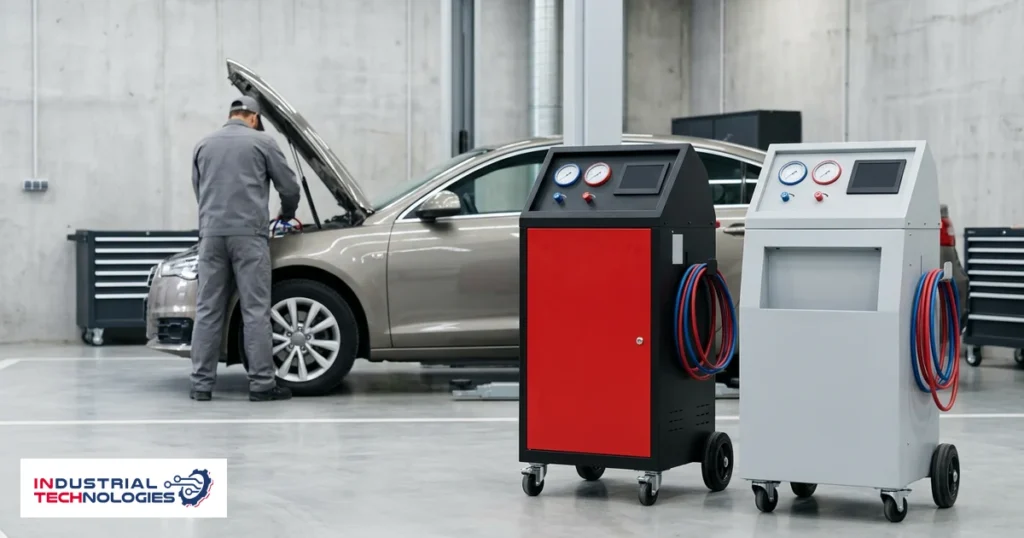
Two figures on an air conditioning station describe how much refrigerant it holds, and they are not the same figure. Confusing them produces a comparison that looks close and is not.
Refrigerant tank capacity is published in different units on the ACMAS301 and the ACMAS302, and the reason is that they store it differently.
Litres and kilograms describe different things
The higher model publishes a refrigerant tank of 12 L. The economy model publishes a gas cylinder of 10 kg.
One is a volume, the other a mass, and converting between them depends on the refrigerant and its state. The useful comparison is not arithmetic between the two but what each means for a working day: how many vehicles can be serviced before the station needs replenishing.
That is the question to put to a supplier directly, in vehicles rather than in units, because it is the one that affects your bay schedule.
Storage interacts with recovery
Tank capacity does not stand alone, because a station that recovers well refills its own tank from the vehicles it services.
The published recovery rates are 99% and 97%, with recovered gas passing through a drying filter before returning to the tank so it is reused rather than buying a new cylinder for every vehicle.
So the relevant quantity is not tank size alone but net consumption per vehicle — what leaves in the vehicle minus what comes back. A larger tank on a station that recovers poorly can empty faster than a smaller tank on one that recovers well.
The heating belt is a capacity feature
The economy model publishes a cylinder heating belt in its standard supply, and it is easy to read past.
Refrigerant transfer depends on pressure, and pressure depends on temperature. A cold cylinder transfers slowly regardless of how much it holds — which turns a storage number into a throughput number.
The same model publishes an integrated condenser and cooling fan described as keeping the cycle stable. Both features address the same underlying issue: a refrigerant circuit is a thermal system, and its behaviour changes with ambient conditions.
Storage is also a site question
Refrigerant held on site is subject to whatever storage and handling requirements apply at your location, and those requirements are local rather than universal.
We meet the regulatory requirements applicable to each project, and the certificates and approvals required are supplied on request. The practical step is to raise storage arrangements before delivery rather than after, alongside the electrical supply and the bay position.
Tank, cylinder and flow figures
Litres and kilograms are not the same figure — these are the published ones:
| Item | Higher model | Economy model |
|---|---|---|
| Refrigerant storage | Tank of 12 L | Gas cylinder of 10 kg |
| Recovery rate | 99% | 97% |
| Vacuum pump | 120 L/min | 60 L/min |
| Function set | 8 functions including circuit flush and UV leak testing | Recovery, evacuation, oil injection and recharge |
| Dimensions | — | 630×620×1040 mm — check against a fixed bay position |
Common questions
Does a bigger tank mean fewer interruptions?
Usually, but recovery rate and daily vehicle count decide the actual interval. Calculate it from your own volume rather than from the headline figure, and ask for the calculation in your quotation.
What else separates the ACMAS301 and the ACMAS302?
Function count and vacuum pump rate. One publishes 8 functions including circuit flush and UV leak testing at 120 L/min; the other publishes recovery, evacuation, oil injection and recharge at 60 L/min. Both are set out on the family page.
How large is the economy model physically?
Its published dimensions are 630×620×1040 mm, which is the figure to check against your bay layout if the station is to have a fixed position rather than being moved between bays.
What to send with your enquiry
Daily vehicle count through the air conditioning bay, the refrigerants in your mix, your on-site storage arrangements, and whether the station stays in one bay. Then request a quotation.