
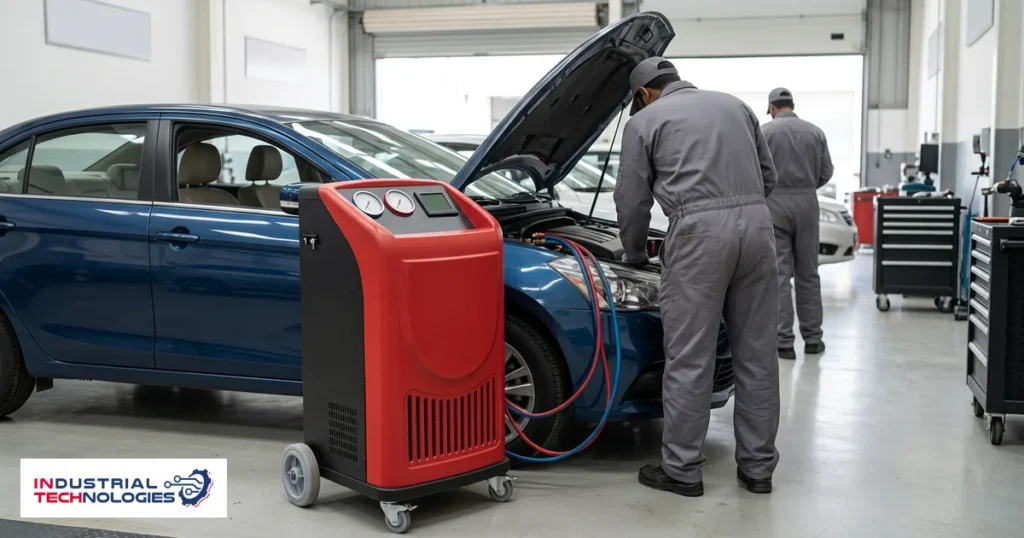
An air conditioning system that is undercharged cools poorly. One that is overcharged cools poorly too, and stresses the compressor while doing it. The window between those two failures is narrower than most workshops assume.
Which is why refrigerant charging accuracy is a specification worth reading in grams, not in adjectives.
The published tolerances
The higher model in the family publishes a scale accurate to ±10 g for gas and ±5 g for oil, and recharging by controlled weight at 2 kg/min.
Two tolerances, not one, and the tighter figure applies to the smaller quantity. That is the right way round: oil is dosed in much smaller amounts than refrigerant, so the same percentage error would be far more consequential.
These are the numbers to put beside a manufacturer’s specified charge for the vehicles you service. A tolerance is only meaningful relative to the target it applies to.
Why oil dosing carries the risk
Refrigerant carries compressor oil around the circuit. Too little and the compressor runs dry; too much and oil displaces refrigerant volume and reduces heat transfer.
Neither failure announces itself on the day. Both appear later as a cooling complaint or a compressor failure that gets attributed to age. This is the quiet reason a station’s oil tolerance deserves more attention than its headline gas figure.
The published function list on that model includes oil injection as an automated step, which removes the estimation that manual dosing invites.
Accuracy depends on what came before
A precise charge into an incompletely evacuated circuit is not a precise charge. Residual air and moisture occupy volume the refrigerant should have.
Which makes vacuum performance part of the accuracy story: the published pump rates are 120 L/min and 60 L/min, depending on the model. Evacuation is also the longest phase in the cycle, so the same specification affects both throughput and result.
The 2 kg/min recharge rate is the other half of cycle time. Read the two together and you have the real duration of a service, which is what a bay schedule is built from.
The scale needs verifying too
A published tolerance describes a calibrated instrument. Instruments drift, and one that has drifted reports confident numbers that are wrong — the worst failure mode available, because nothing looks unusual.
Verification intervals follow the manufacturer’s recommendation and running hours, and belong in the maintenance programme rather than in a general rule. Preventive maintenance after final handover is the operator’s responsibility under our published terms, and this is a specific item to name in it.
The accuracy window in figures
Recovered gas passes a drying filter and is reused — accuracy decides how much:
| Item | Published | Why it matters |
|---|---|---|
| Gas scale accuracy | ±10 g | The charge window is narrower than assumed |
| Oil scale accuracy | ±5 g | Oil quantity affects compressor life |
| Recharge rate | 2 kg/min | The other half of cycle time |
| Vacuum pump rates | 120 L/min and 60 L/min, depending on the model | Vacuum performance is part of the accuracy story |
Common questions
Is the economy model less accurate?
It publishes a different function set rather than a stated lower accuracy — recovery, evacuation, oil injection and recharge, with hand-valve-free operation. Ask for its scale tolerance explicitly if precision is your selection criterion.
Does automation improve accuracy in practice?
It removes the steps where a technician can deviate. The published reasoning for hand-valve-free operation says exactly that: one fewer step for the technician to get wrong, which matters where crews change.
Where does leak testing fit?
Before the charge, not after. UV dye leak testing is published in the higher model’s function list, and finding the leak is what stops the same vehicle returning with the same complaint. The models are compared on the family page.
What to send with your enquiry
The vehicle makes you service and their specified charges, your daily volume, whether you perform circuit repair, and how your workshop currently verifies instruments. Then request a quotation.