
Buyers compare chamber dimensions carefully and then accept whatever door comes with them. That works until the day a vehicle fits inside the booth but not through the opening.
Paint booth door sizing deserves its own line on the comparison sheet, because the door is simultaneously an access constraint, a structural element and — above a certain size — an operating cost.
There is more than one door
A booth in this family has at least two openings, and they answer different questions.
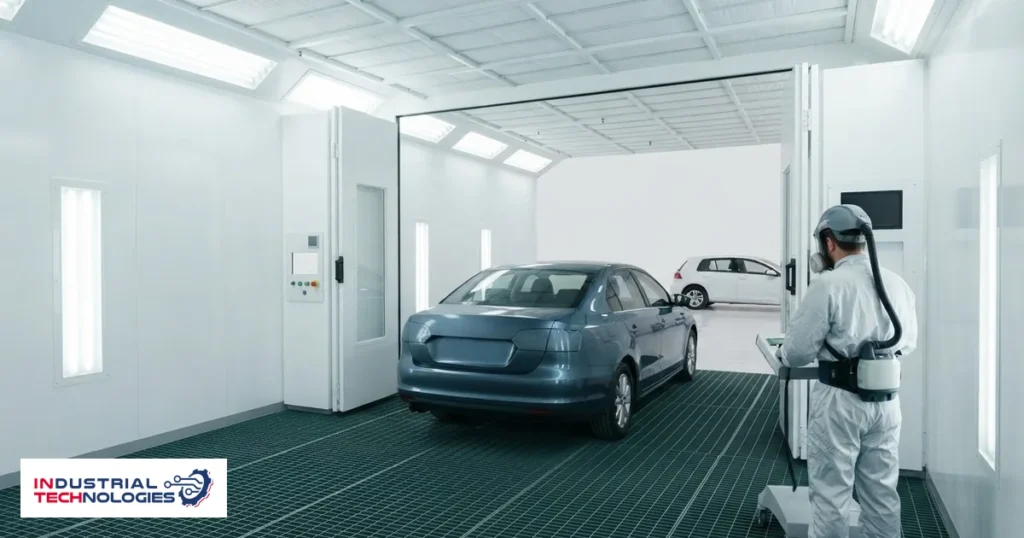
The main door on the INTECH models is 3000×2600 mm — the vehicle entrance. The work door is 800×2000 mm — the technician entrance, used while a vehicle is inside and the main door is shut.
If the second one is missing or badly placed, the main door gets opened during cycles. That single habit undoes the pressure regime, the filtration and the temperature stability that the rest of the booth was specified to maintain.
Entry ramps are part of the opening
The floor arrangement determines whether a vehicle can drive in at all. Pressed floor sections and grating rows sit above the shop slab, so the booth needs ramps to reach that level.
Two ramps at 550×2000 mm are documented on every INTECH model. Those ramps project into your bay, which means the clear approach in front of the booth is longer than the booth’s external footprint suggests.
Chambers built with a full metal grid basement avoid the ramps but require a pit or an entry ramp cut into the floor instead. Either way, the entry arrangement is a civil works decision that has to be settled before the slab is finished.
Above the automotive size the door becomes a building element
In the paint booths and finishing systems family the main door range runs from 3000×2600 mm up to 14,200×5,000 mm electrically operated.
That upper figure is worth pausing on. An opening of that size is not a booth accessory; it affects the building elevation and the route a workpiece takes to reach the site in the first place. Delivered truck and bus chambers show the intermediate step, with main doors up to 4000×4200 mm.
Electrical operation also stops being a convenience option. A door at that scale is not opened by hand several times a day, so powered operation becomes a specification requirement in daily operation rather than an upgrade.
The door as a safety component
Two documented details show that doors are not only about access.
The work door on every INTECH model carries pressure relief that opens above 10 Pa, giving excess chamber pressure a designed escape route instead of letting it find the weakest joint, and the INTECH X500 and above add a pressure gauge showing filter loading. The INTECH X700, X900 and X960 use a four-leaf main door with large glass panels.
The glazing serves two purposes at once — visibility into the chamber during a cycle, and a panel specified for the pressure environment it sits in. Neither is visible in a dimension table, which is why the door line needs reading rather than skimming.
Every opening is its own specification
The doors and ramps documented on the standard models:
| Opening | INTECH X300 and X360 | INTECH X500 |
|---|---|---|
| Main door — vehicle entrance | 3000×2600 mm | 3000×2600 mm |
| Work door — technician entrance | 800×2000 mm | Used while a vehicle is inside and the main door is shut |
| Ramps | Two at 550×2000 mm | Two at 550×2000 mm |
| Family main door range | From 3000×2600 mm to 14,200×5,000 mm electrically operated | — |
Common questions
Why is the main door smaller than the chamber width?
Because the chamber is sized for the vehicle plus working space around it, while the door only has to pass the vehicle. A 3000×2600 mm opening into a 6900×4000×2650 mm chamber leaves the technician room to move that the doorway never needs.
What clearance do I need in front of the booth?
Enough to swing the main door plus the ramp projection plus the vehicle approach. That total is the number to check against your bay depth — not the booth’s external length, which is where most layouts go wrong.
Can a larger door be added to a standard model later?
Door size is fixed with the configuration before manufacture, alongside extraction direction, heating system and filtration stages. Larger openings belong to built-to-order chambers, where the internal dimension is set from the workpiece rather than from a catalogue model.
Measure two things before you compare offers
The widest and tallest vehicle or part you handle, and the clear approach depth in front of the intended booth position. Those two numbers eliminate more unsuitable configurations than any specification table.
Published door dimensions per model are on each product page, or request a quotation with your largest workpiece and bay depth.