
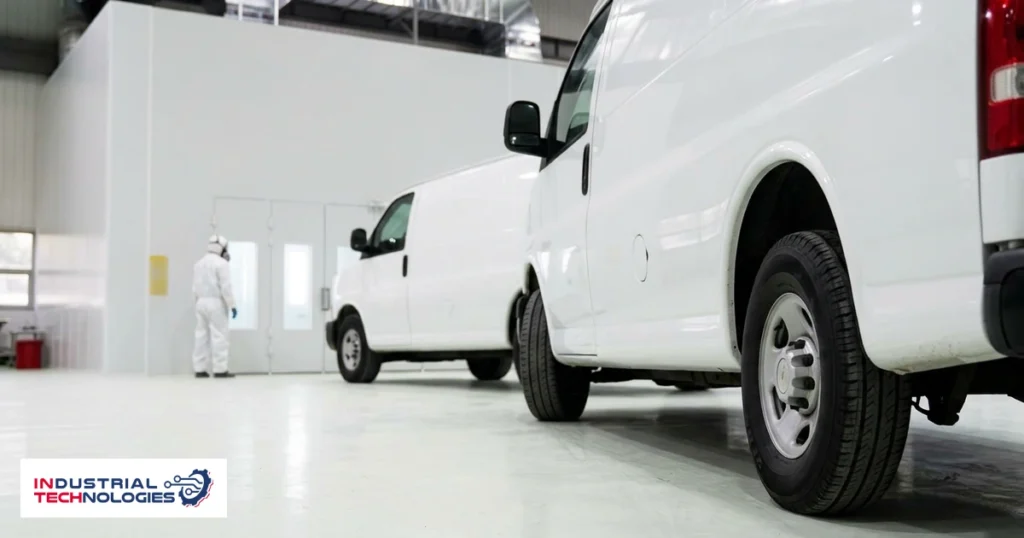
What surprises truck workshop owners is rarely the chamber size. It is the route to it. The drawing says the area is sufficient, and then the vehicle stops at the entrance unable to swing into position.
Turning radius workshop access explains that gap: area enough to park in is not necessarily area enough to reach.
Space is measured by manoeuvring, not by area
A long vehicle needs an approach, an exit and a turning radius between them. All three are measured on the floor as a real movement path; none of them is derived from the total area of the bay.
A workshop with enough area on paper may still be unable to physically get the vehicle into position — the second of the three challenges that govern this sector.
| What is measured | Why it comes first | What shows when it is skipped |
|---|---|---|
| Approach path | Decides whether the vehicle arrives at all | A vehicle stopped at the entrance |
| Turning radius | Decides whether it swings into position | Repeated shunting or reversing in |
| Exit path | Decides how fast the chamber clears | Chamber occupied after the cycle ends |
Why it surfaces late
Because design usually starts from the equipment rather than the building. An internal size is chosen and signed off, then a position is looked for in the bay — and by then the columns and the entrance are a fixed constraint.
The order that works is the reverse: fix the movement path first, place the chamber inside it, then build the size on what remains — or reconsider the entrance position itself, if that turns out cheaper.
What to send with the dimensions
- Bay layout with column positions — a column mid-path cancels the whole path
- Entrance width and height — not the internal width of the bay
- Street orientation outside the workshop — the manoeuvre begins outside the building, not inside it
Those three show whether the proposed chamber position can be served at all, before any figure is fixed in the specification.
Frequently asked questions
Can a smaller chamber solve tight manoeuvring?
Rarely. A smaller chamber does not solve access to it, and may worsen it, because the vehicle then needs more positioning accuracy through a narrower opening.
What if the manoeuvre is genuinely impossible?
Move the chamber or move the entrance. Both are studied in the site survey before the design is fixed — the step every custom booth starts with.
Is reversing in an acceptable answer?
Operationally acceptable in some workshops, but it adds time to every vehicle and needs a banksman. That cost belongs in cycle time, not in chamber size.
Related reading
What to do next
Send the bay layout with column positions and entrance size along with the longest vehicle dimensions, and we will return a chamber position that can actually be served. talk to a specialist. Sector detail is on the Trucks & RV sector page.