
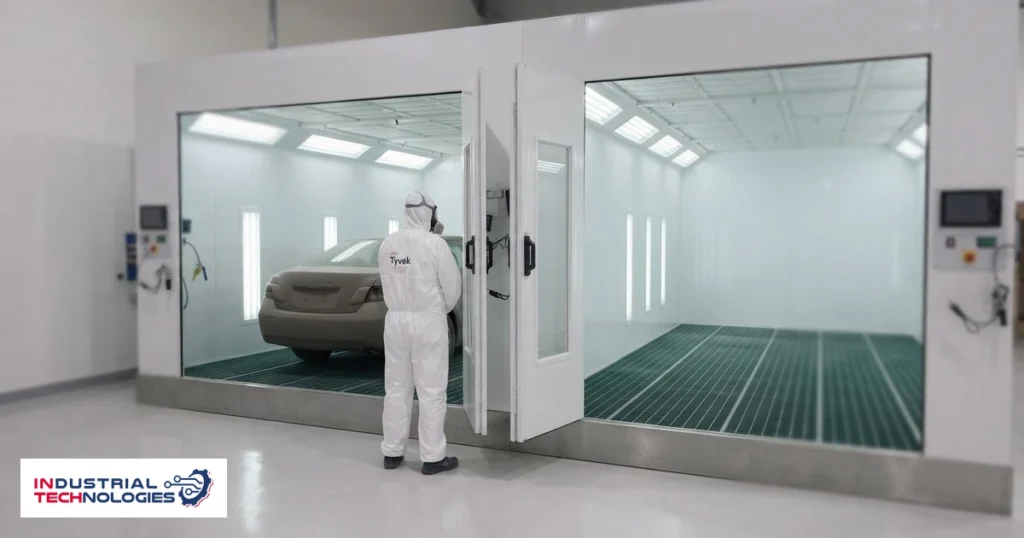
Two booths can share the same internal dimensions, the same air capacity and the same burner, and still behave differently after three years. The difference is usually in the wall.
It is the least discussed line on a quotation because it looks like a commodity. Panels are panels. In practice the panel decides thermal loss, acoustic behaviour, fire performance and how the chamber ages.
Fifty millimetres is the constant, the core is not
Across the standard automotive-sized models the wall thickness is fixed at 50 mm. What changes is what sits inside that thickness.
INTECH X300, X500, X700 and X900 use flame-retardant EPS panels. INTECH X360 and INTECH X960 use ROCKWOOL panels. The steel skin is 0.326 mm on the INTECH X300 and 0.426 mm on the INTECH X500 and above.
So when you compare paint booth wall panels between offers, the thickness figure tells you almost nothing on its own. The core material and the facing are where the two quotations actually diverge.
Why the core material is not a preference
Flame-retardant EPS is an organic foam treated to resist ignition. Rockwool is an inorganic mineral fibre. They are both used, and both are specified in delivered booths — but they answer different questions.
The rockwool models are the ones described with reinforced fire and acoustic insulation, which is why they appear where the booth sits inside a larger occupied building, or where the shop runs long consecutive cycles and noise carries into adjacent bays.
The acoustic half of that sentence is routinely ignored during procurement and routinely complained about afterwards. A booth running two 7.5 kW turbine fans is not a quiet machine, and the wall is the only thing between it and the rest of your workshop.
Above the automotive size the method changes entirely
Panel construction does not simply scale up. In the paint booths and finishing systems family, large chambers are built from 1.5 mm galvanised sheet rather than 50 mm insulated panel.
This is a change of structural approach, not a downgrade of specification. A chamber running to 24,000 mm long and 6000 mm high carries loads that a sandwich panel wall was never intended to carry, and it is framed accordingly.
The practical consequence for a buyer is that thermal insulation in large chambers becomes a separate design item rather than an automatic property of the wall. Ask how it is handled rather than assuming it came with the panel.
What the wall costs you every day
Heat that leaves through the wall is heat the burner has to replace. With a thermal output of 200,000 kcal/h on the standard models, and a delivered range reaching 600,000 kcal/h on large chambers, insulation performance is a recurring fuel line rather than a one-off purchase decision.
In Saudi ambient conditions the same argument runs in the other direction for part of the year: a poorly insulated chamber gains heat from outside during cooling phases, and the cycle lengthens.
Wall construction across the models
Thickness is fixed; the core and facing are what differ:
| Model | Core | Facing and note |
|---|---|---|
| INTECH X300, X500, X700 and X900 | Flame-retardant EPS panels | Wall thickness fixed at 50 mm across the standard automotive-sized models |
| INTECH X360 and X960 | ROCKWOOL panels | — |
| Steel skin | 0.326 mm on the INTECH X300 | 0.426 mm on the INTECH X500 and above |
Common questions
Is thicker always better?
Not in the range these models occupy. All of these standard models are built at 50 mm, and the meaningful variation between them is the core material and facing rather than added thickness. Above the automotive size the construction changes method entirely.
Can I specify rockwool on any model?
Rockwool is what is documented on INTECH X360 and INTECH X960. Whether it can be substituted on another model is a build question rather than a catalogue one, and it is answered against your site conditions when the configuration is fixed before manufacture.
Does the facing material matter?
It is the surface that gets cleaned, knocked and overspray-loaded for the life of the booth. The steel skin — 0.326 mm on the INTECH X300, 0.426 mm on the INTECH X500 and above — is what you are handling every day — the insulation core behind it is never touched again after installation.
One line to add to your comparison sheet
Ask for core material, thickness and facing as three separate values. An offer that answers with a single word has not answered the question.
The published construction for each model is listed on the INTECH X900 product page, or request a quotation with your building type and shift pattern.