
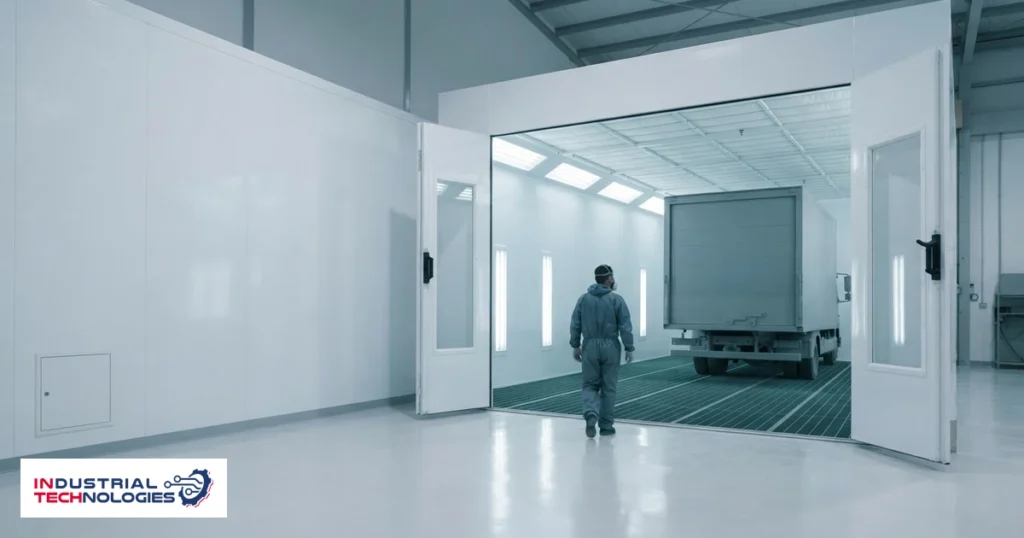
Automotive booths are a solved problem. The INTECH chamber measures 6900×4000×2650 mm internally, which covers passenger cars and SUVs, and a body shop rarely needs to think past it.
The moment your workpiece is an airframe, a bus shell or a rail car, that catalogue stops being useful. Specifying a large structure paint booth is a different exercise: the chamber follows the object, and every other number follows the chamber.
The three size tiers that actually get built
“Custom” is a word that hides more than it explains. The delivered range in the paint booths and finishing systems family is written as numbers: internal length 3000–24,000 mm, width 3000–20,000 mm, height 2650–6000 mm.
Industrial work sits at the small end, starting around 3000×3000×3000 mm for powder coat curing and extending to 5700×3700×3000 mm for industrial baking ovens and above. Here the chamber follows the manufactured part, and the temperature curve is set to the industrial coating rather than to automotive refinish.
Buses and long vehicles occupy the middle: from 8000 mm for minibuses and vans up to 16,000×6,500×4,500 mm, with air capacity reaching 72,000+72,000 m³/h and a main door up to 4000×4200 mm.
Airframe and hull work sits at the top. Chambers for aerospace, marine and rail run from 16,000 mm to 24,000×20,000×6,000 mm, with air capacity up to 190,000+190,000 m³/h.
Air capacity is quoted per group, not as a total
This is the single most misread figure in large-booth tenders. The stated 18,000–190,000 m³/h range is per intake or exhaust group — which is why the aerospace figure above is written as two numbers rather than one sum.
Two suppliers can quote what looks like the same capacity while one means supply and the other means the pair. Ask for supply and extract separately, every time, and compare like with like.
The gap between the two is also deliberate. Supply above extract holds the chamber slightly above ambient pressure, so air leaves through gaps rather than entering through them — the cheapest contamination control available on a site with airborne dust.
Filtration and safety scale with the chamber
At automotive scale, filtration is stop and pre-filters plus ceiling filters in EU3, EU4 and EU5 classes. At structure scale it goes to three stages with bag and high-efficiency filtration at efficiency above 98%.
Large chambers also add provisions that do not exist at bay scale: gas monitoring and static discharge. Neither is a premium option — both follow from the volume of solvent vapour a chamber of this size holds.
The wall construction changes too. Standard sizes use 50 mm insulated panels in EPS, rock wool or glass wool; large chambers move to 1.5 mm galvanised sheet. That is a structural method change driven by span, not a reduction in specification.
The door is a building decision
Main doors range from 3000×2600 mm up to 14,200×5,000 mm electrically operated. At the upper end this stops being a booth component and becomes part of the building envelope.
Before anyone discusses airflow, confirm two routes: how the finished workpiece enters the chamber, and how the chamber panels enter the site. Projects have stalled on the second question long after the first was settled.
The three size tiers that get built
The delivered range written as numbers, by the work it serves:
| Tier | Internal dimensions | Air capacity and door |
|---|---|---|
| Automotive standard | 6900×4000×2650 mm | Covers passenger cars and SUVs |
| Industrial | From 3000×3000×3000 mm for powder coat curing to 5700×3700×3000 mm for baking ovens and above | Small end of the range |
| Buses and long vehicles | From 8000 mm to 16,000×6,500×4,500 mm | Air to 72,000+72,000 m³/h · main door to 4000×4200 mm |
| Aerospace, marine, rail | From 16,000 mm to 24,000×20,000×6,000 mm | Air to 190,000+190,000 m³/h |
| Full executed range | Length 3,000–24,000 · width 3,000–20,000 · height 2650–6000 mm | — |
Common questions
What power supply should we plan for?
Electrical power across this family runs from 11 to 50 kW depending on size and configuration, at 380 V three-phase, 50 or 60 Hz. Heat output runs 200,000 to 600,000 kcal/h. Confirm the available supply at your site early — it constrains configuration more often than budget does.
Which heating system suits a large chamber?
Five systems have been delivered in this family: Italian Riello and Baltur diesel burners, gas, electric heating, heat pump, and short-wave infrared. The choice follows coating type and site energy cost rather than chamber size alone.
Does a published range mean any size in between is available?
The range describes what has been delivered in this family and is a planning reference, not a size list. Final internal dimensions are fixed after a site survey, because service clearance, stack height and the delivery route can constrain what looks feasible on paper.
Where to start
Write down the bounding box of your largest workpiece, add working clearance for the operator around it, and only then look at chamber sizes. Every other decision — air groups, filtration stages, door type, heating — follows from that box.
If your work is vehicle-based but oversized, start with trucks and RV. Otherwise send your workpiece dimensions and site area with a request for quotation.