
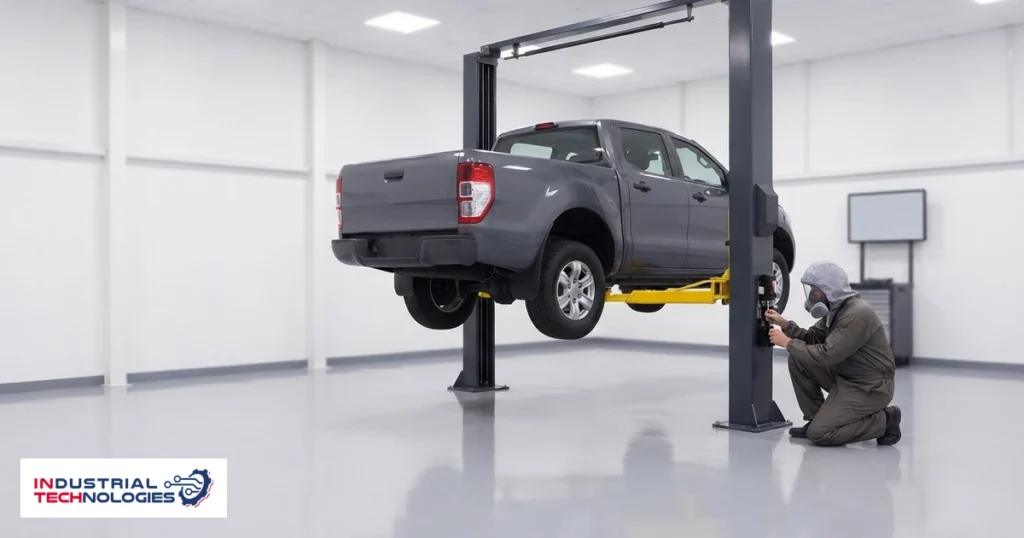
Safety lock inspection is the shortest item on any workshop maintenance schedule and the one with the least tolerance for being skipped. A hydraulic system that degrades gives you warning — slower cycles, drifting performance. A lock that fails gives you none.
This note covers what a lift safety lock inspection actually consists of, and why the interval should not be inherited from a schedule written for a different climate.
Locks are mechanical for a reason
Mechanical ratchet locks hold the vehicle independently of hydraulic pressure. That independence is the entire design intent: if a hose bursts or pressure is lost, the load rests on steel, not on fluid.
Which produces a rule that is easy to state and easy to forget: a lift is only as safe as its locks, regardless of how well the hydraulics perform. Excellent rise times tell you nothing about whether the ratchet will engage.
Automatic engagement matters here more than it is usually credited. A lock that engages at every level without the technician remembering to set it removes the human variable from the safety chain — which is exactly where you want it removed.
What the inspection actually covers
| Item | What you are checking | Failure signal |
|---|---|---|
| Ratchet engagement | Audible, positive engagement at every level | Missed levels, weak or inconsistent sound |
| Column synchronisation | Both columns rising and holding together | Visible lag on one side |
| Release mechanism | Deliberate release only — never accidental | Release under light contact |
| Overhead cut-off | Stops travel before roof contact | No stop, or stop too late |
| Arm restraints | Arms locking in position under load | Movement once loaded |
| Anchor bolts | Torque and base plate contact | Any movement at the base |
Column synchronisation deserves particular attention. A lift raising one side faster than the other is not a comfort issue — it loads the structure asymmetrically and shifts the vehicle on the arms. It is sufficient grounds to take a lift out of service until corrected.
Why the interval should be local, not inherited
Published intervals assume a working environment. Fine dust changes that assumption: it accumulates in the ratchet mechanism and can prevent full engagement while everything still looks and sounds approximately normal.
A shop near an unpaved approach road, or one that runs with doors open through a dusty season, is not operating under the conditions the interval assumed. My recommendation is a short visual and functional check daily — it takes under a minute per lift — with the full documented inspection on the manufacturer’s schedule.
The daily check is not paperwork. It is the difference between finding a fouled ratchet on an empty lift and finding it under a loaded vehicle.
The anchor bolts nobody re-checks
Anchor bolts are torqued at installation and then, in most shops we visit, never touched again. Repeated load cycles work against that initial torque over years.
Any visible movement at the column base under load is a stop-work condition, not something to monitor. And it connects directly back to the slab: bolts can only hold what the concrete beneath them holds, which is why floor specification and lift safety are the same conversation rather than two.
Power failure with a vehicle raised
Every technician who operates a lift should be able to answer this without hesitating, and every supplier should answer it immediately when asked before purchase.
With mechanical locks engaged, the vehicle rests on the ratchets and power loss is not an emergency. The procedure that matters is the controlled lowering sequence afterwards — and it must be documented for your specific model, posted at the bay, and covered in operator training rather than improvised on the day.
Common questions
Can shop staff perform the inspection?
The daily visual and functional check, yes — with brief training. The full documented inspection, including torque verification and structural assessment, belongs with someone qualified to sign it off. The two are complementary rather than alternatives.
What is the most commonly missed item?
Anchor bolt condition, without much competition. It is torqued once at installation and then treated as permanent, while everything visible above it gets attention.
Does heat affect the locks?
The mechanical locks themselves are not hydraulic and hold independently of fluid condition — which is exactly why they are the safety element. Ambient heat affects hydraulic performance, and that is covered separately in the note on fluid viscosity and lift performance.
Is operator training included with supply?
Basic operating training is included to the extent agreed in the quotation. We would insist the technicians who use the lift daily attend, rather than management alone — the safety procedures are theirs to execute.
Where to start
Published models and their protection features are under vehicle lifts and lifting equipment. If you are still specifying, the note on two-post lift selection covers the slab and geometry decisions that determine whether the safety chain has a sound foundation to begin with.