
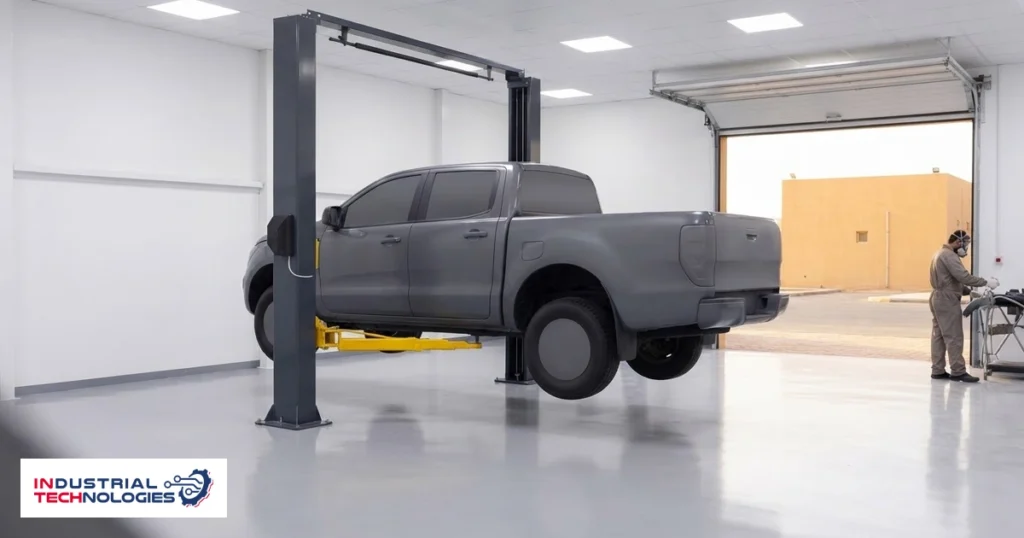
Hydraulic fluid viscosity lift performance is treated as a maintenance detail. In a shop where ambient temperature crosses 45°C for months at a time, it is a specification decision — and one taken at purchase, not at the first oil change.
The symptom that brings us in is almost always the same: a lift that was fine in March feels slow and inconsistent in July. Nothing is broken. The fluid is simply doing a different job than it was chosen for.
Why heat changes lift behaviour
Hydraulic fluid thins as it warms. Thinner fluid passes more easily past internal clearances in the pump and cylinder seals, which means a portion of each pump stroke does not become lift motion.
The visible result is a longer rise time. The invisible result is more work per cycle for the same motor, which is where the temperature problem starts feeding itself: more work means more heat, and more heat means thinner fluid.
None of this is failure. It is a system operating outside the ambient band its fluid grade assumed.
Rise time is your diagnostic instrument
A lift published at 50 seconds rise and 30 seconds descent gives you a reference. That figure is measured under defined conditions — it is a baseline, not a promise for every ambient temperature.
The practical recommendation is unglamorous and works: record rise time monthly with a comparable vehicle, and note ambient temperature alongside it. Two seasons of that log tells you more about your equipment than any datasheet.
What you are watching for is not summer slowdown — some is expected. You are watching for the figure failing to return to baseline when temperatures drop. That is wear, and it is worth catching early.
Where the lift lives matters as much as what fluid is in it
Two identical lifts in the same city can behave very differently. The one in a shaded, ventilated bay stays close to its published figures. The one near a west-facing roller door in direct afternoon sun does not.
This is the cheapest available intervention and it costs nothing at the planning stage: keep the power unit out of direct sun and give the bay cross-ventilation. Retrofitting shade to a bay laid out badly is far more expensive than positioning it correctly on the drawing.
Reference figures worth logging
| Parameter | Published example | What drift indicates |
|---|---|---|
| Rise time | 50 s | Fluid condition, internal leakage, ambient load |
| Descent time | 30 s | Valve and seal condition |
| Motor power | 2.2 kW | Reference for current draw comparison |
| Capacity | 4500 kg | Test consistently — same vehicle each time |
The fluid grade question — and the honest answer
The obvious response to heat is a heavier grade. It is not automatically correct, and we would push back on anyone who offers it as a blanket recommendation.
Fluid that is too heavy at start-up strains the pump on the first cycles of the morning, and that strain is real wear. The grade has to suit the full range the equipment actually sees, not only its hottest hour.
Which is why the specification comes from the manufacturer for your model and your operating conditions, and not from a general rule published in an article. Anyone offering you a grade without asking about your bay has not done the work.
Common questions
Is a slower lift in summer a fault?
Some seasonal variation is normal and expected. The signal that matters is whether performance returns to baseline as ambient drops. If it does not, the cause is wear or contamination rather than temperature, and it should be investigated rather than waited out.
How often should hydraulic fluid be changed?
Intervals depend on the model, the duty cycle and operating conditions, and they are supplied with the equipment. We would not adopt a schedule carried over from a different lift — the variables that drive fluid life are not comparable across models.
Does ambient heat affect the safety locks?
Mechanical ratchet locks are not hydraulic and hold independently of fluid condition — which is precisely why they are non-negotiable. Their inspection is separate from any fluid consideration and should stay on its own schedule.
What single change gives the biggest improvement?
Getting the power unit out of direct sun, in most shops we see. It costs almost nothing and addresses the input rather than compensating for it downstream.
Where to start
Published models and their timing figures are under vehicle lifts and lifting equipment. If you are still choosing between types, the note on two-post lift selection covers the specifications that decide installation before performance becomes the question.