
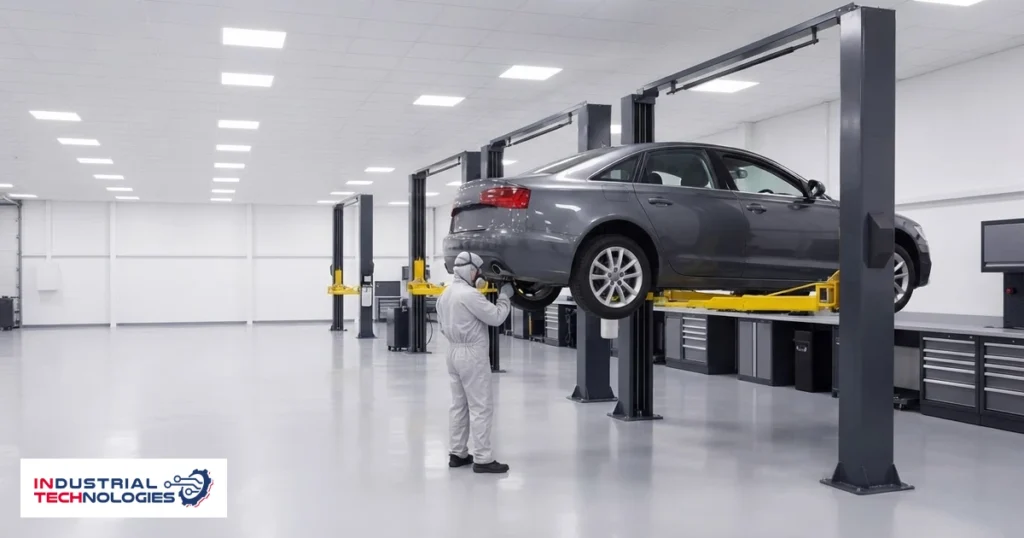
Two-post lifts are usually specified by capacity and nothing else. Capacity is the easiest number to get right and the least likely to cause a problem. The specifications that actually stop installations are ceiling height, slab condition and arm geometry — in that order.
Two post lift selection therefore starts below the vehicle, not on the datasheet. What follows is the sequence we use when a workshop asks which model to take, written as a checklist rather than a sales argument.
Clear floor or baseplate — decide this first
A baseplate lift runs its hydraulic and electrical connections through a plate at floor level, joining the two columns across the drive-through. It installs on the existing slab, costs less, and puts a low obstruction where vehicles enter.
A clear-floor lift moves those connections overhead, leaving the floor completely open. It needs adequate headroom above the raised vehicle and a properly rated slab, and it is the only sensible choice if you regularly take low-clearance vehicles or roll heavy equipment across the bay.
My view: if you service vans and light commercial vehicles alongside passenger cars, clear floor is not an upgrade — it decides whether the vehicle enters the bay at all. If your work is passenger cars only and the ceiling is tight, baseplate is the honest answer and there is no shame in it.
Capacity is specified against your heaviest vehicle
The common error is to size against the most frequent vehicle rather than the heaviest one accepted. A 4500 kg lift gives comfortable margin across passenger cars and light commercials without over-specifying.
Weight distribution matters as much as total mass. A loaded van shifts its centre of gravity rearward, which makes arm reach and lifting-point access more decisive than the headline capacity figure. Two lifts with identical ratings can behave very differently under the same vehicle.
The slab decides your installation date
A two-post lift transfers its entire working load into two base plates. The concrete beneath them needs sufficient thickness, adequate strength, and — often overlooked — to be level within tolerance.
So the question that should be asked before the purchase order, not after: was this slab poured for a workshop, or is it a warehouse floor being reused? That distinction is the difference between commissioning on schedule and waiting on remedial concrete work. It costs nothing to establish and it is the single most common cause of delay we see.
Operating figures worth writing into the order
| Parameter | Published value | Why it matters |
|---|---|---|
| Lifting capacity | 4500 kg | Sized on the heaviest accepted vehicle |
| Lifting height | 1990 mm | Working clearance under the vehicle |
| Rise / descent time | 50 / 30 s | Multiplied by daily vehicle count |
| Motor power | 2.2 kW | Checked against panel headroom |
| Supply | 380 V / 220 V | Determines whether new wiring is needed |
| Protection | Overhead cut-off | Stops the lift before roof contact |
Rise and descent time deserves a second look. Twenty seconds sounds like nothing in a quotation. At thirty vehicles a day it is ten minutes daily. Not a crisis — but a real line item that should be calculated rather than waved away.
Safety features are not options
Mechanical ratchet locks, reliable column synchronisation and an overhead cut-off are baseline requirements. A lift whose columns drift out of synchronisation raises one side faster than the other, and that alone is sufficient grounds to reject a model regardless of price.
Ask every supplier what happens if power fails with a vehicle raised. The answer should be immediate and specific. Hesitation on that question tells you something useful.
Common questions
Two-post or scissor?
It depends on the work, not on preference. Two-post clears the underside completely, which suits mechanical, transmission and exhaust work. Scissor is faster to drive on and off and suits wheel work and rapid inspection, but obstructs part of the underbody. A shop doing both usually needs both rather than a compromise between them.
Do I need to excavate the floor?
Not for baseplate models, which mount on the existing surface. Clear-floor models need a channel or excavation to route connections. Some mobile scissor models install entirely on the surface with no excavation at all, which makes them the practical answer for a leased unit where you cannot modify the floor.
How long does installation take?
The lift itself is rarely the constraint — site preparation is. Slab level, slab thickness and electrical supply determine the schedule, which is why the duration is established after a site assessment rather than quoted before one. Any figure offered before someone has looked at your floor is a guess.
Is operator training included?
Yes — basic operating training is included to the extent agreed in the quotation, and anything beyond that is arranged separately. It is worth insisting that the technician who will actually use the lift daily attends, not only the workshop manager.
What warranty applies?
The manufacturer’s warranty, with its stated duration and conditions; consumable parts are excluded. The full position is in the terms and conditions.
Where to start
Published models and their figures are under vehicle lifts and lifting equipment. For routine servicing operations the automotive repair page covers what changes in configuration. Arrive at the quotation request with three numbers — ceiling height, slab thickness, heaviest vehicle — and the response can be built on fact rather than assumption.