
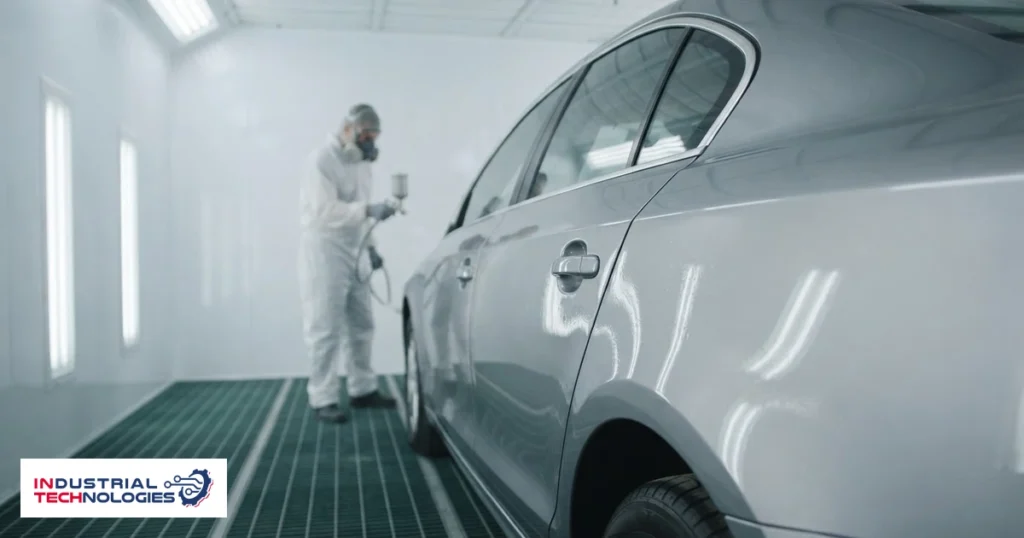
A defect nobody saw inside the booth is found in the sun, in front of the customer. That alone explains why lighting sits on a booth specification next to air volume and heat output rather than among the optional extras.
Yet paint booth lighting is still compared by eye more than by number. “Bright enough” is said of two chambers whose real performance is far apart.
The figure to compare
INTECH X300, X360 and X500 publish the same level: 800 lux and above. That is the number for comparison — not the count of lamps and not their wattage.
Lux measures light arriving at the surface; watts measure what a fitting draws. Two fittings of equal power with different distribution produce different readings on the bodywork, and the bodywork is the only place the reading matters.
Lighting is therefore read from three values together: the lux level, the number and layout of the units, and the angle at which they are fixed.
Layout and angle
INTECH X300 and INTECH X360 publish 32+12 LED lamps at 18 W each. INTECH X500 and above keep the same 32+12 layout at 20 W per lamp, and every model sets the lamps at 45 degrees.
The angle is the real addition. Light falling straight onto a panel shows its colour; light arriving at an angle shows its shape. Surface defects — a wave, a low spot, sanding marks — show through reflected angled light, not through a greater quantity of vertical light.
That is why adding lamps does not do the job of angling them. A chamber can read well on a meter and still let a wave through to the customer.
The prep station runs at the same level
High lighting is often treated as a booth matter only. Finding a defect before paint is far cheaper than finding it afterwards, when the whole coat has to be redone.
The INTECH PURE 200 prep station is published at 800 lux and above from 24 LED units at 16 W each — the same level as inside the booth.
Some sectors raise the requirement
The configuration table for the family names lighting as an item that changes by sector. Collision repair calls for higher lighting for colour-matching work. Education and training calls for a single-vehicle chamber with observation windows and higher lighting, because trainees need to see the process from several positions.
| Model | Published level | Lamps |
|---|---|---|
| INTECH X300 | 800 lux and above | 32+12 LED at 18 W each, set at 45 degrees |
| INTECH X360 | 800 lux and above | 32+12 LED at 18 W each, set at 45 degrees |
| INTECH X500 and above | 800 lux and above | 32+12 LED at 20 W each, set at 45 degrees |
| INTECH PURE 200 prep station | 800 lux and above | 24 LED at 16 W each |
Frequently asked
Can lighting be increased after installation?
Possibly, with two checks: the electrical load available, and the mounting position inside a sealed chamber with a defined air path. That is why the lighting level is fixed with the configuration before manufacture rather than corrected later.
Why publish wattage if lux is what counts?
Because wattage enters the workshop’s electrical schedule. On INTECH X500, 44 lamps at 20 W each are a load added to the fans and the burner, and it belongs in the calculation handed to the electrical contractor.
What does the 45-degree angle do?
It makes light strike a curved panel obliquely, so the reflection exaggerates waves and dips. Vertical light shows colour clearly but hides shape, which is how a defect escapes the booth and appears outside.
Does lighting belong in routine maintenance?
Yes. Dust on the lamp covers lowers the level without anyone noticing, so the reading at the work surface is worth checking seasonally against the 800 lux the booth was delivered with.
Related reading
Practical next step
Ask for the lux level in writing, together with the lamp layout and angle; two offers that say only “LED lighting” cannot be compared. Request a Quote. The published figures sit on the INTECH X500 paint booth page.