
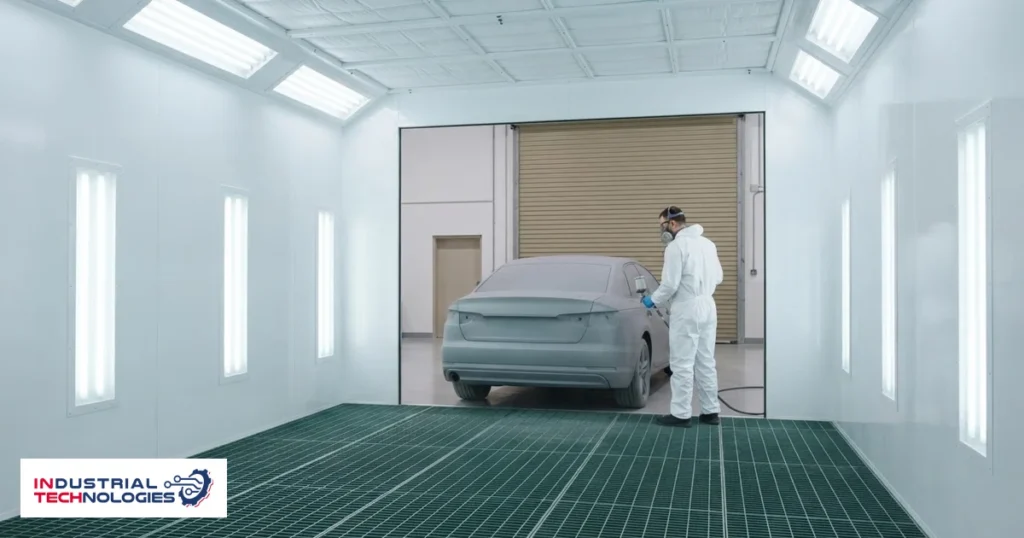
Moving a workshop from solvent-based to waterborne paint looks like a change of product on the mixing shelf. For the booth it is a change of physics. Water leaves a fresh film more slowly than solvent does and does not respond to heat in the same way, so a chamber tuned for solvent work gives a waterborne coat a longer flash and a surface that stays unsettled for longer.
Nothing is wrong with the paint in that case. The booth was configured for a different material, and a paint booth for waterborne paint is configured around how water actually leaves the surface.
Air movement comes before temperature
With solvent coatings, heat does most of the work. With waterborne coatings, moving air over the surface matters more: the thin layer of air right above a wet film fills with moisture, and evaporation slows until that layer is carried away.
That is why the configuration delivered for waterborne work in this family adds two overhead extraction fans to the normal air path. The point is not more air in total. It is air moving where it changes the result — across the painted surface.
Heat aimed at the surface, not the whole chamber
Five heating systems are delivered in this family: Italian Riello and Baltur diesel burners, gas, electric heating, heat pump and short-wave infrared. The waterborne configuration is built on the last of these.
A burner heats the chamber air, and the heat then travels to the part. Short-wave infrared reaches the coated surface directly, so the energy goes into the layer that has to dry instead of into a large volume of air. As delivered, the configuration uses ten infrared units at a combined 30 kW, with a heat-up time of 15–20 minutes. The heating system itself is covered in more depth under short wave infrared curing.
The electrical load moves with it
The standard models run on 380 V three-phase: 11 kW on INTECH X300 and X360, and 17 kW on INTECH X500. The infrared configuration adds 30 kW on top of what the fans draw — more than any standard booth in the range draws on its own.
That figure has to reach the electrical contractor before the supply is designed, not after the booth arrives. A contractor sizes the panel to the load on the drawing and will not guess at a configuration nobody mentioned. Across the family, electrical power runs from 11 to 50 kW and heat output from 200,000 to 600,000 kcal/h, depending on size and configuration. The wider method is set out in workshop electrical load planning.
Moisture in the air is part of the equation
Because a waterborne film dries by losing water, air that already carries a lot of moisture slows it down, and the control panel will not say so: temperature and time read correctly while the film lags behind.
Holding humidity alongside temperature is delivered on custom booths whose coating calls for a controlled environment. The range is set per project from the finishing material and the part, not given as a general figure.
The step before the booth carries more weight
A waterborne topcoat is less forgiving of what sits beneath it, because the film shows it. That raises the weight of the step before the booth rather than reducing it.
The published prep station in this family, INTECH PURE 200, runs 15,000 m³/h of air on a 4 kW turbine fan at 800 Pa, with a pre-filter, a full ceiling plenum with a high-efficiency filter and 24 LED units giving 800 lux and above — because a defect is cheaper to find before the coat than after it.
Start from the share of waterborne work
Before any configuration, fix what share of the work will actually be waterborne. If it is a small part of the total, separating the two in the schedule can cost less than a full configuration. If it is most of the work, the configuration is designed with the chamber from the start.
Chamber size does not change for waterborne work. It follows the largest part or vehicle to be coated, as in any booth, and the INTECH models are built on the standard automotive size with a 6900×4000×2650 mm internal chamber. What changes is the heating system and the extraction path.
| Item | Published | What it means on site |
|---|---|---|
| Extraction | Two overhead extraction fans | Air moved across the painted surface, not more air in total |
| Heating | Short-wave infrared — ten units at a combined 30 kW | The surface is heated, not the whole chamber |
| Heat-up time | 15–20 minutes | A heat-up figure, not a full drying time |
| Electrical supply | 380 V three-phase · 11 kW on INTECH X300 and X360 · 17 kW on INTECH X500 | The configuration adds 30 kW on top of fan load |
| Chamber size | 6900×4000×2650 mm on the standard models | Unchanged — it follows the largest part or vehicle |
| Preparation | INTECH PURE 200 — 15,000 m³/h · 800 Pa · 800 lux | Still a condition, and a heavier one |
Frequently asked
Can an existing booth be converted for waterborne work?
Often not as a simple add-on. The published configuration is built to order, which means it is designed with the chamber rather than necessarily fitted to it later. Whether it can be added to a booth already installed depends on the air path inside the chamber and on the electrical capacity at the site, and it is assessed after a site visit.
Why is a heat-up time given rather than a full drying time?
Heat-up time is a property of the equipment and can be measured: 15–20 minutes on the delivered configuration. Full drying time follows the paint, the film thickness and the conditions of the day, so it belongs to the material rather than to the booth.
Is the waterborne configuration a stock model?
No. It is built to order for each project, and the figures above describe the configuration as delivered rather than a catalogue model.
Is a price list published?
No. The price follows the chamber size, the heating system, the configuration and the delivery period, and it is given in a quotation.
Related reading
Practical next step
Send the share of your work that will be waterborne, the electrical supply available at the site and the dimensions of the largest part or vehicle to be coated. Request a Quote. The published range sits on the paint booth family page.