
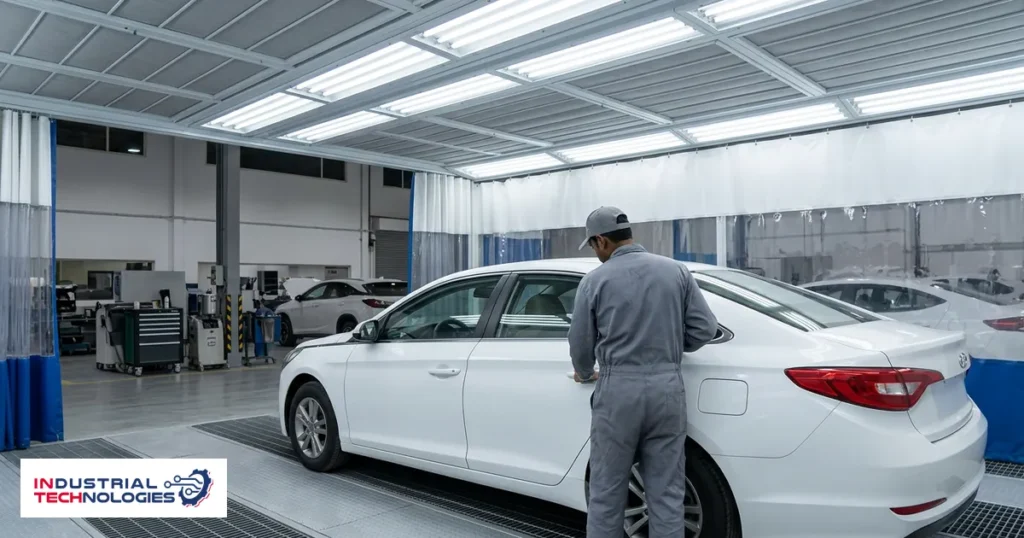
Lighting is the cheapest item in fitting out a workshop and one of the most consequential for the quality of what leaves it. It is also the first line cut from a budget and the last one blamed when defects appear.
Getting workshop lighting levels right starts not from the number of fittings or their wattage but from one figure: how many lux actually reach the working surface.
Watts are not light
Fittings are commonly bought by wattage, and wattage measures consumption, not light. Two fittings of the same power can deliver quite different illumination at the work surface depending on efficiency, beam spread and mounting height.
The unit that matters is the lux: the amount of light arriving at the surface. For precision areas — painting, preparation and inspection — the working threshold is 800 lux and above. It is measured with a simple, inexpensive meter, and the point of owning one is to know the current state of the building before buying anything.
Distribution matters as much as the total
Two strong sources can produce the same reading as two dozen distributed fittings, with a completely different practical result. A concentrated source casts shadows, shadows are where defects hide, and a technician standing between the source and the panel blocks it with their own body.
The published prep station specification shows the alternative: 800 lux and above from 24 LED units at 16 W each. More fittings at lower power do better than fewer at higher power, for the same total lux.
Zones do not need the same level
| Zone | Nature of work | Priority |
|---|---|---|
| Paint booth | Seeing surface defects | Highest — 800 lux and above, evenly spread |
| Prep station | Finding scratches before paint | Equally high — a defect here becomes permanent |
| Service bay | Mechanical work | High, with local lighting under the vehicle |
| Storage | Movement and handling | Moderate — safe circulation lighting |
Uniform lighting across the whole building wastes energy, and leaving a service bay on warehouse lighting is the opposite mistake: a technician who cannot see under the vehicle works by touch.
Dust changes the equation
A clean fitting and a dusty one of the same power give two different readings. The layer on the cover absorbs light gradually, and because the decline is slow the eye adapts to it day by day. It then surfaces as defects attributed to the technician or to the material.
The fix is simple and rarely applied: add cover cleaning to the preventive maintenance schedule and re-measure lux seasonally. Five minutes protects the quality of the output.
Frequently asked
How many fittings does a workshop need?
No general figure can honestly be published. The count follows zone area, ceiling height, wall reflectance and the work itself. The correct method runs backwards: set the lux required per zone, measure what is there now, and design to close the gap.
Is LED worth the price difference?
In a long-hours, hot operating environment, yes, for two reasons: lower consumption per lux, and less heat released into a space that is already working to stay cool.
Is booth lighting bought separately?
No. It is part of the booth design, with fitting positions and covers designed for the interior environment, and it is specified with the booth rather than added later.
What is the quickest improvement available today?
Measure lux at the work surface in the most demanding zone, clean the covers, and measure again. In many workshops that alone recovers a meaningful share of the lost light before a single fitting is bought.
Related reading
Practical next step
Send your zones with their areas and clear heights, the work done in each, and a lux reading at the work surface if you have one. Contact an Expert. Lighting figures for prep stations are on the prep stations and mixing rooms page.