
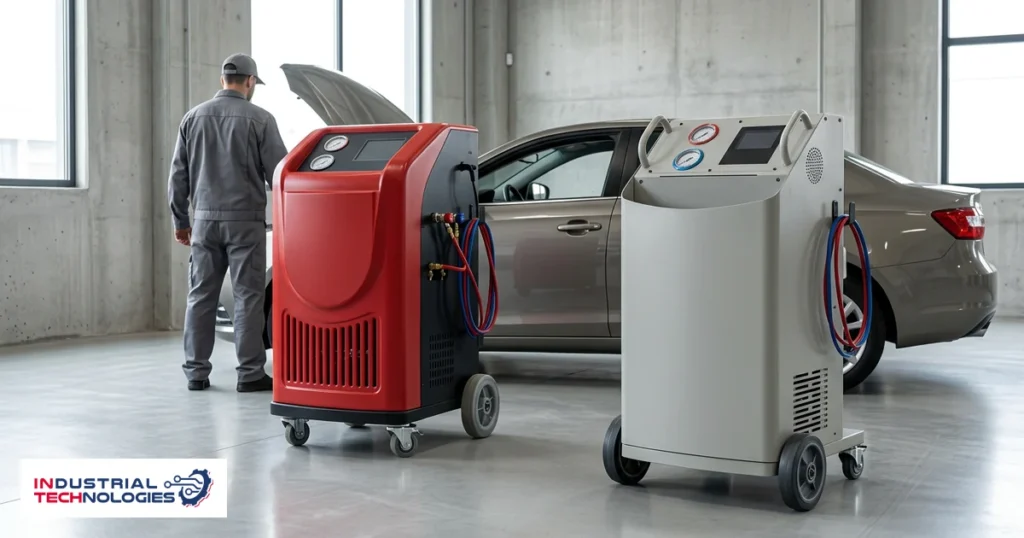
A workshop servicing recent models meets this question sooner or later. The choice between the two refrigerants is not a preference; the vehicles arriving at the bay make it.
Weighing R134a vs R1234yf becomes simpler once one point is clear: the gases are not interchangeable, and neither is the equipment that services them.
Why they cannot be mixed
The difference is more than a name. The two refrigerants differ in their properties and in the oil that goes with each, and mixing them in one circuit spoils the charge and leaves residue in the station that travels to the next vehicle.
Service couplings differ between the two systems by design — a mechanical barrier against the mistake rather than an instruction. The practical consequence: one station serves both only if it was built to, and that belongs in writing in the quotation.
What the published line does
The stations in the family split along exactly this line. The ACMAS301 supports R134a and R1234yf with UV leak-detection dye. The ACMAS302 supports R134a.
The configuration table reflects it: dealer workshops serving newer models take both refrigerants on the ACMAS301, while a car rental inspection line uses the hand-valve-free ACMAS302 for R134a.
Three routes for a workshop
| Route | Suits | Trade-off |
|---|---|---|
| A station for R134a only | A workshop serving mostly older models | Turns away a growing share of work as fleets renew |
| A station built for both gases | Dealers and workshops taking recent models | Must be stated in writing; on the published line, the ACMAS301 |
| Two separate stations | A general workshop serving both populations | More cost and floor space, and no risk of cross-contamination |
For a general workshop, the realistic alternative to the right equipment is not a station that somehow handles everything. It is turning away part of the work, or risking a mix that costs more than a second machine.
What does not change between the gases
The figures that decide the quality of any station stay the same whichever refrigerant flows through it. On the ACMAS301 they are published: a scale accurate to ±10 g on refrigerant and ±5 g on oil, 99% recovery, and a 120 L/min vacuum pump before a 2 kg/min recharge.
Recovery rate and scale accuracy gain weight as the price of the refrigerant rises. A workshop moving to the newer gas needs a more precise station, not a cheaper one.
Handling and storage
Each refrigerant has its own handling and storage requirements, taken from the material safety data sheet and from the competent authority — not from the practice of the workshop next door.
Write them down before the first cylinder arrives, and make sure every technician who touches the system knows them. It is a safety item, not a procedure.
Frequently asked
Can an R134a station be converted to the newer gas?
It cannot be assumed, and it is not decided by improvisation. Whether a conversion exists belongs to a specific model and its maker, and an unapproved modification voids the warranty and puts charge accuracy at risk.
How does a technician know which gas a vehicle uses?
From the system label under the bonnet, which is the authoritative source. Model year alone is not reliable, because the change between the two did not happen at once across all models and markets.
Does summer heat favour one of the two?
System performance follows the vehicle design more than the gas. What the workshop controls is where the station runs: a shaded, ventilated bay gives a quicker cycle and a calmer tank pressure with either refrigerant.
What supply do the stations need?
220 V or 110 V AC at 50/60 Hz, on the ACMAS301 and the ACMAS302 alike.
Related reading
Practical next step
Send the share of recent models in your air conditioning work, the number of AC jobs a month and who operates the station. Request a Quote. The models, with their figures, are on the AC service stations page.