
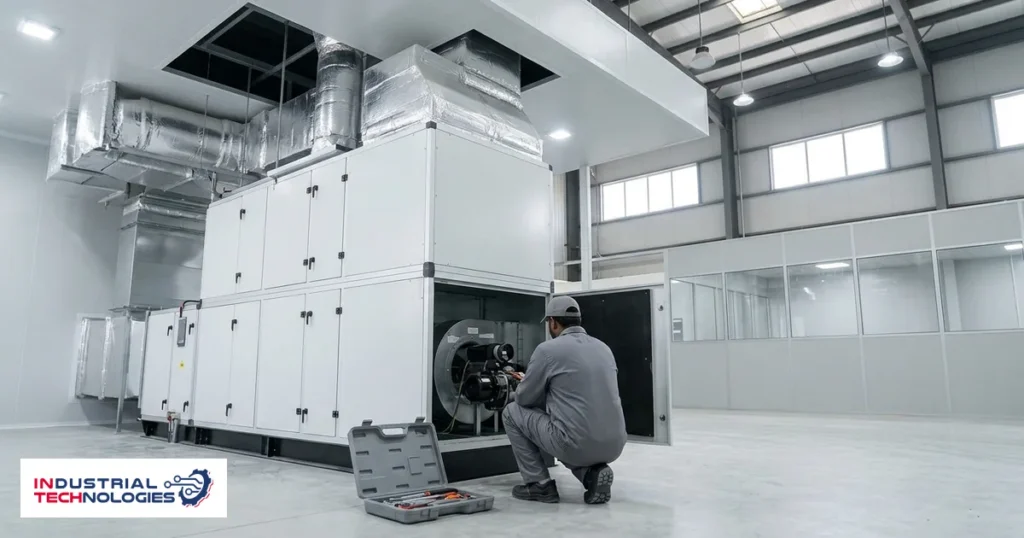
A workshop that deals with breakdowns one request at a time pays twice: once for the repair, and again for the hours spent waiting for the repair to start.
An annual equipment maintenance contract is more usefully read as an arrangement of time rather than a purchase of service. It decides what happens before a failure, not after it.
What actually goes into the contract
Routine maintenance after final handover is the operator’s responsibility. What is offered on top of that is an optional service that takes the work off your hands.
Its published scope is clearing air paths, replacing filtration, and checking electrical and pneumatic safety circuits, by running hours, under a renewable annual maintenance contract or on request. None of the three is arbitrary: each degrades gradually without warning and shows up in quality or safety before it shows up as a breakdown.
The contract opens a door a single request does not
Equipment that did not come through our supply is a different case: there is no record of it and no part that can be vouched for. The published position is that it is taken on under an annual service contract only, limited to large companies and dealerships.
The reasoning is contractual rather than technical. Servicing a machine with no supply record needs a framework that fixes scope and parts, not a one-off request. A facility that has assembled equipment from several sources over the years therefore has one route to consolidating its maintenance, and it is the contract.
What stays outside
Field service is based in Riyadh and covers cities across the Kingdom, with visit arrangements and cost set with the request according to location and the nature of the work. Anything that falls under the manufacturer’s responsibility is referred to the manufacturer, and the role there is follow-up rather than repair.
Spare parts are a separate track that follows the model: parts and filters for the equipment we supply are held in stock, and what is not in stock is supplied within days.
Building a contract that works
Start from an inventory of the equipment: models, supply dates and daily running hours. Those three turn the conversation from a number of visits into a programme based on condition.
Then rank the equipment by the effect of it stopping. What halts all production if it fails? What takes out a single bay? That ranking sets priority, and the published rule is the same: reports are ordered by what the stoppage costs, so a machine fully down comes before a planning enquiry.
| Item | Published position | Note |
|---|---|---|
| Preventive maintenance | Operator’s responsibility after final handover; the contract is an optional service that takes it on | Air paths, filtration, electrical and pneumatic safety circuits |
| Equipment outside our supply | Taken on under an annual contract only, limited to large companies and dealerships | Not accepted as a one-off request |
| Field coverage | Based in Riyadh, covering cities across the Kingdom | Visit arrangements and cost set with the request |
| Request priority | Ordered by what the stoppage costs | A machine fully down comes first |
| Spare parts and filters | In stock for supplied equipment; otherwise within days | A separate track by model |
Frequently asked
Does the contract include spare parts?
No. Parts are a separate track that follows the model: parts and filters for the equipment we supply are held in our warehouse, and what is not in stock is supplied within days.
How often is filtration replaced within the programme?
Filtration is a consumable replaced according to running hours and workload rather than on failure, typically twice a year within preventive maintenance.
How does a service request start?
With the equipment type, model, approximate supply date and a description of the fault. It arrives tagged as a service request in an inbox reviewed daily and does not enter the sales queue.
Does a contract change the warranty?
No. The warranty is the manufacturer’s, on the term and conditions in its documents, and consumables such as filters, belts and lamps are excluded. Keeping a maintenance record protects it, because neglect is one of the published exclusions.
Related reading
- Equipment warranty terms
- Spare parts availability
- Fleet maintenance scheduling
- Preventive maintenance programme
Practical next step
Send your equipment inventory with models, daily running hours, the facility location, and what stopped in the last year. Request a Quote. The service scope is set out on the maintenance and warranty page.