
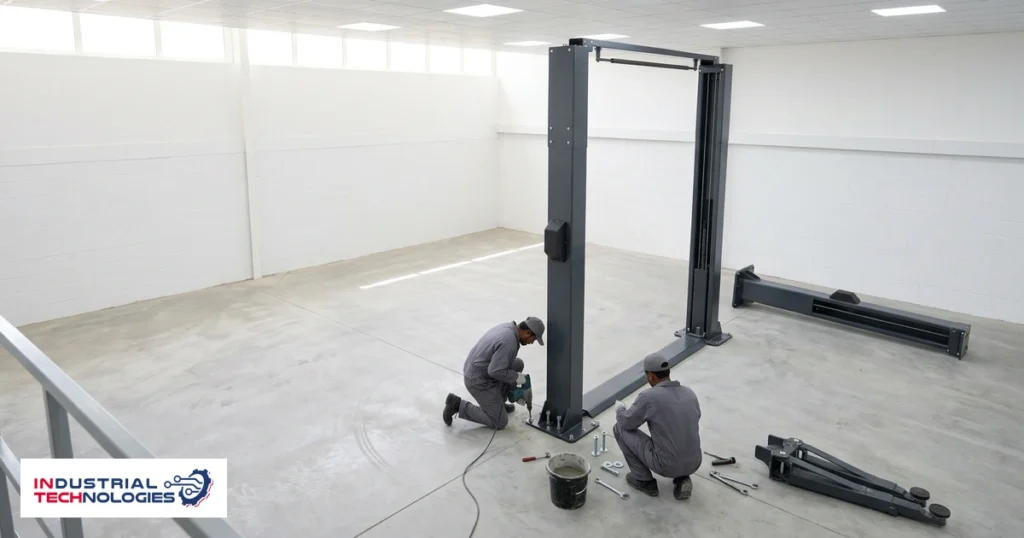
The floor stops more equipment installations than any other item, and it is the one item no equipment quotation mentions. The lift is bought, the team arrives, and the slab turns out to be unsuitable, which turns a day of work into weeks of waiting.
Workshop floor slab requirements are not a purely structural subject. They are an operating decision that sets what can be installed and what cannot.
Workshop slab or warehouse slab
A slab poured for a warehouse is designed for distributed load: racking and stock that spread their weight across a wide area. A two-post lift does the opposite. It gathers the whole vehicle load into two base plates, and concrete that carries a great deal of spread weight can fail under a much smaller concentrated one.
So the first question before any equipment recommendation is whether the floor was poured for a workshop or the building is being reused. The answer changes the whole shortlist.
Three criteria, not one
The subject is usually reduced to how thick the concrete is. Thickness is one of three criteria, and not always the critical one:
- Thickness — resistance to punching under a concentrated load
- Compressive strength — the quality of the mix itself, which extra thickness does not replace
- Flatness — the most neglected, and it stops an installation even when the first two are met
Flatness is the one that surprises people. A two-post lift anchored on an uneven floor runs with posts that are not parallel, so synchronisation becomes a permanent problem rather than an occasional fault. A floor laid to a deliberate drainage fall may need local levelling at the anchor points.
What changes with the equipment
| Equipment | Nature of load | Critical item |
|---|---|---|
| Two-post lift | Concentrated in two base plates | Thickness, strength and flatness together |
| Surface-mounted scissor lift | Spread across the platform | Mainly flatness; no excavation, 125 mm minimum surface mount |
| Paint booth | Spread around the cabin perimeter | Flatness, so the seals close |
| Prep station without a basement pit | Light and spread | The least demanding; installs on the existing floor |
| Chassis puller | Horizontal pull and reaction | Strength of the anchor points |
The practical difference: a prep station without a pit and a surface-mounted scissor lift both go onto the existing floor, while a two-post lift may require treatment. In a leased building that alone can reorder the priorities.
Drainage, chemicals and the order of work
A workshop floor takes oil, solvents and wash water. Bare concrete absorbs them and becomes a dark, slippery surface over time, and slippery ground around a lift is a safety issue rather than a cosmetic one.
A resistant floor coating is paid for once and saves repeatedly. The sequence matters: it goes down after the equipment is anchored, not before, or drilling and anchoring will damage it.
Frequently asked
How is slab thickness established?
A core sample gives thickness and strength together, and it is a short, relatively inexpensive operation. Building drawings are a weaker substitute where they exist. Judging by eye is not a basis for an anchoring decision.
Can an existing slab be strengthened?
In many cases, by casting local footings at the anchor points rather than re-pouring the whole slab. That is cheaper and faster, but whether it is feasible is decided after the condition of the current slab is known.
What works in a leased unit where the floor cannot be modified?
Start from surface-mounted equipment: scissor lifts with the lowest surface mount and prep stations without a pit. They cover much of the work without touching the floor, and they move with the business if it relocates.
When should the floor be measured?
Before purchase. Measuring after delivery turns a negative result into equipment waiting in storage, and preparing the site — floors included — is the customer’s responsibility under the published terms, so delays from an unready site fall to the customer.
Related reading
- Lift installation requirements
- Workshop electrical load planning
- The heights to measure before signing a lease
Practical next step
Send the slab thickness, its strength if known, its flatness at the proposed anchor positions, and the equipment list you are planning. Contact an Expert. Published models sit under vehicle lifts and lifting equipment.