
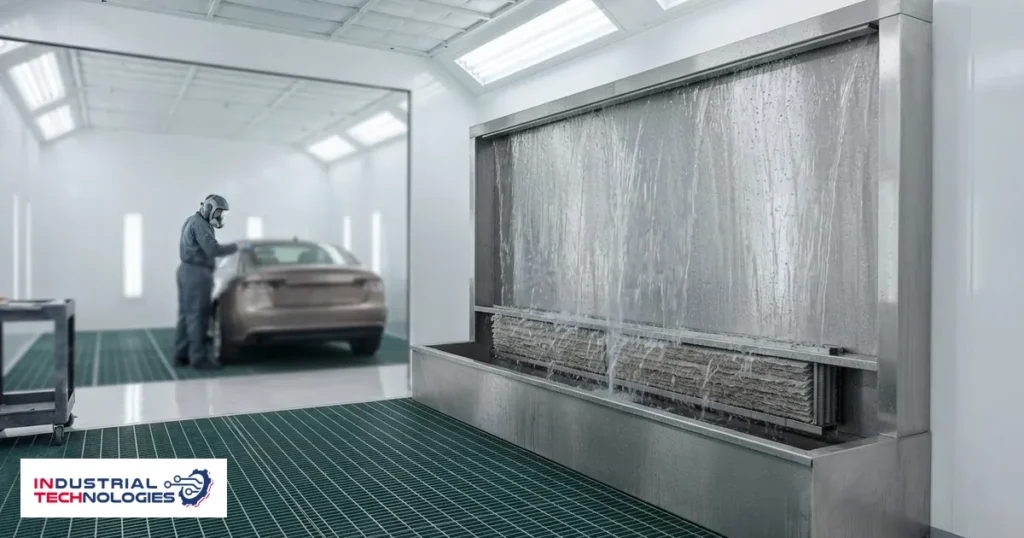
A request for a water curtain is often a different request in disguise: a way to stop changing exhaust filters that clog with overspray. The answer starts with pinning down exactly what a curtain replaces.
A water curtain paint booth captures airborne overspray in a moving sheet of water on the exhaust wall instead of holding it in a dry fibre filter. The published INTECH models run dry glass-fibre filtration; a water curtain is a configuration designed and supplied per project on custom booths.
What the curtain replaces and what it leaves alone
Air entering the chamber passes stop, pre- and ceiling filtration before it reaches the surface, and none of those stages involves the curtain. The curtain works at the other end, on outgoing air loaded with overspray. It replaces the overspray capture stage alone, and the class of intake filtration is still set with the configuration, as it is for any booth.
Overspray does not disappear, it moves
With dry filtration the overspray ends up inside the filter and leaves the workshop with the spent filter. With a water curtain it ends up in the water, becoming sludge collected from the tank, while the water itself is treated, recirculated and topped up for what evaporates. The consumable has not gone; it has changed from a filter you store to water and sludge you manage.
Sludge disposal is subject to the requirements of the competent authority at your site, and those are established before the curtain is chosen, not after the first tank clean-out.
What changes at the exhaust stage
| Item | Dry filtration | Water curtain |
|---|---|---|
| Where overspray ends | Inside the fibre filter | In tank water, then in sludge |
| Consumable | Filters replaced and stored | Top-up water, collected sludge and water treatment |
| Site needs | Storage space for filters | Water supply, drainage and a sludge collection point |
| Routine checks | Filter change when the pressure gauge shows loading | Tank cleaning, pump checks and water level |
| Intake filtration | Stop, pre and ceiling at EU3, EU4 and EU5 | The same classes, unchanged |
When each option fits
Spray volume is the first input. A workshop spraying intermittent batches changes filters at long intervals and gains little from a curtain that needs water and a running pump. A line spraying heavily without pause loads dry filters quickly, and there the cost of changing and storing them becomes the item worth comparing.
The second input is the site: water supply, drainage and a sludge collection point, all fixed during the site survey before the configuration is signed off.
Frequently asked
Does a water curtain remove the need for filters?
No. The curtain captures overspray in exhaust air only, and intake filtration stays because it protects the surface rather than the fan. A water curtain booth still needs stop, pre and ceiling filters and their replacement.
Is a water curtain available on INTECH models?
The published models run dry glass-fibre filtration, as their pages state. A water curtain is supplied and configured on custom booths per project, and signed off within the configuration before manufacture.
Does a water curtain need a special water supply?
It needs a steady supply to replace evaporation, plus drainage and treatment for the recirculated water. Treatment detail follows the coating material and the overspray volume, and it is set with the configuration rather than by a general rule.
Which option protects the fan and exhaust duct?
Both do the same job of holding overspray back before it reaches the fan and duct. The difference is in how that is monitored rather than in the purpose: the pressure gauge reads dry filter loading, while water level and tank condition are read on a curtain.
Related reading
Practical next step
Send your finishing material, your approximate daily spray volume and the water and drainage available on site, and we return the right option for the exhaust stage within the rest of the configuration. Contact an expert. The published range sits on the paint booths family page, and the sector configuration on the industrial and manufacturing sector page.