
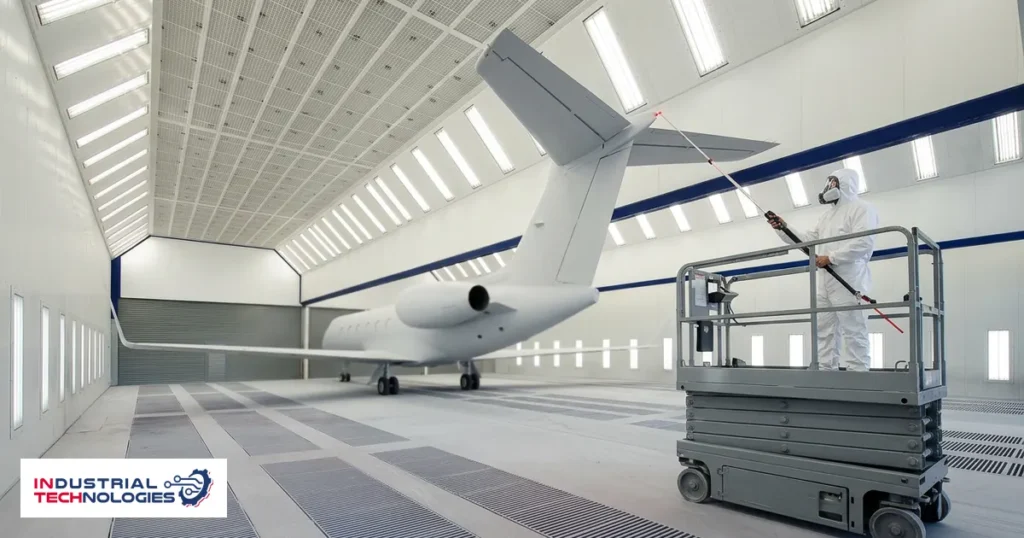
A business jet is the largest complete airframe that still sits inside the executed range published for this family. Anything larger leaves the range; anything smaller enters it comfortably. That is why the decision narrows to exactly one limit.
The aerospace sector page states that the chamber is designed around the airframe, and that the published execution range extends in length, width and height. A business jet paint booth is therefore calculated from height first, because length and span sit comfortably inside the range while height is the dimension nearest its ceiling.
Height is the binding limit
Aircraft length and wingspan fall in the middle of the executed range, so they rarely constrain anything. Tail height is the dimension that reaches or approaches the top of the published range, and above it you still need clearance for access, lighting and extraction. A chamber calculated on length alone comes out correct in two dimensions and short in the third.
The limits measured before design
| Item | Executed range and its role |
|---|---|
| Internal height | 2,650–6,000 mm — usually the binding limit, because tail height approaches it |
| Internal length | 3,000–24,000 mm — accommodates the complete airframe with working clearance |
| Internal width | 3,000–20,000 mm — measured on wingspan, not on the fuselage |
| Air capacity | Up to 190,000 m³/h, built on the volume of a large chamber rather than on floor area |
| Heat output | Up to 600,000 kcal/h, following chamber volume and the coating curve |
| Preparation | A separate prep room with its own extraction requirements precedes the coating chamber |
Why a ready model is not adapted
The sector page states that any attempt to adapt a ready-made model ends with a chamber the piece will not enter or one whose ventilation does not suffice. The reason is that ready models are built on the standard automotive chamber size, which has no relationship to a complete airframe. The chamber here is a design project, not a purchase line item.
Frequently asked
Which dimension actually governs the chamber?
Height, in most cases. Length and span sit inside the executed range with room to spare, while tail height approaches the top of the published range and still needs clearance above it for access and extraction. So the tail is measured first and the rest is built around it.
Is a complete airframe coated in one chamber?
Yes, where the executed range accommodates all three dimensions with working clearance. If one dimension exceeds the range, the options are staging the work or a different design — and that is determined from your airframe rather than by a general rule.
Does preparation happen in the same chamber?
No. The sector page separates preparation from coating with an independent prep room carrying its own extraction requirements, because combining both stages in one space causes one of them to be executed incompletely.
What gets documented for acceptance in this sector?
These sectors judge equipment by its ability to repeat the same result and document it, not by its peak specification. In practice that means fixing the configuration and documenting what the chamber produces repeatably, which is agreed before manufacture.
Related reading
- An aircraft paint booth as a design project
- The aviation component prep room
- Repeatable coating documentation
Practical next step
Send aircraft length, wingspan, tail height and the intended loading method, and we return a chamber design built on your airframe. Contact an expert. The published range sits on the paint booths family page, and the sector configuration on the aerospace, marine and rail sector page.