
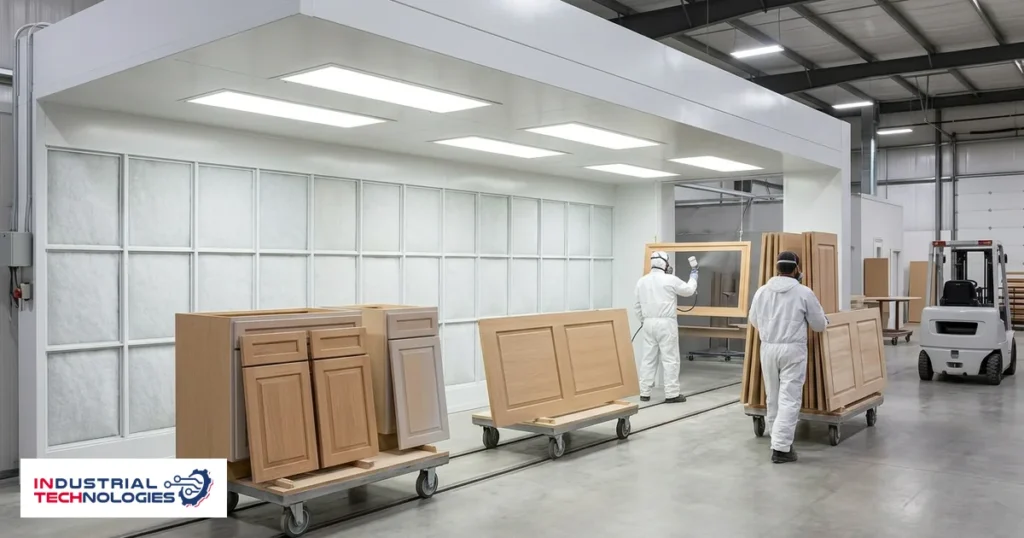
A door factory runs one shape almost all day: a flat leaf with two matching faces. That looks like the easiest case a finishing chamber can be given, and it is the case that quietly inverts the throughput calculation.
The woodworking sector page names the door first among the pieces that pass down one line at completely different sizes, and it states that the chamber is built on the largest piece and on how that piece is hung or laid. A wooden door coating oven parts company with the rest of the furniture line on that last clause: a door is coated on two faces, so handling governs its cycle, not its size.
Two faces, one cycle or two
A leaf hung vertically presents both faces to the air stream in a single pass. A leaf laid flat presents one face, so it needs a flip and a wait until the first face is dry enough to turn. The difference is not chamber size. It is a doubling of cycle time per unit, and it shows up in month-end output rather than on a specification sheet.
What the configuration changes
| Item | What changes on a door line |
|---|---|
| Loading method | Set by how the piece is hung or laid — the input that separates one cycle from two |
| Internal length | Built on the largest leaf plus handling clearance, inside the executed range 3,000–24,000 mm |
| Internal width | Follows leaf width and fixing method, inside 3,000–20,000 mm |
| Air capacity | Calculated on chamber volume and finishing material together, inside 18,000–190,000 m³/h |
| Prep location | Physically separated in a prep and mixing room with its own extraction, so sanding dust does not return to a prepared face |
Why chamber size does not settle this
Chamber size is derived from the largest piece, and that is a separate and already-settled item. A door line can run in a chamber of exactly the right size and still produce half of what it could, because the leaves wait in front of it rather than inside it. So the question to answer before specifying the chamber is how many doors per shift you intend to finish.
Frequently asked
Are both faces coated in one cycle?
It follows the loading method. Vertical hanging presents both faces in a single pass; laying flat forces a flip and a second cycle. That method is fixed during the site survey together with your largest leaf dimensions, because it governs cycle time rather than size.
Will a furniture chamber serve a door line?
It is the same family and it is built to order, but the governing input differs. Furniture is calculated on the largest piece; doors are calculated on the largest piece and the number of faces per shift together. One chamber serves both cases when it is designed around the correct handling from the start.
What internal size does a door line need?
It is built on the largest leaf plus handling clearance and fixing method, and it falls inside the executed range published for this family. No general figure is given before the largest size in your line and its loading method are known.
How do I tell that my line loses time in handling rather than coating?
The operating indicator is leaves accumulating in front of a chamber that is running, rather than coating being redone. A queue in front of a working chamber means the cycle is longer than line takt, and that the length sits in loading and flipping rather than in spraying.
Related reading
- Furniture booth sizing and where it starts
- Ordering the stations on a furniture line
- Air capacity for wood coating
Practical next step
Send the largest leaf size in your line, its fixing method and your target doors per shift, and we return a chamber design built on your line. Contact an expert. The published range sits on the paint booths family page, and the sector configuration on the woodworking and furniture sector page.