
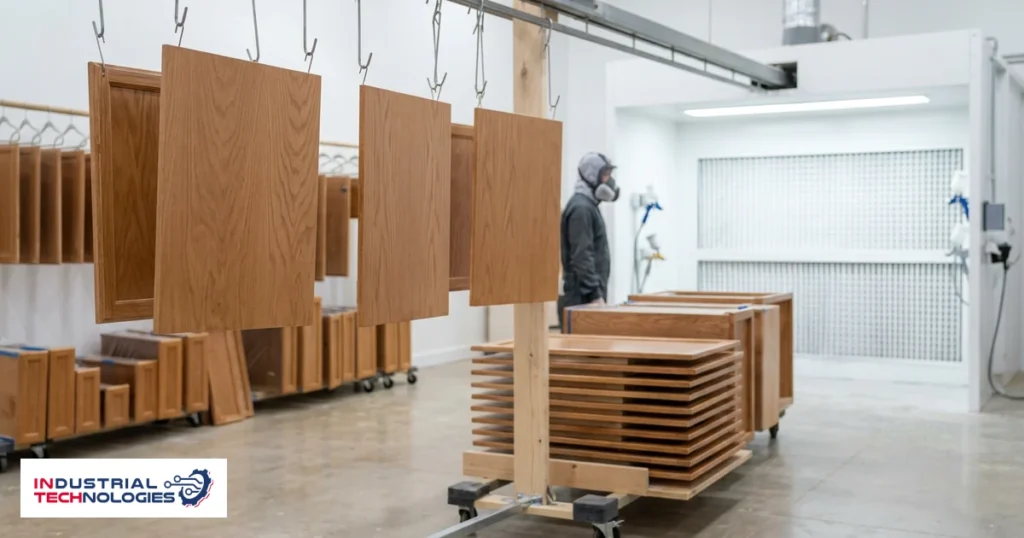
A kitchen front is a large flat surface on a thin section, seen close up and under direct light. Any dust that lands on it is visible, and any variation in the coat is felt by hand.
The line is not built for it alone, though. Kitchen front finishing happens on the same line that carries the door, the panel and the table — the sector page names all four together, at completely different sizes, within a single day.
What the variety imposes on the chamber
| Item | What follows from it |
|---|---|
| Internal size | Built around the largest piece on the line, not around the kitchen front alone |
| Loading method | Differs between a flat part that is laid and one that is hung, and is set with the size |
| Air path | Designed around the hardest part rather than the usual one |
| Prep | Physically separated, because a wide flat surface shows dust more than any other shape |
Why not build one line per product type
The four types share the material, the drying cycle and the same dust load, and differ in size and loading. Size is handled by building the chamber around the largest; loading is handled by an arrangement inside the same configuration. One line built at the upper limit serves all four, while four lines separate what does not need separating.
Frequently asked questions
Do flat fronts need a dedicated configuration?
They need attention in how they are laid or hung inside the chamber more than a separate configuration, because a wide surface is more sensitive to air direction than a shaped part. That is settled with extraction direction before manufacture.
Are both faces sprayed in one pass?
That follows the loading method adopted in your configuration: a hung part allows what a laid part does not. Which is why loading method is stated with the size rather than after it.
What does this do to air capacity?
Air capacity is calculated from chamber volume and finishing material together, and volume is derived from the largest part. Variety therefore shows up in the volume rather than in a separate equation.
Does it differ if the fronts are foil-wrapped?
A wrap changes the finishing material in use, and the finishing material is what filtration class and drying curve are built on. So state the type explicitly, to be built on rather than assumed.
Related reading
Next step
Send the largest part on your line, how it is loaded and the finishing material you use, and a chamber design comes back built around your line. Talk to a specialist. The published range sits on the paint booths family page, and the sector configuration on the Woodworking & Furniture sector page.