
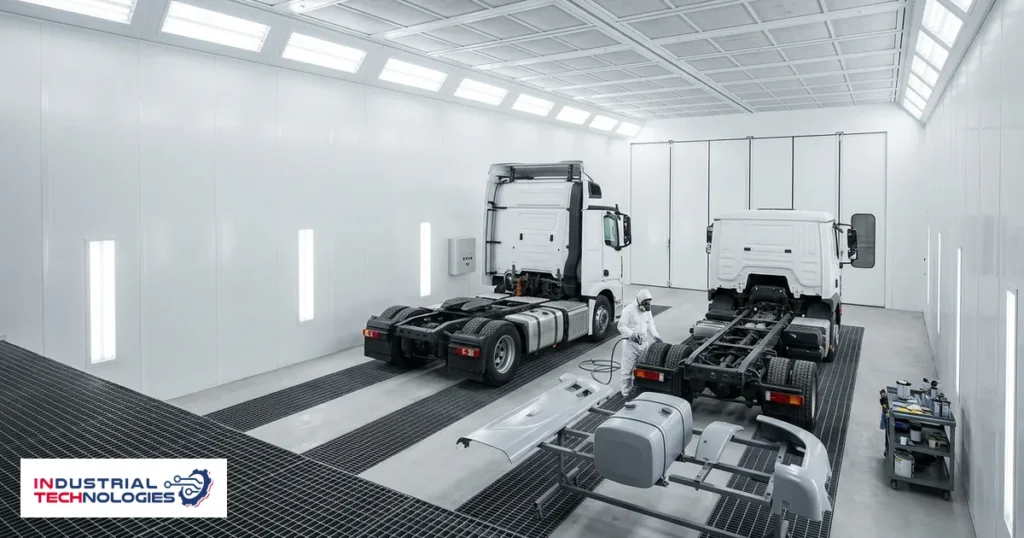
Before anyone asks how big the chamber should be, there is an earlier question: is the part coated while it is on the vehicle, or taken off and coated alone? The answer changes the whole chamber, not one line in it.
So vehicle attachment coating starts from an operating decision rather than from a number. The rule published in this family points the way: size follows the manufactured part, not the vehicle.
What changes between the two cases
| Item | Fitted to the vehicle | Removed |
|---|---|---|
| Governing size | Vehicle length and height once fitted | Part dimensions plus operator clearance |
| Chamber required | Within 3,000 – 24,000 mm long | From 3000×3000×3000 mm in delivered builds |
| Support | The vehicle carries the part | A cradle or hanging point inside the chamber |
| Faces needed | Usually the outside only | Both faces in the same cycle |
| Where time goes | A longer cycle over a larger volume | A removal and refit step outside the chamber |
A removed part needs what a vehicle does not
A vehicle stands on its wheels. A removed part does not — it needs a cradle that lifts it to working height, or a hanging point that carries its weight, and both belong to the chamber configuration rather than to the workshop’s general equipment. What is published in this family is provision for hanging or conveying parts inside the cabin, which is exactly this case.
A third item follows from that: a hanging part occupies volume in the air path rather than area on the floor, so extraction direction is reviewed to pass around it instead of beneath it.
The heat curve may not be the vehicle’s
Attachments are often coated in an industrial paint rather than a vehicle refinish, because they carry loads, abrasion or materials that a body panel never meets. The heat curve is set to the coating in use, and five heating systems are delivered in this family: diesel, gas, electric heating, heat pump, and short-wave infrared.
Frequently asked questions
Which is cheaper: one large chamber or a small dedicated one?
It depends on how often each case runs. A large chamber serves both but consumes airflow and heat on its own volume every cycle, even for a small part. A small chamber is cheaper to run and forces a removal step. Send the monthly count for each case, because the answer is arithmetic rather than preference.
What is the smallest delivered size suitable for a removed part?
The published internal range for the family starts at 3000 mm long and wide and 2650 mm high, and delivered industrial builds start at a 3000×3000×3000 mm cabin.
Is a separate compressed-air supply needed?
The published site requirements include compressed-air runs feeding the booth alongside the concrete floor, the electrical supply and the duct runs. These are fixed during the site survey before manufacture.
What electrical supply is required?
380 V three-phase across all documented models, with power from 11 to 50 kW depending on size and configuration.
Related reading
What to do next
Send the dimensions of the largest attachment you handle, whether it is removed or stays fitted, and how many times a month, and we will come back with a chamber size and support arrangement built on your work. Talk to a specialist. The published range sits on the paint booth family page.