
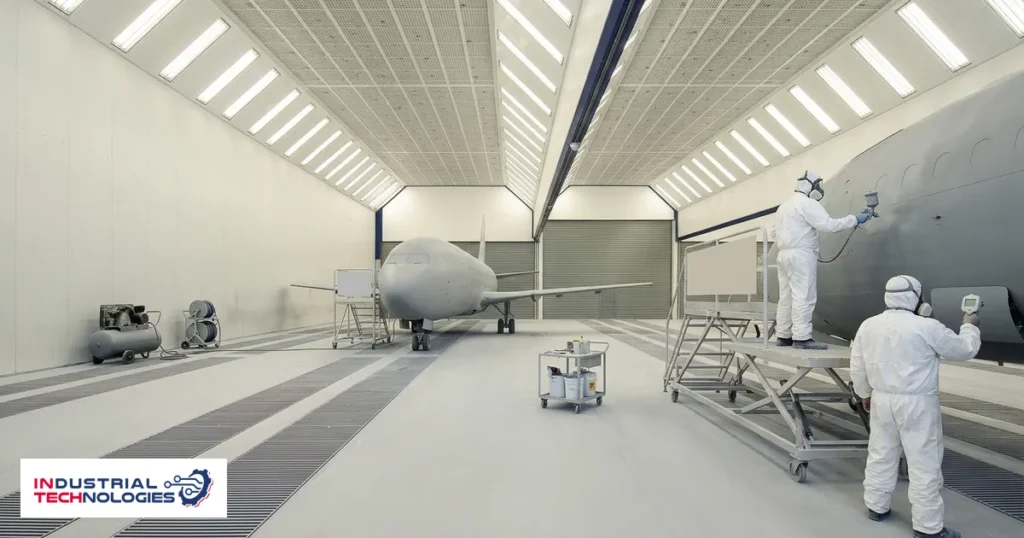
A finishing enclosure for an airframe is not a larger version of a spray booth. Past a certain size the design logic inverts: instead of fitting the part to a model, the enclosure is drawn around the part.
That inversion is what separates an airframe finishing hangar from a workshop booth. The structure dimensions and how it enters are the first inputs, and everything downstream follows from them.
Where the automotive envelope stops
INTECH models run a 6900×4000×2650 mm internal cabin, which is the vehicle size. An airframe exceeds the length, width and height of any stock model many times over, so no model selection resolves it.
The published build range for this class runs from 16,000 mm up to 24,000×20,000×6,000 mm.
| Item | Delivered range | What sets it |
|---|---|---|
| Internal length | 16,000 – 24,000 mm | Structure length plus working space |
| Internal width | up to 20,000 mm | Wingspan or hull beam |
| Internal height | 2650 – 6000 mm | Stand height plus overhead access |
| Air capacity | up to 190,000 + 190,000 m³/h | Chamber volume, not part surface |
Three inputs fix the internal size
The dimensions of the structure, the technician working space around it, and the method of entry. A site survey establishes all three before any figure is quoted, and the configuration is signed off before manufacture.
Nothing in that sequence is optional. Extraction direction, heating system, filtration stages and doors are all decided at sign-off, because changing them afterwards means altering the structure rather than adding a component.
What comes with the scale
Chambers in this class are delivered with up to three-stage bag and high-efficiency filtration at 98% or better, a powered door up to 14,200×5,000 mm, plus gas monitoring and static discharge. Those last two do not appear in the automotive specification at all.
Frequently asked questions
Does one enclosure cover the whole process?
It depends on how the stages are split. Preparation, stripping and inspection have different extraction requirements from spraying, and combining them in one enclosure compromises one of the stages.
What heating systems are delivered at this size?
Five across the family: diesel burners, gas, electric heating, heat pump, and short-wave infrared. The choice follows the coating type and the cost of energy on site.
What electrical supply does a chamber this size need?
380 V three-phase at 50 or 60 Hz across all documented models, with power from 11 to 50 kW depending on size and configuration.
Read also
Next step
Send the structure dimensions, the stand you use and how the part is brought in, and we will come back with an enclosure concept built around it. Talk to a specialist. The published range sits on the aerospace, marine and rail industry page.