
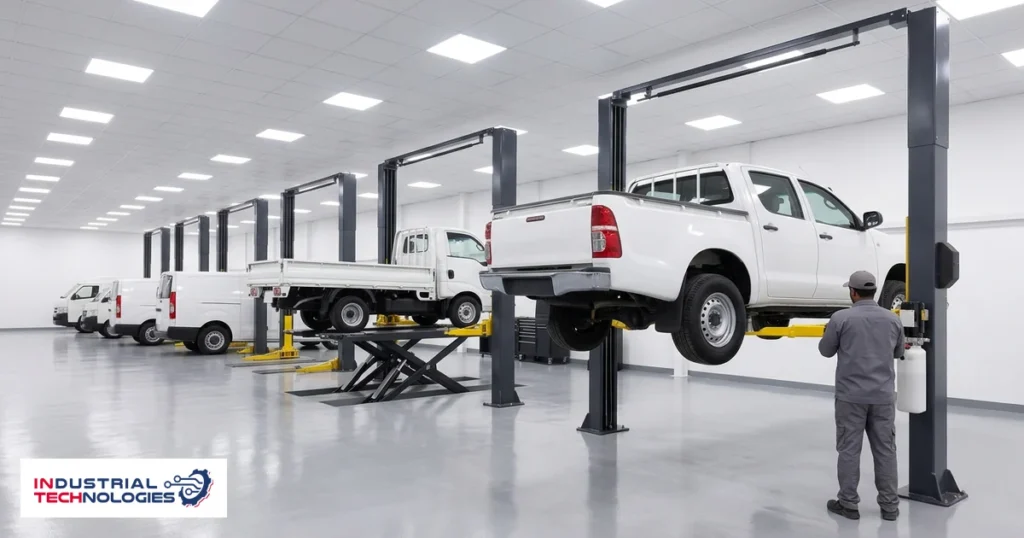
The difference between fitting out a commercial workshop and a government one is rarely in the equipment. It is in what is required around it: a written specification, verifiable conformity, and a record proving what was done.
A government fleet workshop fit out therefore starts by drafting the equipment list in language a tender document can carry, rather than by choosing equipment and describing it afterwards.
Three items asked for here and not commercially
- Written technical specifications — usable in a tender document without rewriting
- Conformity evidence — including SASO conformity for imported equipment
- Documentation and asset tracking — because operations and maintenance contracts require proof of work done
The third is the one forgotten at fit-out: a fit-out that does not support documentation produces a workshop that works but cannot prove what it did.
Why documentation belongs in the fit-out
Job records and asset tracking need a place in both the layout and the procedure: where a vehicle is logged on arrival, how the job is tied to the vehicle, and where the record is held. Adding that after the workshop is running means changing an established procedure instead of building it correctly.
| Item | What is written | Published source |
|---|---|---|
| Lift capacity | 1,200–4,500 kg depending on the model | Published lift range |
| Lift height | 600–1,999 mm depending on the model | Published lift range |
| Power | 2.2–3 kW | The published model |
| Booth size | 6,900 × 4,000 × 2,650 mm cabin · built to order up to 24,000 mm long | Published family range |
| Conformity | SASO conformity for imported equipment | Published regulatory considerations |
Where our scope stops
We produce written technical specifications that can go into a tender document, together with the conformity evidence required. Registration and qualification procedures with the awarding body itself sit outside what our published pages define, and are discussed case by case rather than promised here.
Common questions
Can the equipment list go into a tender as it stands?
Yes — that is the purpose of drafting it that way. Written specifications and verifiable conformity make the list usable in a tender or a direct purchase without rewriting.
What conformity is required?
SASO conformity for imported equipment, alongside professional workshop requirements for ventilation, cooling, lighting and waste handling, and fire and safety requirements in oil and fuel storage areas.
Do you support qualification procedures with the authority?
What we provide is defined: the written specification and the conformity evidence. The scope of support for registration and qualification is agreed case by case, and no general figure or promise is published here.
Does the fit-out itself differ from a commercial workshop?
The equipment usually does not. What differs is that documentation and asset tracking enter the workshop design, and that every item needs a written specification the contract can carry.
Related reading
- Fleet maintenance scheduling around the booth
- Distribution fleet workshop
- Hard wearing internal finish
- Site security during installation inside a defense facility
Next step
Send your fleet mix, available floor area and any tender requirements already issued, and we will come back with an equipment list specified for inclusion. Talk to a specialist. The regulatory considerations sit on the fleet sector page.