
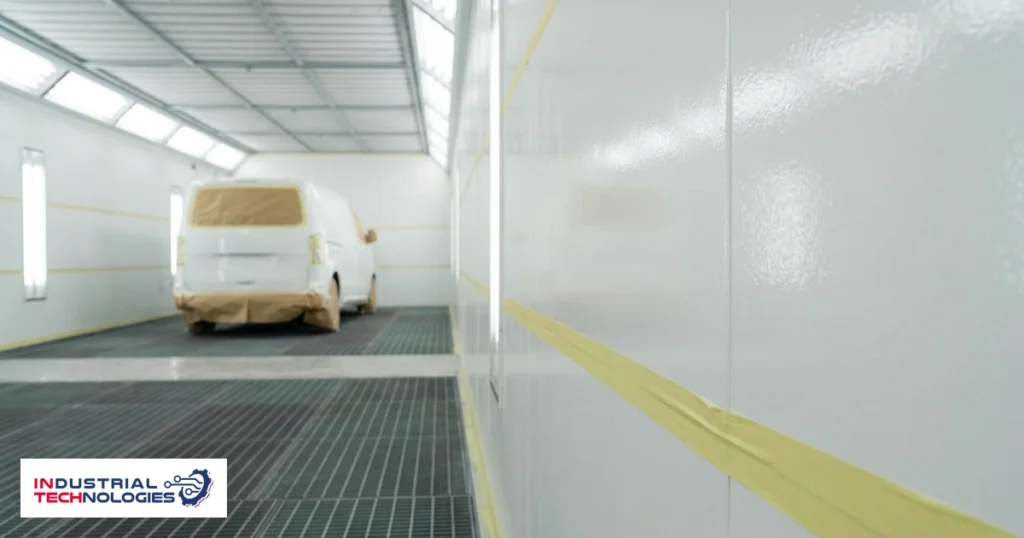
A cabin taking one vehicle a day and a cabin taking eight share a specification and differ in service life. The gap does not show in year one. It shows in year three, when the internal wall starts carrying the marks of abrasion and repeated cleaning.
That is why a hard wearing internal finish appears as an explicit item in the published fleet configuration, alongside the longer internal length and the higher extraction capacity.
What actually consumes the internal wall
Three things rather than one: tool trolleys and ladders knocking the walls in what is already a tight space; dried overspray removed by scraping or by solvent; and the cleaning cycles themselves, run between jobs in any high-use workshop.
The result is that the wall surface — not the cabin structure — decides when a cabin starts to look old, and when dust begins clinging to it instead of sliding off.
| Material | Published specification | Where it is used |
|---|---|---|
| Insulated panel | 50 mm — EPS | The standard build |
| Insulated panel | 50 mm — rockwool | Where higher thermal or fire performance is asked for |
| Insulated panel | 50 mm — glass wool | Among the published insulated panel options |
| Galvanised sheet | 1.5 mm | Large cabins |
Why galvanised sheet on large cabins
A large cabin carries far more wall area, and more area means both more exposure to damage and more weight on the structure. Galvanised sheet at 1.5 mm is what gets built in that case instead of the insulated panel, and it appears in the published range for this family.
This is settled with the size rather than after it, because changing wall material after fabrication is not a modification — it is a rebuild.
What gets asked before the choice is fixed
- Expected vehicles per day — the figure that turns “heavy use” into a number
- Whether tool trolleys enter the cabin with the vehicle or stay outside
- The cleaning method the workshop uses, and how often
Common questions
Does insulation material change how long the wall lasts?
Insulation serves thermal performance. What survives use is the panel surface and its resistance to abrasion and cleaning. Surface and insulation are therefore discussed as two items, not one.
Can the wall be upgraded later?
Changing wall material after fabrication is a rebuild rather than an upgrade, which is why the choice is fixed with the size at design stage.
How does a worn wall show up in the paint?
A roughened surface holds dust instead of shedding it, so the dust releases into the airflow and settles on wet coating. The effect appears in the finish before anyone notices it on the wall.
Is this item specific to fleets?
It is listed in the fleet configuration because use intensity there is the rule rather than the exception. Any workshop working at the same intensity benefits from it.
Related reading
- Back to back booth cycles
- Internal length for light commercial vehicles
- Government fleet workshop fit out
- Oversize platform chamber sizing
Next step
Send your expected vehicles per day and the cabin size you need, and we will come back with a wall specification built on your use intensity. Talk to a specialist. The published specifications sit on the paint booth family page.