
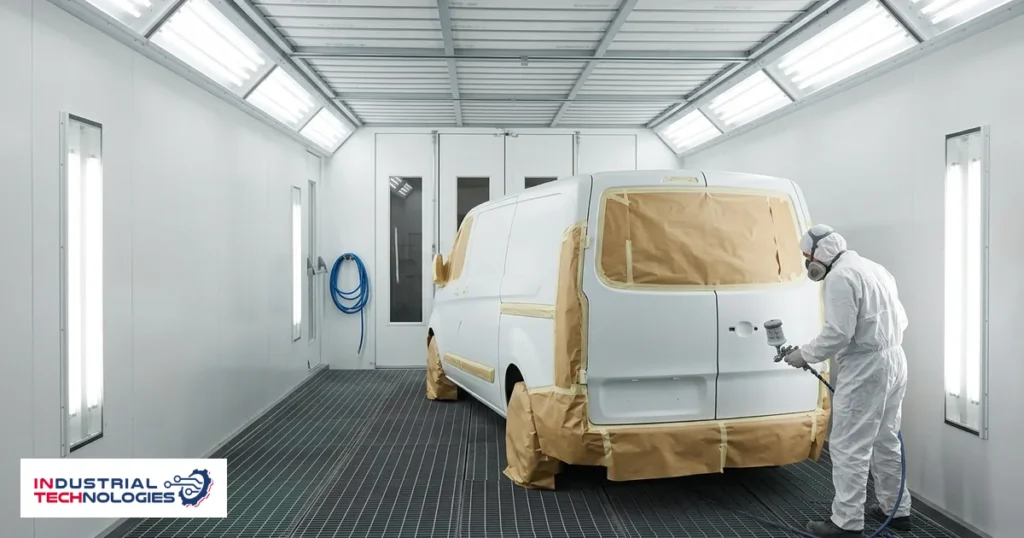
A workshop serving a mixed parc faces a question a single-type workshop never meets: the cabin is built to a fixed length, and the fleet is not of a fixed length.
That is why the internal length light commercial vehicles require is listed first in the published fleet configuration — and what is meant is a length that accommodates the longest unit entering, not one that suits the most frequent unit.
Why the longest, not the most common
Vehicle count governs how many cabins you need and how the operating cycle runs. Internal length is fixed by the longest vehicle entering — otherwise that vehicle stays out of service however many cycles are available.
The rule looks expensive until the alternatives are costed: a vehicle that does not fit is repaired outside, at a price, on someone else’s schedule, and at the risk of losing livery colour consistency.
| Class | Internal length | Note |
|---|---|---|
| Passenger cars and SUVs | INTECH cabin 6,900 × 4,000 × 2,650 mm | The stock model |
| Light commercial vehicles | A longer length within the delivered range | The published fleet configuration item |
| Minibuses and vans | From 8,000 mm | Built to order |
| Full family range | 3,000 – 24,000 mm | Internal length delivered |
What a long cabin costs on a short vehicle
A longer cabin always accommodates a shorter vehicle, but the cycle is computed on cabin volume rather than vehicle volume. Running a long cabin for a single passenger car consumes more air and heat than that car requires.
This is what leads some fleets to two cabins at two sizes instead of one large cabin: an automotive-sized cabin for daily work, and a longer one for the vehicles that exceed it. The choice between them is arithmetic — long vehicles per year against the daily running cost difference.
Common questions
How do we identify the longest vehicle in the parc?
By measuring it as it presents at the door, not from the manufacturer plate. Rear attachments, carriers and ladders all add to overall length beyond the plated figure.
One large cabin or two?
It is settled by how many long vehicles you handle per year. If they are few, one long cabin serves despite its running cost; if they arrive daily, two cabins cost less to run.
Is it acceptable to leave part of the vehicle past the door?
No. The section outside the cabin is outside both the air and the heat envelope, so it never sees the same drying curve, and the difference shows in the finish.
What else changes with length besides the size?
Air capacity and heat follow cabin volume rather than vehicle type, and the door follows the size as well, within the published range.
Related reading
- Minibus and van paint booth
- Distribution fleet workshop
- Fleet livery colour consistency
- Furniture finishing line
Next step
Send the overall length of the longest vehicle you run and how many units exceed the automotive envelope each year, and we will come back with a comparison between one cabin and two. Talk to a specialist. The range sits on the paint booth family page.