
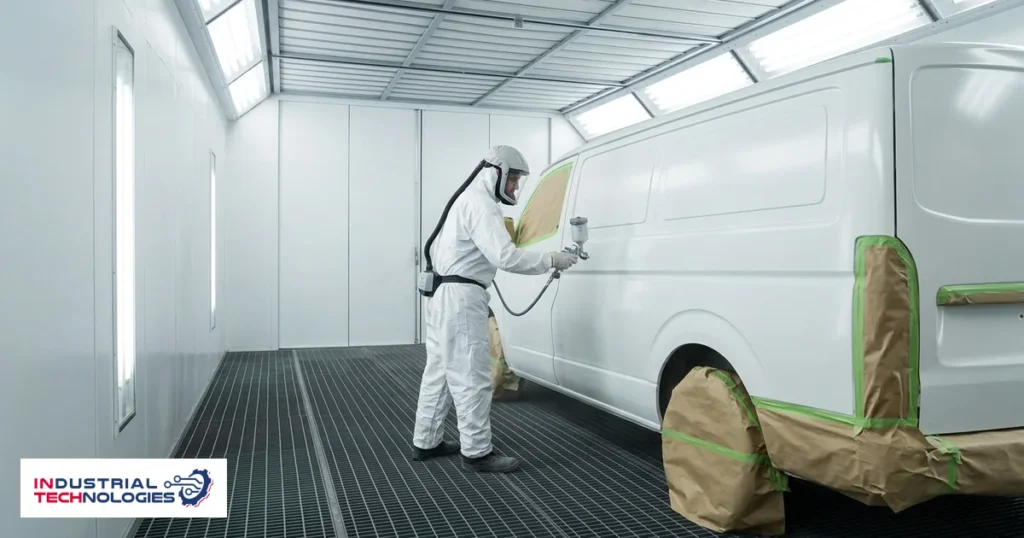
A cabin that succeeds on the first cycle can stumble on the sixth. Each cycle leaves residual heat in the panels and additional load on the filters, so the next cycle begins from a worse starting point than the one before it.
That is why the published fleet configuration is distinguished by higher extraction capacity for back to back booth cycles through the day — not by a different size and not by a different model.
What accumulates between one cycle and the next
- Residual heat — the insulated panel retains part of the previous cycle’s heat
- Filter load — every cycle adds to the pre-filter and the ceiling filter
- Suspended overspray — it needs full clearance before the next vehicle enters
Extraction addresses all three at once: it removes the loaded air and introduces clean air at a rate that lets the next cycle start from a state close to the first.
The range it is drawn from
Air capacity delivered in this family runs from 18,000 to 190,000 m³/h per supply or extraction set, heat output from 200,000 to 600,000 kcal/h, and electrical power from 11 to 50 kW.
| Item | Delivered range | Effect on succession |
|---|---|---|
| Air capacity | 18,000 – 190,000 m³/h per set | Cabin clearance time between cycles |
| Heat output | 200,000 – 600,000 kcal/h | How fast the heat curve is reached again |
| Electrical power | 11 – 50 kW | What the building has to supply |
| Voltage | 380 V three-phase · 50 or 60 Hz | A site condition verified before installation |
How this differs from single-cycle time
The duration of one cycle is governed by the coated surface area and the heat curve. The number of cycles available in a day is governed by what happens between cycles: clearance, cooling and reset. The two figures improve by different means, and improving one does not improve the other by itself.
Common questions
Does more capacity shorten the cycle itself?
Not necessarily. Higher capacity shortens clearance time between cycles more than it shortens any single cycle, so its effect shows in the daily vehicle count rather than in one vehicle’s turnaround.
What figure do we send to size extraction?
The target vehicles per day and the cabin size required. Those two give the air change rate needed, and capacity is then drawn from the published range.
Does higher capacity raise the electricity bill?
It raises instantaneous draw, and it can lower consumption per vehicle if it is the thing keeping the cabin from standing idle between cycles. The valid comparison is consumption per completed vehicle, not installed power.
Is raising extraction enough for a two-shift operation?
No. Filters enter the calculation too, because a doubled cycle count doubles filter load and shortens the replacement schedule against the norm.
Related reading
Next step
Send your target vehicles per day and the cabin size that suits your parc, and we will come back with an extraction and heat output sized on that count. Talk to a specialist. The full range sits on the paint booth family page.