
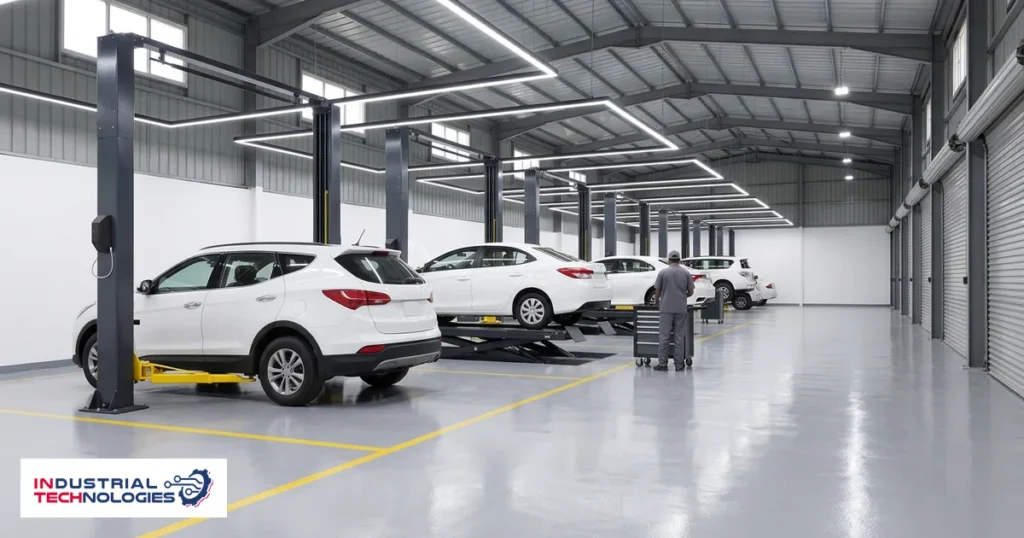
A dealer service centre is judged on waiting time before it is judged on repair quality. Customers compare the queue because it is the part they experience directly.
That has a direct consequence for how dealer service centre equipment gets selected: the list is derived from a throughput target, not assembled from a catalogue. Start with the number of vehicles you intend to receive per day, derive the bay count and its split, then choose equipment per bay type.
Four activities, four rhythms, one building
A dealer facility runs quick service, heavy repair, storage and vehicle washing under one roof. Each has a different cycle length.
Mixed into one space, the short operation waits behind the long one, and billable hours turn into reception complaints. Separating quick service from structural and paint work raises capacity without adding floor area — which is the cheapest capacity you will ever buy.
Duty cycle beats rated capacity
Capacity is the easy number to compare. The vehicle lifts family runs from 1200 to 4500 kg, with lift heights from 600 to 1999 mm and power from 2.2 to 3 kW.
But a dealer centre operates each lift dozens of times a day, six days a week. Equipment that suits an independent workshop reaches the end of its service life here in a fraction of the expected period — so the selection criterion shifts from rated capacity to endurance under repetition.
Cycle time enters the arithmetic too. The documented two-post lifts rise in 50 seconds and descend in 30. Multiply by the daily cycle count of a busy bay and the difference between models is measured in hours per month.
EV handling and calibration are floor-plan items
These two entries arrive on dealer equipment lists as purchases. They are floor-plan requirements first.
Electric vehicle service needs battery handling and an isolation area that does not intersect the general service route. The published battery lifting platform measures 1350×790 mm with 1800 mm lift height and 1200 kg capacity, and it is moved on a trailer — so it needs manoeuvring space around it, not just a parking spot.
Driver assistance calibration needs a level floor, clear frontal distance and controlled lighting after any work affecting sensor geometry. Equipment for it sits within general workshop equipment and tooling, including the ADAS PRO platform — but the room is the harder half to provide.
Size the booth on the largest model you sell
Where the centre offers refinishing under the brand’s own standards, the chamber follows the largest vehicle in the range rather than the average one.
The INTECH internal chamber at 6900×4000×2650 mm covers passenger cars and SUVs. A range that includes light commercial or larger vehicles pushes past it, and those are built to order. Ceiling filtration at the highest class available in the model, and a faster drying cycle to shorten handover time, are the two configuration points that recur in dealer work.
Bay figures for a dealer centre
Plan in bays first — these are the figures each bay type is built around:
| Item | Published | Planning consequence |
|---|---|---|
| Vehicle lifts | 1200–4500 kg · lift heights 600–1999 mm · power 2.2–3 kW | Bay type follows the work, not the maximum |
| Two-post cycle | 50 seconds up · 30 seconds down | Fixed machine time per vehicle |
| Battery lifting platform | 1350×790 mm · 1800 mm lift · 1200 kg | Moved on a trailer — needs manoeuvring space, not just a parking spot |
Common questions
Why does preventive maintenance appear in a capacity discussion?
Because one stopped lift closes an entire service bay. At dealer volumes that is a capacity decision rather than a cost decision, and it is scheduled against operating hours under an annual, extendable maintenance agreement with filters replaced twice a year in normal use.
Should structural repair stay in-house?
It depends on the monthly volume of structural damage reaching you. Where that volume justifies a dedicated bay, keeping it in-house removes the transfer time to an external shop — and the pulling benches run from two to four towers depending on model.
What sets the number of service bays?
The daily vehicle target and its split between routine servicing and heavy repair. That split determines bay count and distribution, and bay count then determines how many lifts you need and of which type — booth and preparation follow after.
Five answers that shorten the process
Daily vehicle target, the routine-to-heavy split, the largest vehicle in your range, clear ceiling height, and slab thickness. Send those and the conversation starts at layout rather than at catalogue.
Sector configuration notes are on the auto dealers page, or request a quotation with your facility plan.