
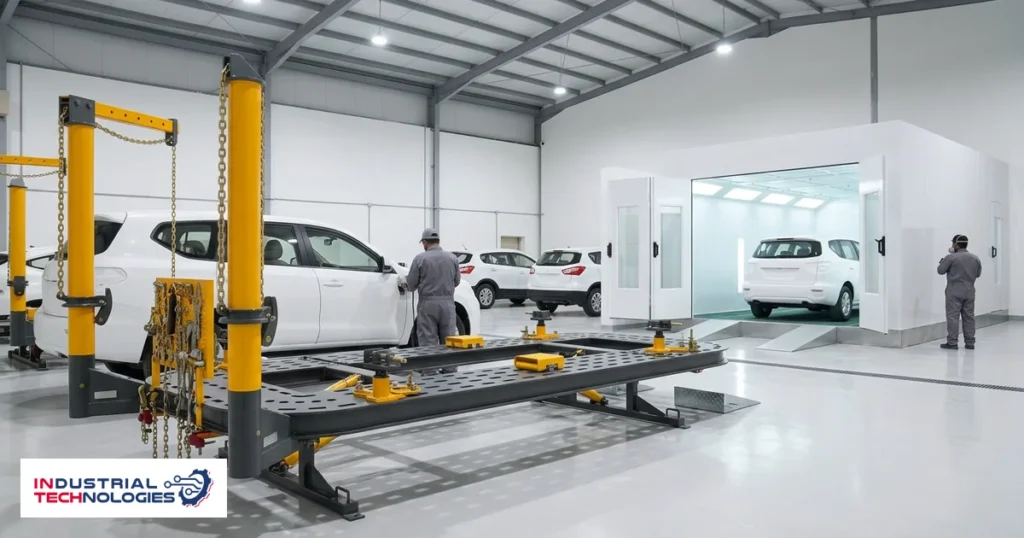
A body that has not returned to its original dimensions stays a defect after painting. Everything downstream — panel gaps, glass seating, sensor geometry — inherits whatever the structure was left at.
Which is why collision repair centre equipment is best planned as a sequence rather than a shopping list. The published workflow is explicit: reception, teardown, structure, preparation, booth, reassembly, calibration, delivery. Every item you buy serves one of those eight stations.
The routes must not cross
The single biggest capacity loss in a collision centre is not slow work. It is a vehicle moving backwards through the sequence because two stations share a space.
Preparation generating dust next to a booth being loaded is the obvious case. Calibration needing clear frontal space in a bay that is also a through-route is the less obvious one. Both are layout decisions, and neither is fixable by buying better equipment afterwards.
Structure: the floor is part of the tool
Pulling benches in the chassis pullers and body repair family run from two to four towers depending on model, which allows the structure to be pulled from more than one direction in a single set-up.
The published capacities are per tower rather than per bench: 4000 kg lift, 10 tonnes of pull per tower. So tower count buys you pull directions, not raw force — a distinction that changes which model suits the damage you actually see.
And the anchoring is a site item, not a delivery item. Pulling equipment needs a floor that can carry the applied forces, with the fixing reviewed before installation rather than after. Retrofitting anchorage into a slab that was never assessed is the most expensive way to learn this.
The booth is your daily delivery ceiling
In collision work the booth is not one machine among many. Controlled drying is what produces colour and gloss consistency, and booth capacity sets the ceiling on what the centre can hand back per day.
Two configuration points follow from that. First, size the chamber on the largest vehicle that passes through your shop, not the average — one vehicle that does not fit stops the whole flow. The INTECH internal chamber is 6900×4000×2650 mm, with larger sizes built to order.
Second, collision work weights air capacity and heating cycle higher than general repair does, because throughput is measured in vehicles per day. Lighting is weighted higher too, for the simple reason that colour matching is a visual task performed by a human eye.
Preparation is where rework is created
The step most often compressed under schedule pressure is surface preparation, and it is the step that produces the repaint. Dust released during sanding inside the bay settles on the surface that is about to be coated.
A prep station separates the two physically. The published PURE 200 runs 15,000 m³/h through a 4 kW turbine fan at 800 Pa, with three filtration stages ending in a full ceiling high-efficiency filter, and 800 lux or more from 24 LED units.
Calibration is a space requirement
Driver assistance calibration after structural work is a delivery condition on modern vehicles, not an optional extra. It needs level floor, clear frontal distance and controlled lighting.
Note what that list contains: three properties of a room, and no properties of a device. The equipment sits within general workshop equipment and tooling — but buying it without allocating the space is buying half the capability.
Station figures across the eight
Published capacities for the stations that carry the work:
| Station | Published figures | Note |
|---|---|---|
| Chassis pulling | 4000 kg lift · 10 tonnes of pull per tower | Capacities are per tower, not per bench |
| Paint booth | Internal chamber 6900×4000×2650 mm | Larger sizes built to order |
| Preparation — PURE 200 | 15,000 m³/h · 4 kW turbine fan at 800 Pa · three filtration stages ending in full ceiling high-efficiency filter · 800 lux or more from 24 LED units | — |
| Vehicle lifting | 1200–4500 kg · lift heights 600–1999 mm | Across the family |
Common questions
How many towers do I actually need?
It follows the damage profile you receive rather than a general rule. More towers mean more simultaneous pull directions in one set-up, which shortens jobs with complex distortion — and adds nothing if most of your work is single-direction correction.
Do I need lifts if I have pulling benches?
They serve different stations. Benches handle structure; lifts handle the mechanical and electrical work that accompanies collision repair, which otherwise leaves your building. Published lift capacity runs from 1200 to 4500 kg with lift heights from 600 to 1999 mm.
Which station should be equipped first?
Whichever one currently sends work out of the building. Every outsourced stage adds transport time and a second queue to the cycle, so the station that removes the most external handoffs pays back before the one that improves an internal step.
What to send with an enquiry
The damage types you handle, your shop area, and the number of vehicles you expect monthly. Those three shape the layout before any model is named.
Sector-specific configuration notes are on the collision repair page, or request a quotation with your floor plan.