
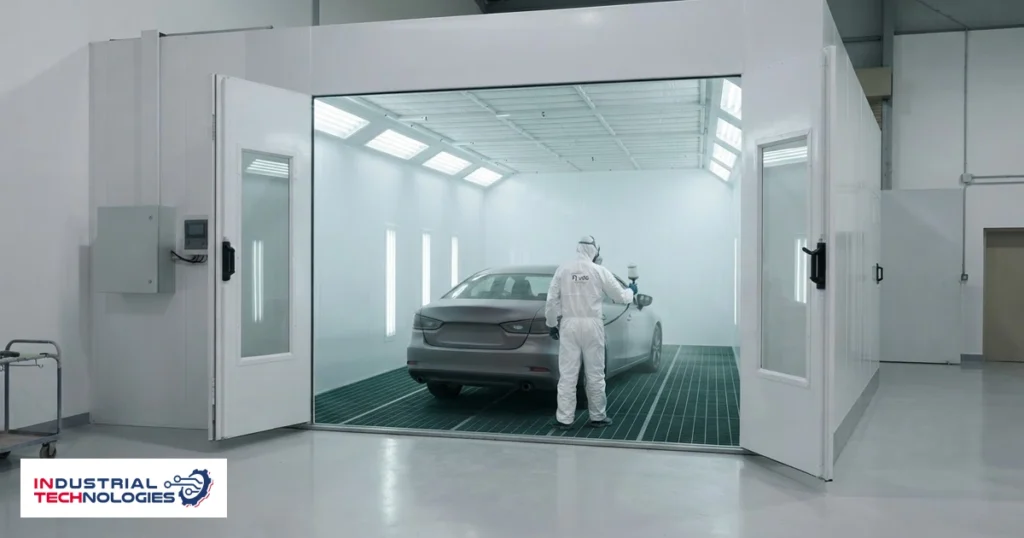
Two booths can carry the same chamber dimensions, the same airflow figure and the same burner, and behave differently in a fire drill and on a fuel bill. The difference is usually in the panel.
Insulation is the least discussed line in most quotations and one of the few that cannot be changed after installation. Choosing rockwool paint booth insulation over a lighter core is a decision you make once.
What the published models actually specify
The INTECH range documents this explicitly rather than leaving it to inference. One model is published with ROCKWOOL walls with reinforced fire and acoustic insulation, described as offering higher extraction than the entry model with metal-mineral insulation instead of EPS, at the same electrical consumption.
That last clause is the useful one. They are separated by wall construction and extraction capacity, not by running cost — so the comparison is between what the wall gives you and what it costs to buy, with the operating figure held constant.
Across the custom range, the published wall options are insulated panels at 50 mm in EPS, rockwool or glass wool — or 1.5 mm galvanised sheet for the largest chambers.
Fire behaviour is the first consideration
A spray booth is a compartment where atomised solvent-bearing material and a heat source share a volume by design. Whatever the wall is made of participates in that situation.
Mineral wool cores and expanded polystyrene cores do not behave the same way under sustained heat, and the distinction is one that local authorities having jurisdiction tend to care about. We meet the regulatory requirements applicable to each project, and the certificates and approvals required are supplied on request.
This matters commercially, not just technically: an approval query raised after the chamber is standing is an expensive time to discover which core you bought.
Acoustic performance is the quiet benefit
The published description pairs fire and acoustic insulation in the same phrase, and the acoustic half is rarely priced by buyers.
Two turbine fans moving tens of thousands of cubic metres per hour produce noise that has to go somewhere. In a workshop where the booth sits beside general bays, that noise is a working condition for everyone else on the floor for the whole shift.
It is also a neighbour question in an urban industrial site, and one that is far cheaper to address in the panel specification than in remedial cladding afterwards.
Thermal loss is a recurring cost
Every unit of heat that leaves through the wall is paid for twice — once to generate it and once to replace it. Over a cure cycle repeated several times a day, that difference compounds.
The buyer’s guidance published on this site puts it plainly: insulated panels should cover the entire body — walls, roof and doors — without thermal gaps. A well-cored panel with an uninsulated door frame still leaks.
Published wall options
What the family actually specifies, so you compare wall behaviour rather than usable space:
| Option | Published specification | What it changes |
|---|---|---|
| Insulated panel | 50 mm in EPS, rockwool or glass wool | Fire behaviour, acoustic and thermal performance |
| Galvanised sheet | 1.5 mm — largest chambers | Structural demand at the published maximum length |
| Internal chamber | 6900×4000×2650 mm across the automotive-size range | Unchanged by wall type |
| Maximum executed length | 24,000 mm | Imposes structural demands a short chamber does not |
Common questions
Does the core change chamber dimensions?
Not in the standard models. The internal chamber is published as 6900×4000×2650 mm across the automotive-size range regardless of wall construction, so you are comparing wall behaviour rather than usable space.
Why is galvanised sheet listed for the largest chambers?
Span behaviour changes with size. A chamber built out to the published maximum of 24,000 mm in length imposes structural demands a short chamber does not, and the wall specification follows the engineering rather than the catalogue.
Can the wall type be changed later?
Practically, no. This is a build decision. It belongs in the quotation stage alongside airflow and heat output, which is where the family page sets out what is supplied as standard on each model.
What to send with your enquiry
Your local fire and building requirements, the booth’s position relative to occupied areas, your shift pattern, and whether the site is enclosed or open. Then request a quotation against those conditions.