
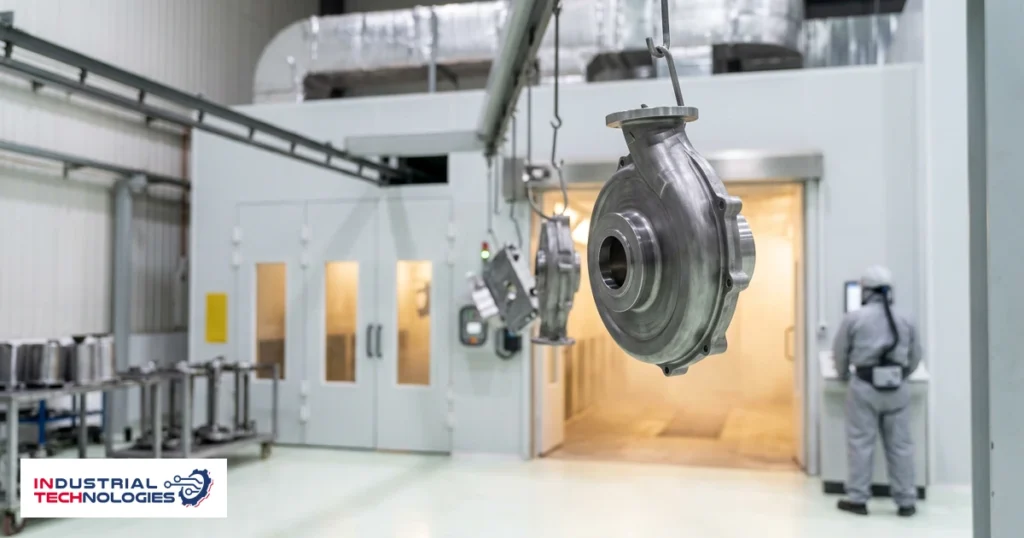
A vehicle booth is specified around an object that is always roughly the same shape. A manufacturer’s finishing station is not, and that single fact invalidates most of the comparison habits carried over from automotive.
Specifying an industrial parts finishing oven starts from the part and from the production line it sits inside — its size, how it is suspended or carried, the coating chemistry, and the rhythm it has to keep up with.
Where the delivered sizes actually start
Industrial work does not sit at the large end of the range. It starts at the small end, because a manufactured component is usually smaller than a car.
The delivered starting point is a 3000×3000×3000 mm chamber for powder coat curing, extending to 5700×3700×3000 mm for industrial baking ovens and above. Both sit well inside the family range of 3000–24,000 mm long by 3000–20,000 mm wide.
What fills the difference between part size and chamber size is not clearance in the automotive sense. It is the arrangement for hanging or conveying parts through the chamber, which consumes height and width that never appears on the part drawing.
The temperature curve belongs to the coating
In a body shop the cure profile is broadly settled by the paint system and rarely revisited. In manufacturing it is a specification input, because the coating changes with the product.
The temperature curve is therefore set to the industrial coating in use rather than inherited from a vehicle configuration. Thermal output across the paint booths and finishing systems family runs from 200,000 to 600,000 kcal/h, and air capacity from 18,000 to 190,000 m³/h per intake or exhaust group.
Five heating systems are delivered in this family — diesel, gas, electric, heat pump and shortwave infrared. For an industrial line the choice follows coating chemistry and site energy cost, not preference, because the oven will run this profile continuously rather than a few times a day.
Cycle time is the constraint nobody quotes
This is the difference that catches manufacturers who specify a finishing station like a body shop specifies a booth.
Finishing is a step inside a production line, so its cycle time has to match the line rhythm or fall below it. An oven that cures beautifully but slower than the line feeds it does not produce a quality problem — it produces a bottleneck, and the bottleneck relocates the entire plant’s output ceiling into the finishing bay.
So the first number to fix is not chamber size. It is the required cycle time, derived from your line rate, and it should be stated in the enquiry rather than discovered during commissioning.
Continuous shifts change the selection criterion
A body shop booth idles between vehicles. A production oven often does not idle at all.
Under continuous shift operation, durability and ease of maintenance move ahead of peak specification, because a stoppage here halts a whole line rather than one bay. That reorders the comparison sheet: filter access, component availability and service intervals stop being footnotes.
It also raises the value of the step before finishing. A prep and mixing room ahead of the finishing station protects the surface from factory-environment contamination — and in a plant, that contamination is generated continuously and internally.
Where industrial finishing sits in the range
The delivered starting point is smaller than a vehicle booth, not larger:
| Item | Published | Note |
|---|---|---|
| Powder coat curing chamber | 3000×3000×3000 mm | Specified separately, not as a variant of a vehicle booth |
| Industrial baking ovens | To 5700×3700×3000 mm and above | — |
| Family range | Length 3,000–24,000 mm · width 3,000–20,000 mm | Both sit well inside it |
| Thermal output | 200,000–600,000 kcal/h | Across the family |
| Air capacity | 18,000–190,000 m³/h per intake or exhaust group | What differs is the temperature curve and internal arrangement |
Common questions
Is a powder cure oven the same thing as a paint booth?
They share the principle of a controlled air and temperature environment, and both are built in this family. What differs is the temperature curve and the internal arrangement for holding parts — which is why the powder cure chamber is specified separately at 3000×3000×3000 mm rather than as a variant of a vehicle booth.
How do I know what chamber size to ask for?
From the largest part in your line and the way it is suspended or carried, plus the clear area available on your site. Those two, together with the required cycle time, settle most of the specification before any model is discussed.
Are these built to order or selected from a catalogue?
Built to order. Each one begins with a site survey that fixes the internal dimension, after which the configuration — extraction direction, heating system, filtration stages and doors — is approved before fabrication rather than adjusted afterwards.
Related reading
Three inputs before any quotation
Largest part dimensions and how it travels, coating chemistry, and required cycle time. Without those three, any proposed chamber size is an estimate wearing a specification sheet.
Sector configuration notes are on the industrial and manufacturing page, or request a quotation with your line rate.