
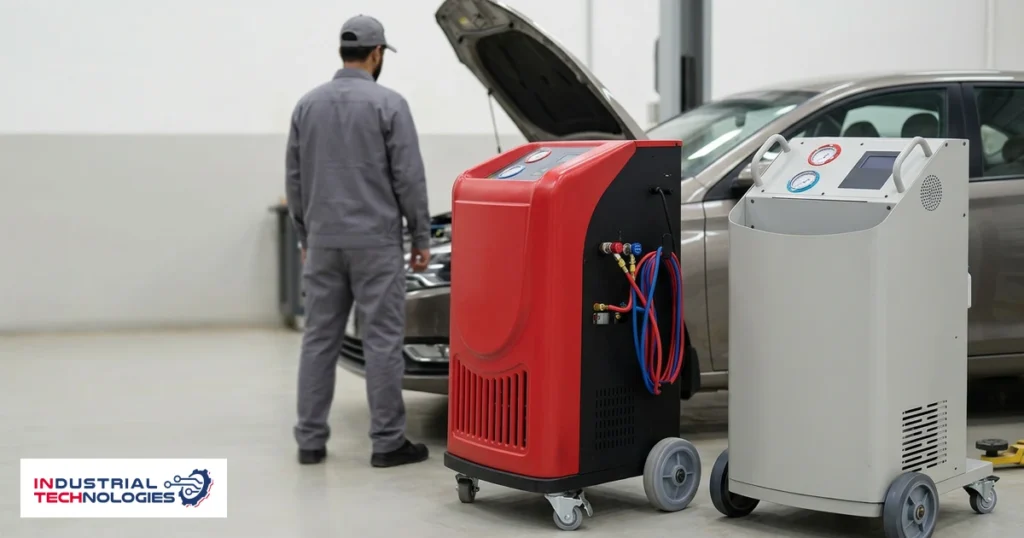
The ACMAS301 and the ACMAS302 sit side by side in the same family. One recovers 99% of the refrigerant charge, the other 97%. On a single car that difference is invisible, and most buyers treat it as a rounding error.
It is not, and understanding why is most of what refrigerant recovery standards are actually about.
Where the two percent goes
What is not recovered is not stored. It is vented, and it is bought again on the next job. On one vehicle that is trivial. Across a workshop servicing several vehicles a day, all year, it becomes a line item — and a compliance position, since venting refrigerant is exactly what recovery equipment exists to prevent.
The DaTo ACMAS301 records 99% recovery with a 12 L refrigerant tank; the ACMAS302 records 97% with a 10 kg cylinder. That is the whole of the difference on this specific line, and it is a volume decision rather than a quality one.
Recovery is worthless without the dryer
Recovered gas carries moisture and contaminants out of the vehicle’s circuit. Putting it straight back in would be worse than using none of it.
This is why the ACMAS301 sheet lists a 0.122 L dry filter alongside the recovery rate. The filter is what makes the recovered charge reusable, and it is a consumable — which means the recovery figure on the datasheet is a figure the machine achieves with a serviceable filter in it, not a permanent property of the box.
If you take one operational habit from this article, take that one: recovery rate is a maintained condition, not a nameplate.
The number that decides whether the system works afterwards
Recovery gets attention because it is the headline. Charge accuracy is what the customer actually feels.
Modern AC circuits hold small charges with narrow tolerances. Undercharge and cooling is weak; overcharge and head pressure rises, which stresses the compressor. The ACMAS301 lists a scale accurate to ±10 g on refrigerant and ±5 g on oil, and recharges at 2 kg/min after evacuating with a 120 L/min vacuum pump.
Evacuation matters as much as weighing. Air and moisture left in a circuit will not be weighed out later — they stay, and they degrade performance regardless of how precisely the refrigerant was measured.
Automation is a repeatability decision
The ACMAS301 runs eight functions on one connection: recovery, recycling, evacuation, weighed recharge, A/C flush and UV dye leak testing among them. The technician connects the hoses once and the cycle runs.
The ACMAS302 takes a different route to the same goal: it is hand-valve free. A manual valve opened at the wrong moment loses a full charge, and removing the valve removes the error. For a shop with rotating crews — or a training institute with new intakes every term — we would weight that higher than the two points of recovery rate.
It also carries a service reminder every 600 operations, which is the machine counting its own work instead of a wall calendar guessing at it.
The stations in figures
Where the two percent goes, and what makes recovery worth having:
| Item | DaTo ACMAS301 | DaTo ACMAS302 |
|---|---|---|
| Recovery rate | 99% | 97% |
| Refrigerant storage | 12 L tank | 10 kg cylinder |
| Dry filter | 0.122 L | — |
| Scale accuracy | ±10 g refrigerant · ±5 g oil | — |
| Recharge and vacuum | 2 kg/min after evacuating with a 120 L/min pump | — |
Common questions
Does two percent of recovery really matter?
Not per vehicle, and anyone telling you otherwise is selling. It matters cumulatively, so it scales with throughput: a high-volume dealer workshop or fleet operation should weight it, a low-volume shop should weight ease of use and cycle time instead.
What does the dry filter do?
It removes moisture and contaminants from recovered gas before it returns to the tank, so the charge can be reused rather than discarded. It is a consumable and is excluded from warranty cover like other consumables, so budget for it as a running cost from day one.
How do I know when the station needs servicing?
On the ACMAS302 the machine tells you: it prompts every 600 operations. On any station, the practical indicators are a vacuum that takes longer to pull down than it used to, and recovered volumes that drift below what you expect for the vehicle.
Where to start
Count the AC jobs you actually invoice in a month before you compare specifications — that number decides which of the two lines above should carry the weight in your decision. The models, with their full figures, are on the AC service stations page, and the quotation request asks for the sector and volume that make the recommendation meaningful.