
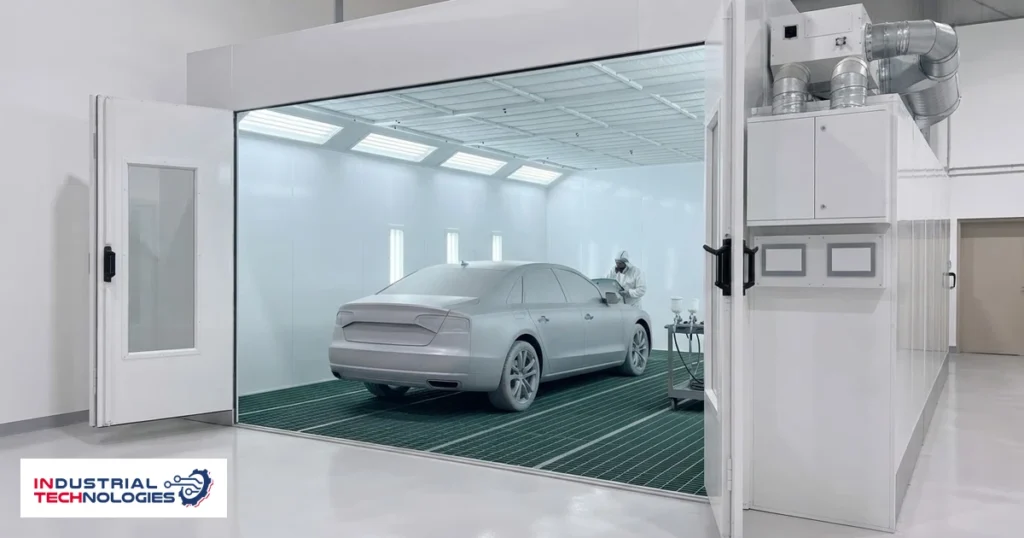
Two numbers sit next to each other on every paint booth specification sheet, and buyers routinely read them as one. On the INTECH X300 sheet they are 200,000 kcal/h and 11 kW.
The first is thermal output produced by burning fuel. The second is the electrical draw of the fans, control panel and lighting. They do not add up, and they are not comparable — and once you separate them, the gas vs electric booth heater question stops being about efficiency claims and becomes a question about your site.
Why the electrical figure looks so small
The INTECH X300 and INTECH X360 both ship with a Riello G20 diesel burner. Heat comes from the fuel line, not from the meter — which is why 11 kW covers the whole electrical side of a booth producing 200,000 kcal/h.
Move that heat source to an electric element and the kW figure rises sharply, because the energy that was arriving as fuel now arrives as current. That is the actual trade being made. Any comparison that does not show both numbers, on both configurations, is not a comparison yet.
Five systems are executed, not two
The question is usually framed as a binary. The range actually executed across the paint booth family is wider: diesel, gas, electric heating, heat pump, and short-wave infrared — with thermal output from 200,000 to 600,000 kcal/h and electrical power from 11 to 50 kW depending on chamber size and configuration.
That range is also the answer to “which system is best”. There is no context-free best. A plant on an industrial estate with a gas connection reads this decision very differently from a body shop in a leased unit with a fixed electrical allowance.
What each option actually costs you
Diesel buys independence from your electrical supply, which matters when the supply is the constraint. You pay for it with a tank, a refuelling routine, burner servicing and a flue.
Gas is cleaner in operation and lighter on burner maintenance, but it is entirely conditional on a real supply reaching the building. Permits and local requirements for a gas connection are settled before the purchase order, not after it — this is the single most common cause of a booth sitting uncommissioned.
Electric is the simplest to install and control, with no combustion flue and no fuel storage. Its price is that the entire load moves onto your board, which turns the first question into an electrical one rather than a booth one.
Short-wave infrared heats the panel rather than the whole chamber volume. It earns its place on spot repairs that do not justify a full bake cycle, and it does not replace a primary heating system in a booth running shifts.
The component that decides whether heat arrives
Heat from the burner reaches the cabin through a heat exchanger. On the INTECH models that exchanger is 1.5 mm SUS304 stainless with efficiency above 90%.
We weight this line more heavily than most buyers do. A lower-efficiency exchanger means you buy fuel and send part of it up the flue every cycle. The thickness is not cosmetic either: the exchanger expands and contracts on every heat-and-cool cycle, and the thinner ones crack first.
Chamber volume comes before fuel choice
The standard chamber in this family is 6,900 × 4,000 × 2,650 mm. Every increase over that is more air to raise to the same temperature, on every cycle, for the life of the booth.
So the correct order of questions is: what is the largest item that genuinely enters your shop, what chamber covers it with a sensible margin, and what energy is available on site. The heating system is the answer to those three — not the opening question.
The two numbers side by side
Thermal output and electrical power are different figures — and the second is not the smaller version of the first:
| Item | INTECH X300 | Executed range |
|---|---|---|
| Thermal output | 200,000 kcal/h | 200,000–600,000 kcal/h |
| Electrical power | 11 kW | 11–50 kW depending on chamber size and configuration |
| Heat source | Riello G20 diesel burner | Diesel, gas, electric, heat pump, short-wave infrared |
| Heat exchanger | SUS304 stainless, 1.5 mm, efficiency above 90% | The component that decides whether heat arrives |
Common questions
Is electric heating cheaper to run?
It depends on your tariff against fuel price and on how many bake cycles you run per day, so it has to be calculated rather than assumed. What can be settled in advance is the prior question: can your board carry the additional load at all? If not, the running-cost comparison has not started.
Does the warranty cover the burner?
The applicable warranty is the manufacturer’s, on its own terms and duration — not a parallel warranty from us — and filters, belts and consumables are expressly excluded. The burner is a component from an independent manufacturer, so its own warranty document governs it. The detail is in the terms and conditions, clause 9 specifically.
Can the heating system be changed after installation?
It is not a component swap. Changing it touches the exchanger, the flue, and either the fuel line or the electrical board. In practice this is a design-stage decision, which is why the energy source should be fixed before the quotation is approved.
Where to start
Before comparing two offers, write three lines about your site: available electrical capacity, whether a gas supply exists, and whether a diesel tank can be placed. Then read the models with their figures on the family page and send those three lines with your request for quotation. A quotation built on your site reads very differently from one built on a catalogue.