
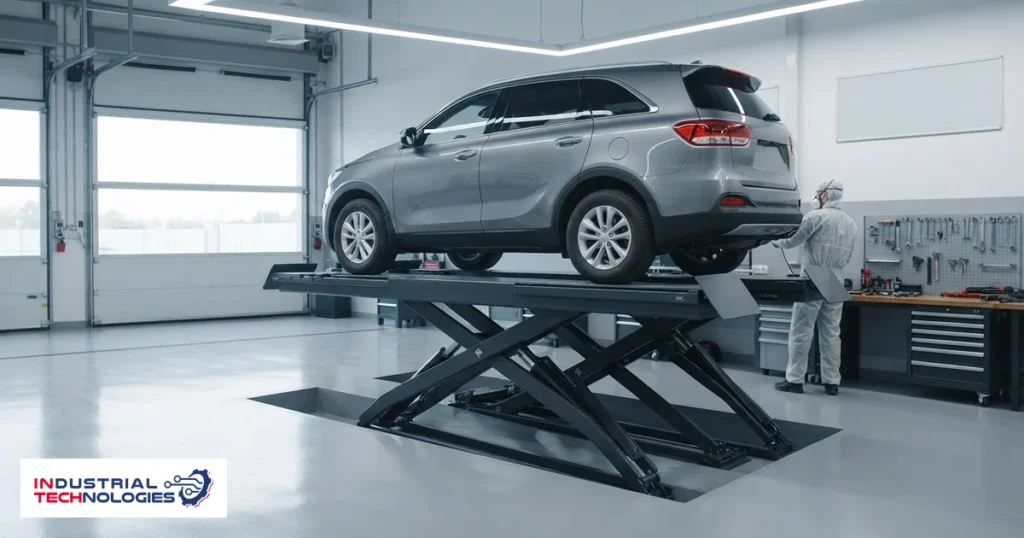
Lift selection comparison usually starts with capacity, which is the specification least likely to cause a problem. The decision that actually shapes your shop is which type sits in each bay — and that follows from the work, not from a ranking of lifts.
There is no best type. There is a correct type per bay, and shops that try to standardise on one usually end up compromising both the work it suits and the work it does not.
What each type is actually for
| Type | Typical lifting height | Suits | Trade-off |
|---|---|---|---|
| Two-post | ≈ 1990 mm | Mechanical, transmission, exhaust — full underbody access | Needs headroom and a rated slab |
| Scissor (surface) | ≈ 1220 mm | Wheels, brakes, rapid inspection | Obstructs part of the underbody |
| Four-post | Varies by model | Alignment, long-duration storage, heavier vehicles | Largest footprint; wheels remain loaded |
The height figures are the clearest way to see the divide. A two-post lets a technician stand upright beneath the vehicle. A scissor at roughly 1220 mm gives a comfortable working height for wheels and brakes but not a standing height — and that is a category definition, not a shortcoming.
The constraint that decides for you
In practice one of three constraints usually removes the choice before preference enters:
- Ceiling height — rules out two-post before anything else is discussed
- Slab condition — a two-post concentrates its entire load into two base plates; a surface-mounted scissor spreads it
- Tenancy — a leased unit where you cannot cut the floor points to surface-mounted equipment at around 125 mm installed height
This is why we ask about the building before asking about the work. Half of these conversations are settled by the ceiling and the slab, and discussing lift types before measuring them wastes everyone’s time.
Electrical supply: a real differentiator
A scissor lift at 3 kW on 220 V single phase runs on simpler supply than a two-post at 2.2 kW on three phase. That is not a trivial distinction — it can be the difference between commissioning the same day and waiting on a three-phase extension.
Check panel headroom before selecting the model, not after. Every time this is left until installation day it costs weeks.
The mixed-bay argument
A general workshop trying to cover everything with one lift type ends up with technicians working awkwardly on half the jobs. The two-post bay is occupied by a wheel change while a mechanical job waits.
The practical arrangement in most shops we see is two-post bays for mechanical work and scissor bays for rapid service, sized by your actual job mix. Pull a month of work orders and count — the ratio is usually clearer than anyone in the shop expects.
An extendable scissor platform — roughly 1530 to 2130 mm — widens what a single bay accepts, which reduces how many lifts you need to cover your vehicle range.
Safety features are constant across types
Whatever the type, the non-negotiables do not change: mechanical locks that engage automatically, reliable synchronisation, and a documented power-failure procedure. An automatic ratchet with pneumatic release is preferable to any arrangement that depends on the technician remembering to set it.
Common questions
Can one type cover a general workshop?
Only if your work is genuinely concentrated. A shop doing both mechanical and rapid service work needs both types — not because one is deficient, but because the height that suits underbody work is wrong for wheel work and the reverse.
Which needs the least floor preparation?
Surface-mounted scissor models, which install on the existing slab with no excavation. That makes them the practical answer for leased premises and for working shops that cannot stop production for concrete work.
Can a lift be relocated later?
Surface-mounted models move far more easily than anchored or in-ground installations because they leave no floor modification behind. It remains a technical operation — disconnection, re-anchoring, re-levelling and recommissioning — rather than something you drag across the bay.
What determines installation time?
Site preparation, not the lift. Slab level, slab thickness and electrical supply set the schedule, which is why duration is established after a site assessment rather than quoted in advance.
Where to start
Published models across all types sit under vehicle lifts and lifting equipment. For the specification detail behind each choice, see two-post lift selection and the safety lock inspection note, which covers what stays constant whichever type you install.