
Wood finishing is decided by dust and airflow before it is decided by the coating
A controlled finishing environment for wood.
Sanding dust does not settle — it comes back onto the surface right after spraying. A furniture plant that does not control airflow and separate prep from spraying pays the difference in re-sanding and repainting, not in finishing materials.
Operational challenges
What stalls production in this sector
Three challenges govern wood finishing.
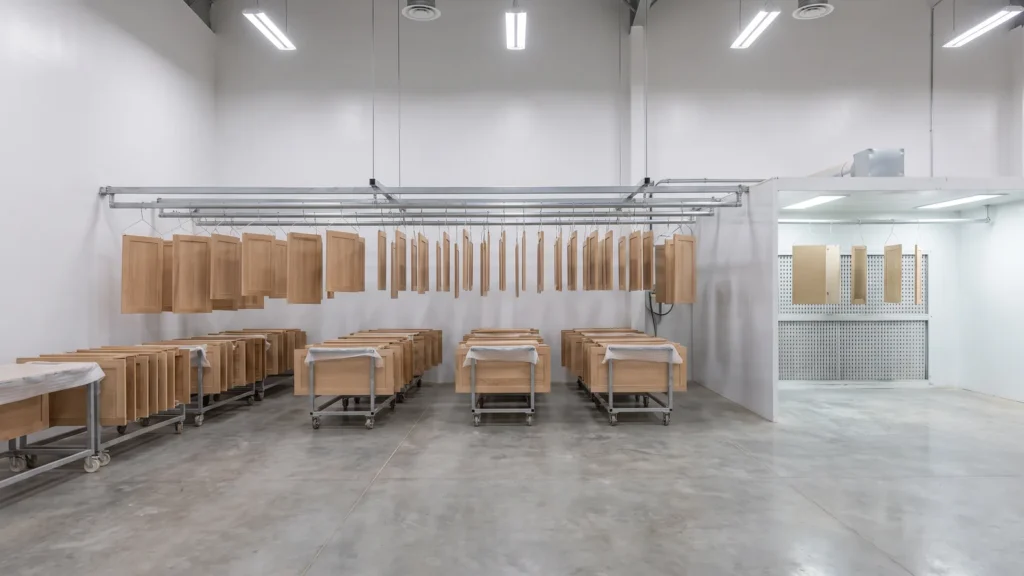
In this sector the dust is produced inside the plant, not outside it
Unlike a car workshop, a furniture plant generates its own dust from sanding and cutting. Extraction and separating prep from spray areas are not an environmental nicety but a surface-quality requirement.
Parts vary in size and shape within a single day
A door, a panel, a table and a kitchen front pass down the same line at completely different sizes. The finishing chamber here is not chosen from a vehicle envelope; it is built around the largest part and how that part is hung or laid.
Wood dust and finishing materials raise the safety bar
Accumulated wood dust and flammable finishing materials make ventilation, filtration and waste handling regulatory items rather than operational choices.
Our approach
How each challenge is addressed
At the level of approach and configuration — before any product is named.
The booth is built around the part, not around a vehicle. Our booths for this sector are built to order: size, openings and how the part enters are set by the largest piece on your line, within a range extending to 24,000 mm long and 20,000 mm wide.
Prep is physically separated from spraying. A prep and mixing room with its own extraction stops sanding dust from returning to the prepared surface. The separation here is physical, not procedural — procedure alone does not stop dust.
Ventilation and filtration are designed around the finishing material. Wood finishing materials differ from vehicle paint in volatility and curing requirements, so air capacity and filtration class are set from them rather than carried over from another sector.
Recommended equipment
Configurations that serve this sector
Listed as we actually supply them — nothing appears here unless we serve this sector with it.
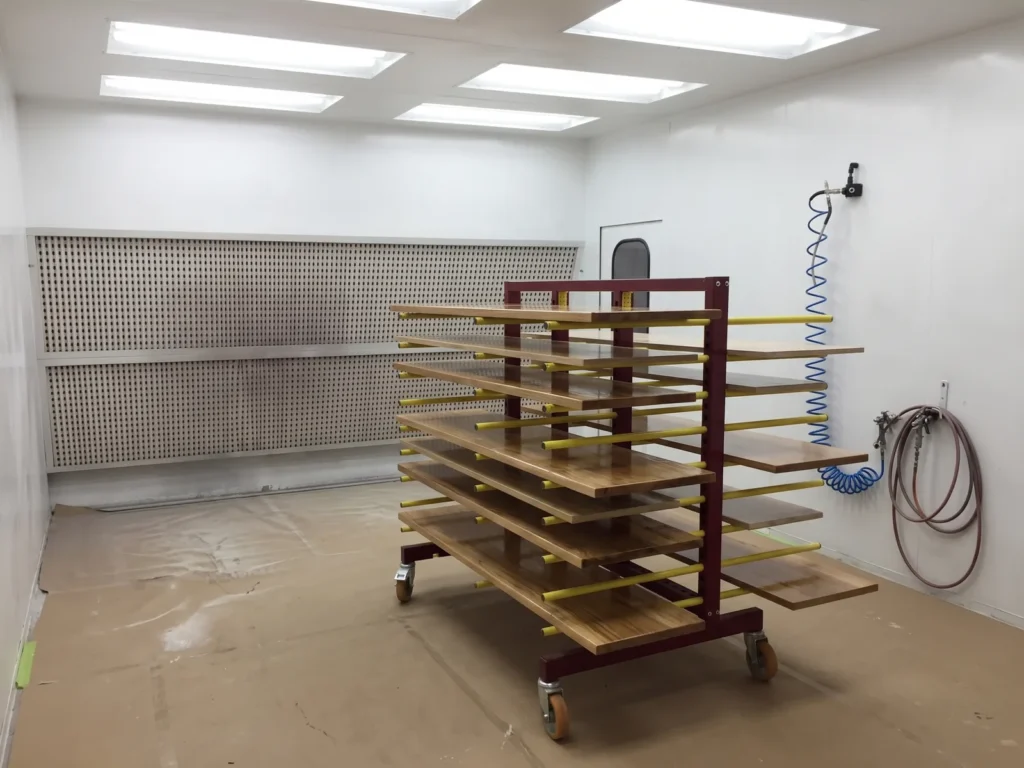
Paint Booths & Finishing Systems
A finishing booth built to the size of the part and the production line, not an off-the-shelf vehicle-sized model.
INTECH chamber 6,900 × 4,000 × 2,650 mm — custom builds to 24,000 mm long Family details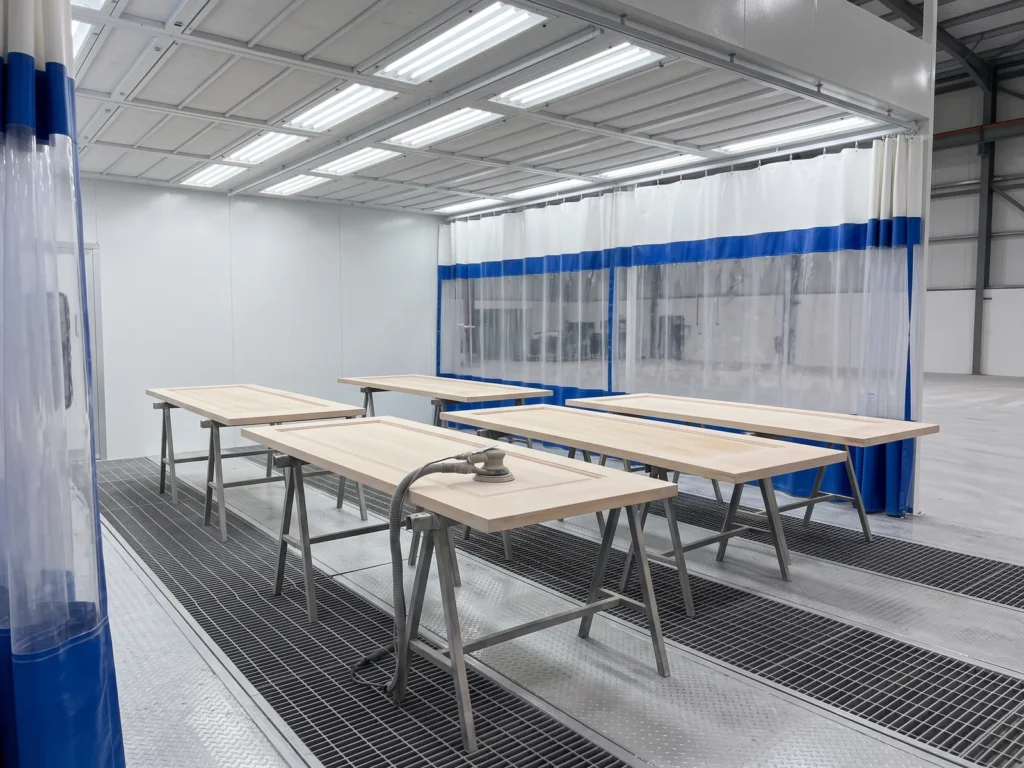
Prep Stations & Mixing Rooms
A prep and mixing room with dedicated extraction that physically separates sanding from spraying.
15,000 m³/h air capacity at 800 Pa · PURE 200 and PURE 120 Family detailsConfiguration notes
What actually changes for this sector
Configuration — not product identity — is the real difference between sectors.
| Item | Range / value | Why it changes for this sector |
|---|---|---|
| Chamber dimensions | Built to order: 3,000–24,000 mm long · 3,000–20,000 mm wide · 2,650–6,000 mm high | Furniture parts vary in size and shape within a single day, so the chamber is built around the largest piece and how it enters rather than a standard envelope. |
| Air capacity | Delivered range 18,000–190,000 m³/h depending on the size required | A wooden part is sprayed from several directions and then left to cure, so air capacity is calculated from chamber volume and finishing material together. |
| Prep-area extraction | Set per project by the prep room size | Here dust is generated inside the plant continuously, so extraction is a surface-quality requirement, not merely an environmental one. |
| Delivered size range for woodworking | Sizes are configured to the requirements of the plant | The published size range is drawn from cross-sector builds; fixing a woodworking-specific range needs a delivery record from the team. |
Regulatory and site considerations
- Management of accumulated wood dust and the fire requirements attached to it.
- Ventilation and disposal of finishing-material and solvent waste.
- SASO conformity for imported equipment.
- Municipal and environmental permit requirements for a furniture plant depend on its location, and we review them with you before execution.
Frequently asked questions about this sector
Can car paint booths be used for wood finishing?
The principle is the same — a controlled air and temperature environment — but the size and the way parts are loaded are completely different. That is why a wood finishing booth is built to order around the part and the line, rather than bought as a vehicle-sized model.
What is the largest booth you can build?
The published build range reaches 24,000 mm long, 20,000 mm wide and 6,000 mm high, with air capacity up to 190,000 m³/h. The final size is set by the largest part on your line and how it is loaded.
Do I need a prep room separate from the booth?
In woodworking, yes — more clearly than in the automotive sector, because dust is generated inside the plant continuously by sanding. Physical separation with dedicated extraction is what stops dust returning to the surface after spraying.
How long does a custom booth take to design and build?
Design, manufacture and delivery of a custom booth take up to 90 working days, and some projects take less depending on size and configuration.
Setting up a finishing line in a furniture plant?
Send the largest part on your line, how it is loaded and the finishing material you use, and we will come back with a chamber design built around your line.