
A trainee should learn on the equipment they will meet in the market, not on a teaching model
A training bay that mirrors the job.
A graduate trained on equipment that no workshop actually uses starts from zero on day one, and the training provider pays for it in the reputation of its programmes. The gap is usually not in the curriculum but in the equipment the trainee stood in front of.
Operational challenges
What stalls production in this sector
The challenges that recur in education and training.
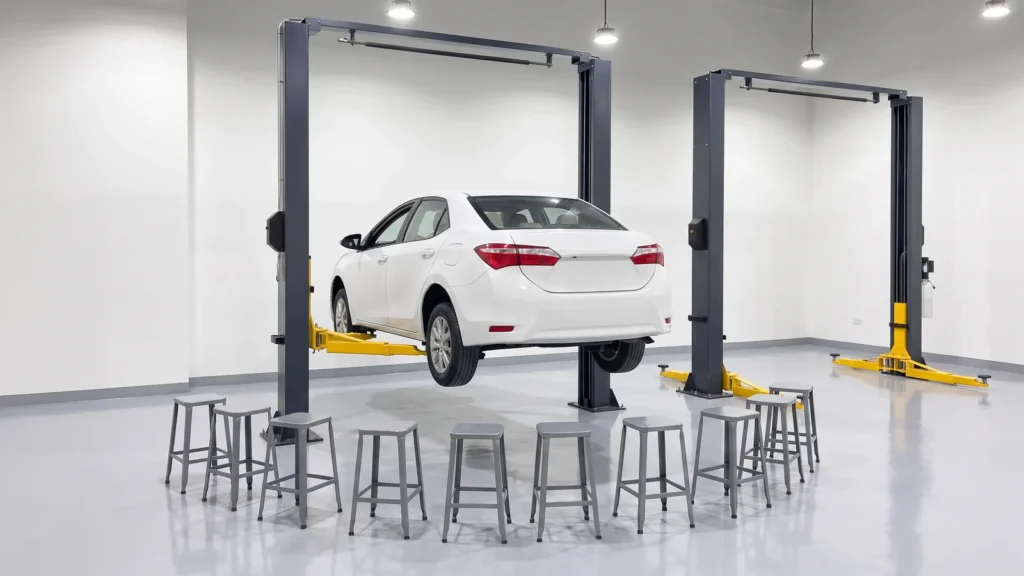
The gap between training equipment and market equipment
Simplified teaching equipment produces a trainee who knows the principle but not the machine. The labour market judges graduates on their ability to operate what is actually installed in workshops, not on theory.
Safety requirements rise when the user is a trainee
Trainees make mistakes — that is part of learning. Equipment in a training environment needs guarding, procedures, supervision and a floor layout that assumes error rather than assuming experience.
A teaching bay serves a group, not one person
A bay sized for one technician does not fit an instructor and a group standing around to see the work. Planning a training workshop starts from sightlines and standing room, not from the machine’s footprint.
Intensive use by constantly changing hands
Training equipment is operated by dozens of users a day at different skill levels. The selection criteria are endurance and ease of maintenance, not peak specification.
A curriculum needs coverage, not specialisation
A training programme covers lifting, diagnostics, air conditioning and finishing, so it needs a genuinely operational spread rather than depth in one family.
Our approach
How each challenge is addressed
At the level of approach and configuration — before any product is named.
We equip with the same equipment the market uses. The equipment we supply to colleges and institutes is the equipment we supply to workshops, because the value of training lies in the trainee facing what they will meet on the job.
We plan space around the group, not the machine. Standing and viewing space around the machine, a movement route that does not cross another group’s, and a position from which the instructor sees everyone. These are planning decisions that precede model selection.
Safety goes into the layout, not into the instructions. Clearances, work-zone boundaries and stop-switch positions go into the drawing. An environment that assumes error is safer than one that relies on reminding people about it.
We cover the curriculum across several families. Lifting, diagnostics, air conditioning and finishing are covered with genuinely operational equipment, so the programme produces graduates who have used more than one family.
Recommended equipment
Configurations that serve this sector
Listed as we actually supply them — nothing appears here unless we serve this sector with it.
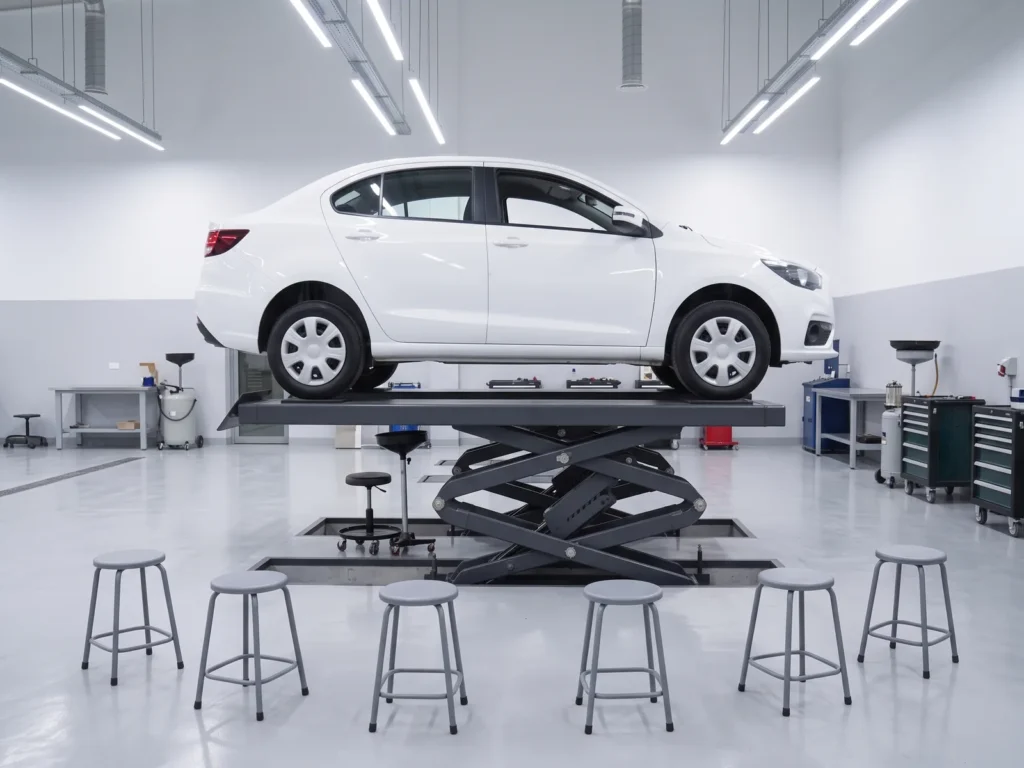
Vehicle Lifts & Lifting Equipment
Lifting and underbody work training — the first thing a technician meets on the job.
1,200–4,500 kg capacity · 600–1,999 mm lift height · 2.2–3 kW Family details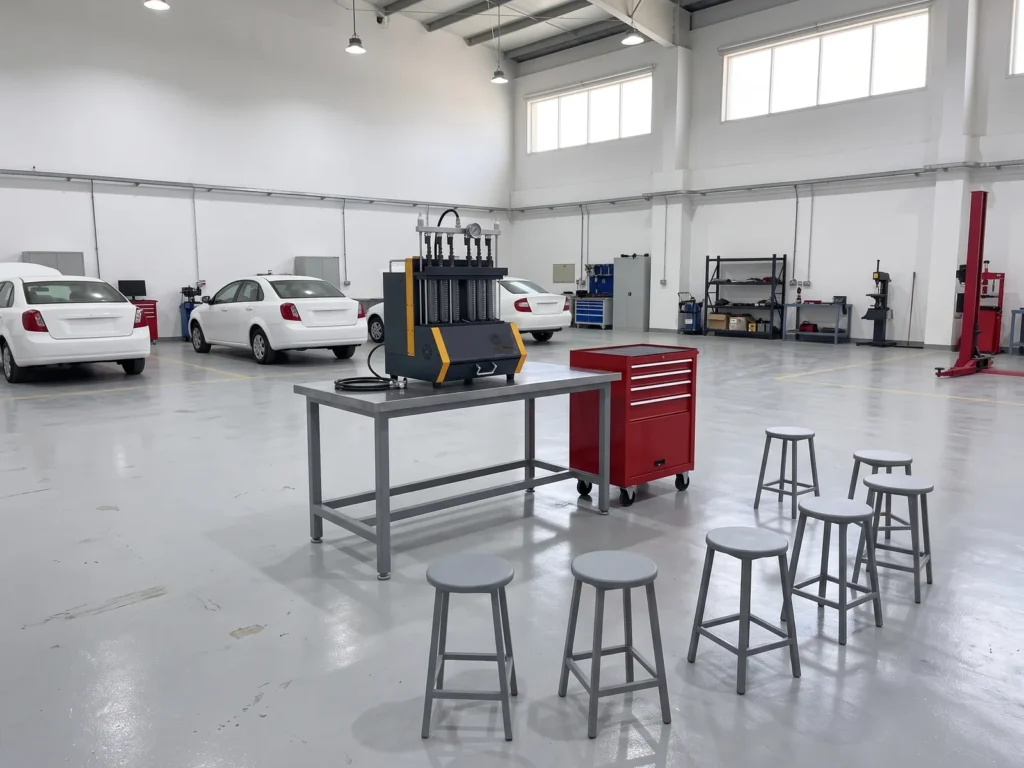
General Workshop Equipment & Tooling
Diagnostics and shop tooling for fault-finding training — the skill the market asks for most today.
Scan and programming for 1996-onward vehicles (MS906 MAX) · ADAS PRO calibration Family details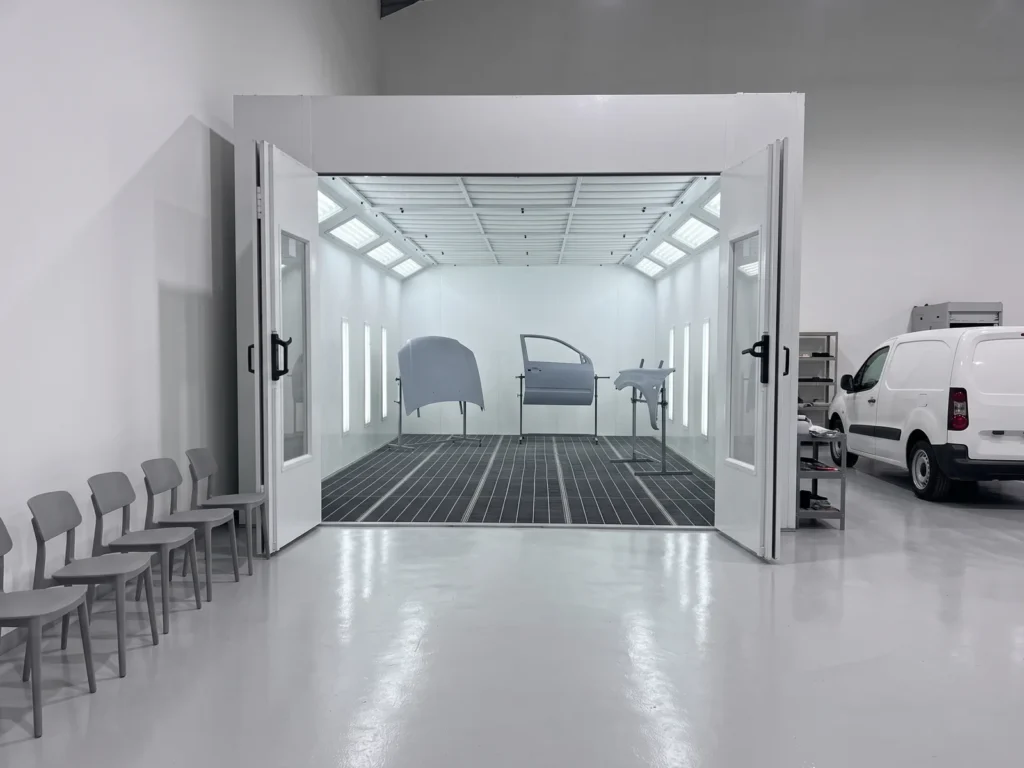
Paint Booths & Finishing Systems
Refinishing training in a controlled environment that resembles a real body shop, not an open spraying area.
INTECH chamber 6,900 × 4,000 × 2,650 mm — custom builds to 24,000 mm long Family details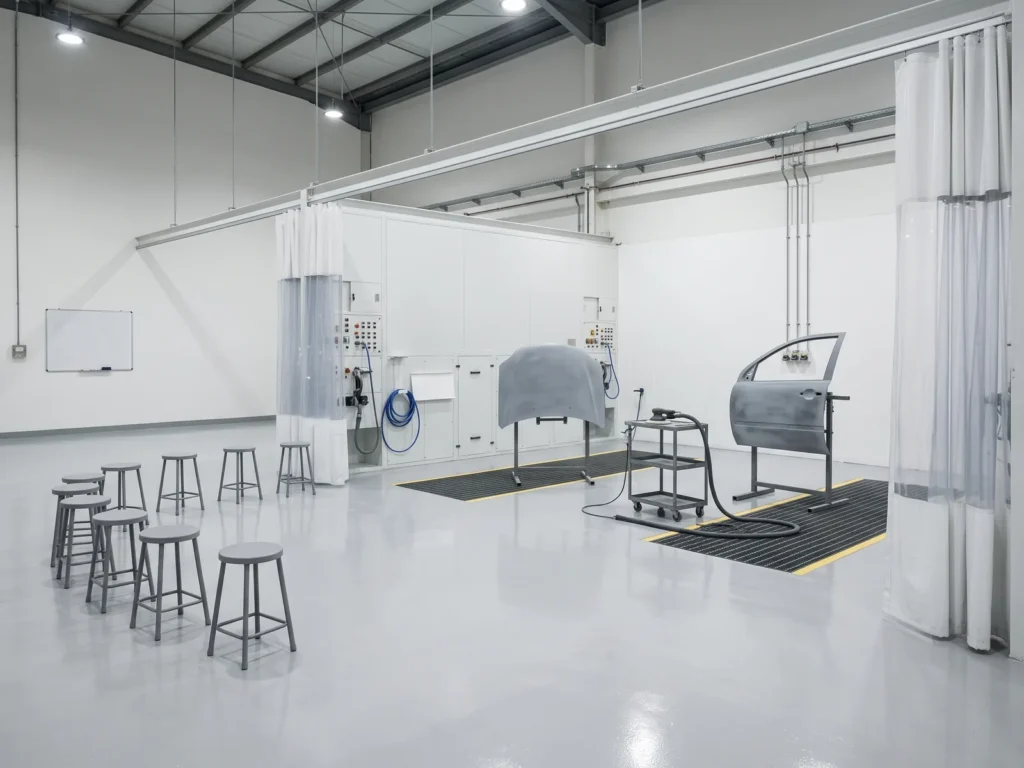
Prep Stations & Mixing Rooms
Prep, sanding and mixing training — where a trainee learns why paint gets redone.
15,000 m³/h air capacity at 800 Pa · PURE 200 and PURE 120 Family details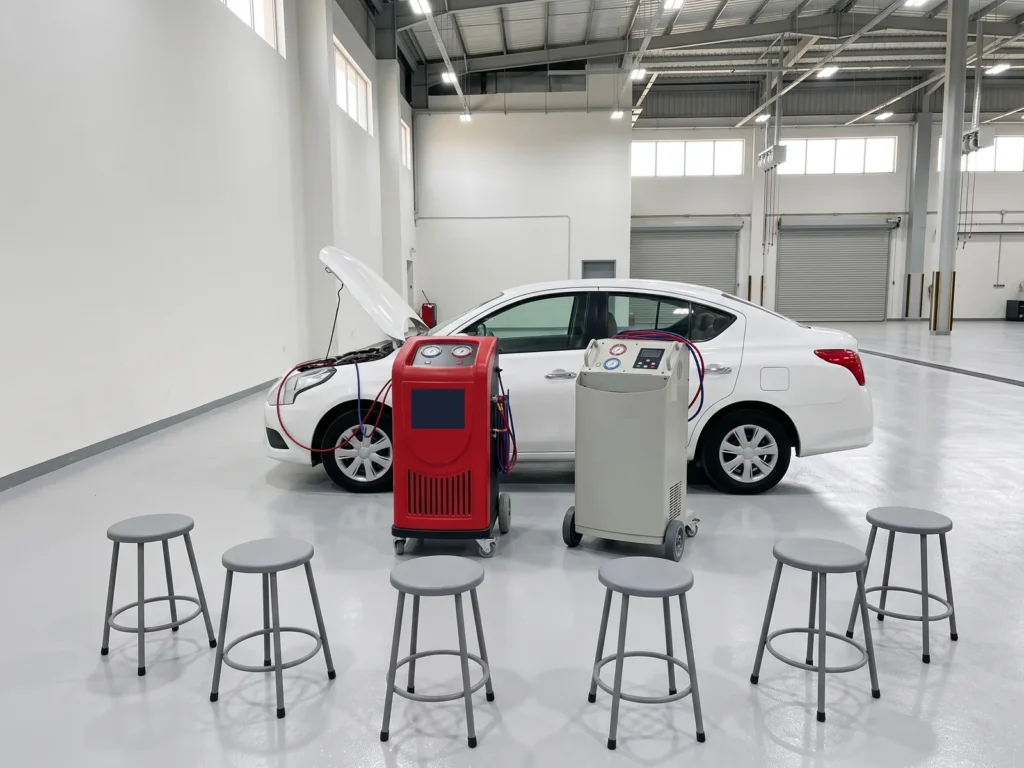
AC Service Stations
Vehicle A/C service training: recovery, recharge and leak testing.
120 L/min vacuum pump · 2 kg/min recharge · R134a and R1234yf (ACMAS301) Family detailsConfiguration notes
What actually changes for this sector
Configuration — not product identity — is the real difference between sectors.
| Item | Range / value | Why it changes for this sector |
|---|---|---|
| Trainees per station | Three technicians per session | Space around the machine is calculated for a group standing to observe, not for a single technician — the distinguishing feature of a training bay. |
| Daily equipment cycles | Set per project | Dozens of users a day at varying skill levels consume equipment faster than a production shop, so endurance outranks peak specification. |
| Curriculum coverage across families | The equipment we supply | A programme is judged by the breadth of what trainees have used, so the fit-out spreads across several families rather than deepening one. |
| Lighting and sightlines | Set per project | Training depends on seeing the work from several angles, so lighting here is a teaching tool, not only a safety requirement. |
| Training booth dimensions | INTECH chamber 6,900 × 4,000 × 2,650 mm | A training booth must be a genuinely operational size so that what the trainee learns transfers to the workshop without relearning. |
Regulatory and site considerations
- Safety requirements in training environments: guarding, working clearances and stop switches.
- SASO conformity for imported equipment.
- Professional workshop requirements: ventilation, cooling, lighting and waste handling.
- Pre-installation site requirements: available voltage, slab thickness, clear height and air pressure.
- Institutional and accreditation requirements are set per programme, and the certificates required for the equipment are provided on request.
Frequently asked questions about this sector
Do you supply simplified teaching equipment or operational equipment?
Operational equipment — the same units we supply to workshops. The aim is for the trainee to face what they will meet in the market, because simplified equipment produces a graduate who knows the principle and still needs retraining on the real machine.
How does a training workshop differ from a production workshop in planning?
In the space around the machine rather than the machine itself. A training station needs standing and viewing room for a group, a movement route that does not cross another group’s, and an instructor position with full sight of the work. Those decisions precede model selection.
Which families cover an automotive training curriculum?
Lifts for lifting and underbody work, diagnostics for fault-finding, A/C stations for refrigeration service, and paint booths with prep stations for finishing. All five families are what we supply to the education and training sector.
Is your equipment suitable for intensive trainee use?
In a training environment the criteria are endurance and ease of maintenance before peak specification, because the equipment is used by many people at different skill levels. Send your trainee numbers and daily session count and we will recommend on that basis.
Does your scope include training the instructors on the equipment?
Yes. The content and duration of instructor training are agreed with the institution according to the equipment supplied and its programme.
Fitting out or upgrading a training workshop?
Send your trainees per session, workshop area and the families your curriculum covers, and we will come back with a station layout and a list of operational equipment — not teaching models.