
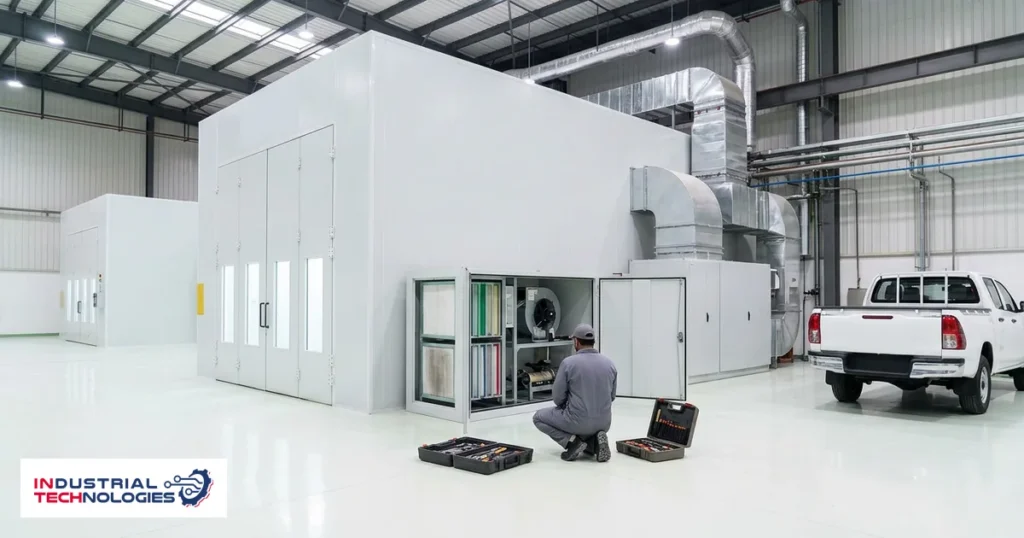
Almost every workshop says it runs preventive maintenance. Most are running reactive maintenance with a calendar attached: fixing what broke, with a good intention to schedule inspections later.
The difference is not discipline. A preventive maintenance programme differs from a calendar in what its intervals are built on.
A calendar assumes wear follows time
A fixed quarterly visit sounds like prevention. It assumes that equipment wears with the passing of time, and most workshop equipment does not.
Booth filtration loads with site dust and the quantity of material sprayed. Lift hydraulics wear with cycles. A compressor filter follows running hours and ambient heat. Two workshops on identical calendars can differ several times over in what they actually consume.
So the calendar is the floor of a programme, not the programme. A working one combines three kinds of trigger.
Three triggers, not one
| Trigger | Suits | Example |
|---|---|---|
| Time | What ages on its own | A seasonal check of booth door seals |
| Use | What the work consumes | Lift hydraulics by cycles · exhaust filtration by material sprayed · a service prompt every 600 operations on the ACMAS302 |
| Condition | What can be measured before it fails | Pressure reading across booth filtration · time to reach cure temperature · lift rise time |
The third is the strongest and the least used. Three figures logged weekly give an earlier and more honest warning than any calendar: the pressure reading across booth filtration, the time the booth takes to reach cure temperature, and the time a lift takes to rise.
The absolute figure matters less than its direction. A steady rise is a signal even while the reading is still inside the acceptable band.
Where the readings come from
Some equipment already reports its own condition. The highest-extraction booth in the INTECH range publishes a pressure gauge in its standard supply, and the economic A/C station counts its own work and prompts for service every 600 operations — a use trigger built into the machine rather than written on a wall chart.
Where no instrument exists, a stopwatch does the job. Time to cure temperature and lift rise time need nothing more than a record kept the same way each week.
Why written programmes fail
Good programmes on paper go unexecuted, and the reason is usually the same: the task was never assigned to a named person. The workshop is not a person, and the team does not remember.
The second reason is length. A long list is ignored in full, while a short daily list gets done. Starting small and reliable beats starting complete and ignored.
The third is that nobody reads the log. Recording without a monthly review is effort without return, because the value is in seeing the trend, not in filling the column.
What stays in-house and what needs a technician
Routine maintenance after final handover is the operator’s responsibility. Visual checks, filter changes, draining water and logging the readings can be done by the workshop’s own technician after short instruction.
Calibrating temperature, checking the burner, verifying lift synchronisation and anchor torque need tools and experience. The published optional service covers clearing air paths, replacing filtration and checking electrical and pneumatic safety circuits, by running hours, under a renewable annual contract or on request.
Frequently asked
Where should a workshop start with no programme at all?
With three weekly readings rather than a complete plan: the pressure across booth filtration, the time to cure temperature and the lift rise time. A couple of months of records gives a baseline built on the equipment actually installed.
Is maintenance software needed?
Not at the start. A simple table that is kept up beats an integrated system that is ignored. Software earns its place when the number of machines makes manual tracking unreliable.
What is the exact interval for each item?
The interval comes with each model’s manual, and that is the one to follow. Filtration is the one published position: replaced by running hours and workload, typically twice a year, with the interval differing between pre-filter, ceiling filter and floor filter.
Does the warranty cover consumables?
No. The warranty is the manufacturer’s, on the term and conditions in its documents, and it excludes consumables such as filters, belts and lamps. Neglect is one of the published exclusions, which makes the maintenance log part of protecting the warranty.
Related reading
Practical next step
Send the equipment list with models and supply dates, daily running hours and what stopped in the last year. Contact an Expert. The optional service is set out on the maintenance and warranty page.