
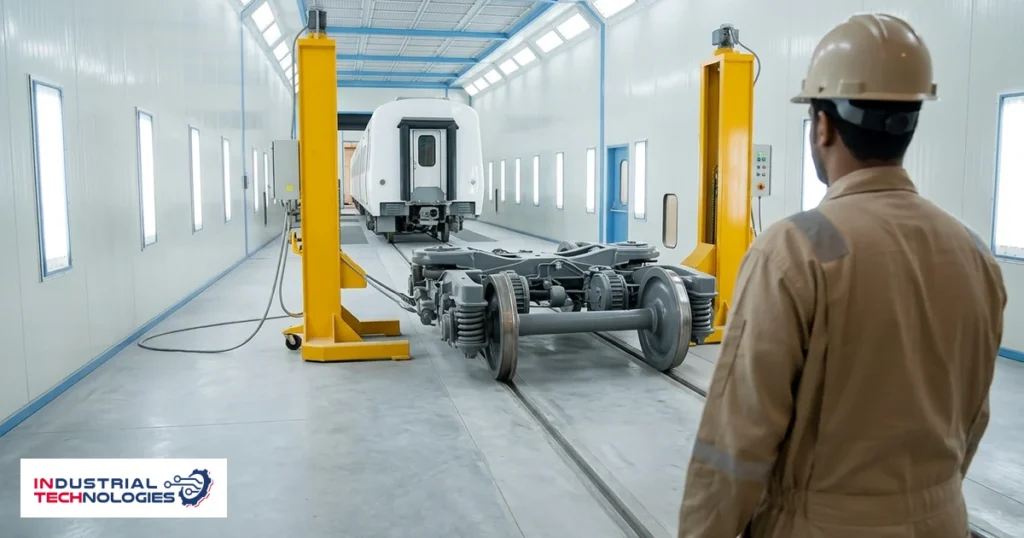
Industrial Technologies Co. Ltd. does supply rail axle lifting equipment — but built to request, not from a stocked catalogue. A rail axle or a full bogie carries a load and a geometry that differ completely from a workshop vehicle, and that alone puts it outside the standard published lift range.
The difference is not a small detail. A vehicle lift is engineered to lift from points under a vehicle body within a set capacity; a rail axle lifts from entirely different points, and its load in most cases exceeds what a vehicle-rated lift is built for.
Why it falls outside the standard lift range
The published Vehicle Lifts & Lifting Equipment family covers a lift capacity from 1,200 to 4,500 kg and a lift height from 600 to 1,999 mm, a range built to serve workshop vehicles, not rail axles. Selecting a lift within it starts from four questions: the heaviest vehicle to raise, workshop ceiling height, floor construction, and the work performed under or around the vehicle — and every one of those questions changes fundamentally for a rail axle.
| Input | Effect |
|---|---|
| Axle or full bogie load | Sets lift capacity and the number of lift points |
| Axle geometry and lift points | Differs from a vehicle’s lift points, taken from the car’s drawing |
| Track gauge and axle spacing | Sets the distance between lift points |
| Site floor construction | Sets whether installation is surface-mount or pit-mounted |
| Single axle vs full bogie | Changes the number of lift points required |
Built to request, not to a published range
This application carries no published range the way workshop models do, because every rail project differs in axle load, car geometry and track gauge. The lift is designed from your project’s own figures, not fitted to a category set in advance.
Frequently asked questions
Does Industrial Technologies Co. Ltd. actually supply lifting equipment for rail axles?
Yes. This application is delivered to request, with the load and dimension range set from your project’s own figures rather than a fixed published value.
Why isn’t there a single capacity figure the way there is for vehicle lifts?
Because the standard lift family (1,200–4,500 kg) is built for workshop vehicles, and rail axles or full bogies fall outside that range in both geometry and load in most cases, so one figure cannot be generalised across them.
What data is needed before design starts?
Axle or full bogie weight, a drawing of the lift points, track gauge, and the site’s floor construction — these build the lift concept.
Is the axle lifted alone, or the whole car?
It depends on your project. Some applications lift the axle or bogie separately from the body, others need the full car raised — and this is set by the maintenance goal itself.
Related reading
- Vehicle Lifts & Lifting Equipment
- Aerospace, Marine & Rail industry page
- Chamber Length for Rail Vehicles Starts Its Count at 16,000 mm
What to do next
Send the axle or full bogie weight, a drawing of the lift points, and your track gauge, and we will return a lift concept built on your project. Talk to a specialist. Family detail sits on the Vehicle Lifts & Lifting Equipment page, and sector detail on the Aerospace, Marine & Rail industry page.